Fasciated Antshrike

This Fasciated Antshrike played hard to get along the entrance road at La Selva Biological Research Station in the Sarapiqui valley of Costa Rica. I have lots of photos of it partially obscured by foliage…more obscured even than this photo. 🙂 This one captures enough of the bird to be mildly satisfying, including the reddish tint to the eye. Sony Rx10iv at 600mm equivalent. Program mode with my custom birds and wildlife modifications. Processed in Polarr and Apple Photos.
Slaty-tailed Trogon

While some of the Point and Shoot Nature Photography group enjoyed the Chocolate Tour near Selva Verde Lodge in Costa Rica, a few of us went back to the entrance road to La Selva Biological Research Station to see what the afternoon would bring. Our first visit had been early morning in the rain, and the half mile or so of road through second growth rainforest can be one of the best and most productive birding sites in the world. Our guide, Edwin was convinced we had only scratched the surface. And the birding was indeed good. This Slaty-tailed Trogon greeted us only moments after we got out of the van, and we had 6 different woodcreepers, two woodpeckers, a jacamar, and an antshrike before we got back in the van to pick up our compatriots from the Chocolate Tour. Though it was afternoon, the light under the canopy is always difficult. Sony Rx10iv at 1200mm equivalent (2x Clear Image Zoom). Program mode with my custom birds and wildlife modifications. Processed in Polarr and Apple Photos.
Green Kingfisher drama

We watched this little drama unfold as we floated, engine idling to keep us in place, along the shore of the Sarapiqui river in Costa Rica. Our Point and Shoot Nature Photography Adventure in Costa Rica always includes a morning on a tour boat out of Puerto Viejo. When the river is high enough we go upstream and then up the Puerto Viejo river at least as far as the cable bridge at La Selva Biological Research Station…looking for birds and wildlife along the shores. This is a female and fledgling Green Kingfisher. When we first saw them they were locked together, beak to beak, and seemed to be having difficulty separating. They struggled for a good 10 minutes as we watched, but then suddenly pulled apart. I could not figure out exactly what was going on. It is possible their beaks were indeed somehow locked…and it is possible the greedy youngster just would not let go. At any rate, all’s well that ends well, and both birds seemed fine in the end. The male, by the way, sat a few yards away and watched the whole thing. Sony Rx10iv at 1200mm equivalent (2x Clear Image Zoom). Program mode with my custom birds and wildlife modifications. Processed in Polarr and Apple Photos and assembled in Framemagic.
Great Green Macaw

The Great Green Macaw is emerging as a conservation success story in Costa Rica. Over the past years its numbers have steadily increased. It is still listed as endangered, but the bird is no longer an uncommon sight in the Sarapiqui valley and the lowlands of the Caribbean slope. There is even a reliable roost, near Puerto Viejo, where it is possible to see them fly in most evenings. There is never enough light by the time they do, but it is still the spot to go to see Great Green Macaws. Sony Rx10iv at 600mm equivalent. Program mode with my custom birds and wildlife modifications. Processed in Polarr and Apple Photos.
Band-tailed Barbthroat
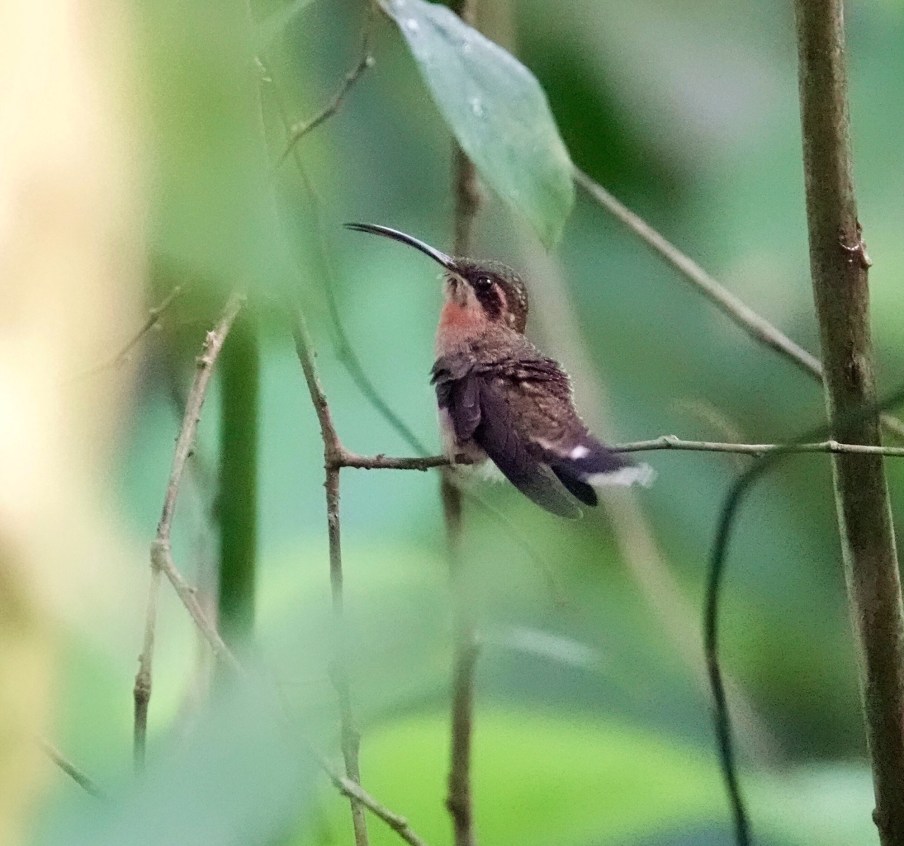
Our guide Edwin’s sharp eyes picked this perched Band-tailed Barbthroat out of the foliage along one of the trails at Selva Verde Lodge in the Sarapiqui river valley of Costa Rica. This little hummer is a member of the Hermit clan, about the same size as the more commonly seen Stripe-throated Hermit, but its much shorter tail makes it look smaller. Barbthroats come to the flowers near the feeders at Selva Verde, along with Stripe-throated Hermits, but this is the first one I have ever seen perched. Early morning under heavy rainforest canopy, threatening rain, so the light was marginal. Sony Rx10iv at 600mm equivalent. Program mode with my custom birds and wildlife modifications. Processed in Polarr and Apple Photos.
Green Honeycreeper


I have extolled the virtues of Dave and Dave’s Costa Rica Nature Park for bird photography already, but these shots demonstrate what is possible there once more. Raining hard but I was dry, and the birds are close. They do put out natural banana rounds to bring the birds in, but that is the only way you are likely to get this close to a Green Honeycreeper. This is the female, and it is the “green” in the name. The male is blue-green at best, and most people would call it blue. Sony Rx10iv at 600mm equivalent. Program mode with my custom birds and wildlife modifications, plus Multi-frame Noise Reduction. Processed in Polarr and Apple Photos.
Rufous-tailed Hummingbird

As the most common, and most aggressive, hummingbird around feeders at low to mid elevations in Costa Rica, it is way too easy to stop looking at Rufous-tailed Hummingbirds. I mean they are always there. You have already seen dozens, and will see dozens more in the days to come. This one, however, sat so nicely, just off the covered patio at Dave and Dave’s Costa Rica Nature Park, waiting patiently in the rain. I am not sure what it was waiting for, but it returned to this same perch repeatedly in the few hours we spent at Dave and Dave’s. It is a beautiful example of the Amazonia hummers, with its predominantly green iridescence, and, rufous tail and noticeable red base to the bill. Sony Rx10iv at 1200mm equivalent. Program mode with my custom birds and wildlife modifications, plus Multi-frame Noise Reduction. Processed in Polarr and Apple Photos.
White-necked Jacobin drinking

Dave and Dave put out fresh flowers each day for the hummers who come to drink, even in the rain. This is a male White-necked Jacobin. Sony Rx10iv at 600mm equivalent. Program mode with my custom birds and wildlife modifications. Processed in Polarr and Apple Photos. Dave and Dave’s Costa Rica Nature Park, La Vergin, Costa Rica.
Keel-billed Toucan

And yet more birding in the rain. This is an immature Keel-billed Toucan at Dave and Dave’s Costa Rica Nature Park in La Vergin, Costa Rica. I was standing more or less dry under the covered patio at Dave and Dave’s, but the bird was very wet and getting wetter. This is this year’s hatchling so the bill is not as vivid or quite as large as it will get. The Keel-billed Toucan is perhaps the bird people think of first when thinking of tropical American birds, and it is certainly an impressive bird. This year at least, it was easily outnumbered by its larger cousin…the Yellow-throated Toucan. I was pleased to see this one at Dave and Dave’s. Sony Rx10iv at 600mm equivalent. Program mode with my custom birds and wildlife modifications. Processed in Polarr and Apple Photos.
Montezuma’s Oropendola in the rain

This year the Point and Shoot Nature Photography Adventure in Costa Rica got lots of experience photographing birds in the rain. Fortunately Dave and Dave’s Costa Rican Nature Pavilion has a covered patio area, surrounded by features to draw birds in, where you can keep yourself, and your cameras, relatively dry. They put out whole bananas to draw the larger rainforest birds, like this Montezuma’s Oropendola, the largest member of the Oriole family. You see colonies of huge hanging, pendulous, Oropendola nests in large trees. Oropendolas prefer free staining trees where the flight lines are open. Shooting in the rain means low light levels and high ISOs. I used Multi-frame Noise Reduction on this shot. Sony Rx10iv at 386mm equivalent. Program mode with my custom birds and wildlife modifications and MFNR. Processed in Polarr and Apple Photos.