Posts in Category: animals
Green Basilisk


Green Basilisk: Sarapique River, Puerto Viejo, Costa Rica — You do see all kinds of things from the safari boat on the Sarapique and Puerto Viejo rivers. We came along side this group of Green Basilisks. We saw the adult male first of course…or rather our boatman, who is on the river every day, and knows were to look (as well as having a natural talent for spotting birds and wildlife, which he has demonstrated on every trip with him over the years) saw it. Only as we drew near in the boat did we spot the two females below the male in the tangle of branches (one might be an immature male??). The Green Basilisk is called the Jesus Christ Lizard by the locals, because of its ability to “walk on water”. It does indeed run across the water, moving fast enough and light enough not to break the surface tension. I have seen lots of Basilisks…in Costa Rica, Honduras, and Panama…but I have yet to see one on the water. Sony Rx10iv at 534mm. Processed in Pixelmator Photo and Apple Photos. ISO 400 (females) and 250 (male), f4 @ 1/500th.
Red-eyed Leaf Frogs


Red-eyed Leaf Frogs: Selva Verde Lodge. Costa Rica’s Best Chocolate, and, Danta Corcovado Lodge, Costa Rica — The Red-eyed Leaf Frog shares top billing with the Resplendent Quetzal as the emblem of conservation and ecological awareness in Costa Rica. You need, as our guide Edwin says, “a sexy” emblem to get people excited about conservation. People love Leaf Frogs. We always go out looking for them at Selva Verde Lodge one of our first nights there. This year the pond near the dinning hall, which is maintained specifically to attract the frogs, was under repair, so they were not as abundant, or at least not as easy to see, as they have been on past visits, but we still found a few on good perches for photography. The gallery includes a male and a female from Selva Verde, showing off the typical colors. I have included two frogs with similar poses, one from the Chocolate Tour at Costa Rica’s Best Chocolate, just across the road from Selva Verde in the Sarapique Valley of the Caribbean lowlands and one from Danta Corcovado Lodge on the Osa Peninsula in the Pacific lowlands. At first I was convinced the Osa frog was a different species, but it turns out there are at least 3 distinct color variations of the one species. They are all Red-eyed Leaf Frogs. The Pacific variety is not the one you see on the conservation posters, but it is still a great frog! Sony Rx10iv at various focal lengths to frame the frogs. Program mode with multi-frame noise reduction. Taken with flashlights (not camera flash) to disturb the frogs as little as possible.
Porcupine, and a cautionary tale

North American Porcupine: Wells Estuarine Research Reserve at Laudholm Farms, Wells, Maine, USA — As I came to the junction of the Piliger Trail and the Laudholm Connector there was a family standing just beyond under the old apple trees, with cell phones out, looking into the deeper brush, so of course, I had to go see what they were seeing. Nothing much they said, just a porcupine in the apple tree. And indeed, there was one, out on a branch asleep when I first saw it. Not easy to see as it blended well with the bark of the tree. I (again, of course), took hundreds of photos from all different angles, mostly trying to get a clear shot of the face. It is pretty rare in my experience to see a healthy porcupine right out in plain sight (as opposed to flattened the road). In fact, my last “out in the open” sighing of a porcupine was the Mexican Porcupine in Honduras many years ago. When I had my photos, I left the porcupine to the attention of others who had come down the path after me. Going up the hill toward the Knight Trail and back to my eTrike, I was pretty full of the experience (and myself to be honest) and decided to take a look at a few of the photos on the back of the camera just to check if I had ever really gotten the face. The face is easily lost, black on black within the gray cowl of the quills. “NO CARD, CAN NOT DISPLAY” What? This was not a good time for the camera to tell me that! Not useful at all. Very disappointing. I mean, why not tell me that when I took my first photo of the porcupine? This is not the first time this has happened to me, but the first time when the photos really mattered to me. I mean, really, my porcupine shots? Not that it would have done me any good if the camera had been more forthcoming. I stopped carrying a second card when out on my eTrike several months ago. That is a bad habit I will now make every effort to break. Always carry a spare card! Sigh! So I trudged back to the apple tree. The porcupine was still there, though it had, under the pressure of less cautions observation (there were a lot of folks using the trail that day), retreated down the branch toward the safety of the crotch of the tree, where it had taken refuge. I was just a bit chagrined to be among the cell phone photographers, but I put my Sirui 60mm portrait lens on my iPhone SE and got as close as I felt good about to take my shots. Nothing great, but I did get the face. This shot has been through Pixomator Pro’s ML Super Resolution treatment to simulate a longer telephoto, as well as being processed in Apple Photos. So folks, always carry a spare card! You never know when you will see something very special in the wild.
Northern Black Racer


Northern Black Racer: Kennebunk Plains, Kennebunk, Maine, USA — The Northern Black Racer reaches the northern limits of its range here in York County, Maine. It is on the Maine State Endangered Species List, and is a Species High Concern. There is a monitored population on the Kennebunk Plains Reserve, which is managed by the Nature Conservancy in cooperation with the state wildlife agency. It is, in fact, one of the species, along with the Northern Blazing Star plant, Upland Sandpiper, and Grasshopper Sparrow populations, and a few other endangered or threatened species, which prompted the Nature Conservancy, the Kennebunk Land Trust, and the state of Maine to preserve the Plains. Black Racers are not easy to see…they are secretive and keep under cover much of their lives. Wildlife and Inland Fisheries has a radio tagging study on the Kennebunk Plains, and I have bumped into the researchers a few times. Even with radio tags the snakes are hard to find. I did not find this one. I just happened to be there when a gentleman…and amateur herpetologist…was releasing this snake where he had captured it the day before. He had taken it home to treat some wounds on its belly (perhaps from a hawk encounter) and to show it to his son, who had never seen one. I am not condoning this behavior…it is both illegal and in my opinion unwise (especially when it comes to endangered species)…something this gentleman was well aware of. To be fair, he was very conscientious about handling the snake with care…and the snake did not seem to be any worse for the experience. And, since I don’t go around turning over logs on the Plains (or anywhere for that matter) I would not have seen this snake any other way. (I have seen one Black Racer before on the Plains…but that was a chance encounter…and once out of many hundreds of visits to the Plains over the past 20 years.) This was not a big racer…though compared to the size of the head (about the size of my thumb) it was a very long snake (likely five feet or more). Like most constrictors its body, with it smooth scales, just exudes power. And, once sure of its footing after release, it demonstrated how apt its name is by racing, about as fast as my eye could follow, for the deep cover of a low stand of dense brush. Nikon B700 at 370mm, 140mm, and 445mm to frame the snake. Shutter program at 1/640th. ISO 220. Processed in Polarr and Apple Photos.
Painted Turtles


Eastern Painted Turtle: Kennebunk, Maine, USA — There are seven or eight species of turtles in Maine, depending on what authority you check. By far the most common is the Eastern Painted Turtle, which is found in ponds all over the state. They tend, in my experience, to be relatively shy…sliding into the water at any approach. I rarely get as close to them as I would like for photography. These live in the little drainage pond at the back of the Southern Maine Health Care parking lot, and seem especially brightly painted. Nikon B700 at 1440mm equivalent. Shutter program at 1/400th. Processed in Polarr and Apple Photos.
Red is back again

Red Squirrel: Kennbunk, Maine, USA — We had a Red Squirrel visiting yesterday…probably the same one that visited a month ago…but it is really hard to tell. This time I decided not to be satisfied with photos through the thermal glass deck door. I opened the door gently and, when the squirrel did not take much notice, I stepped out on the deck. For the next half hour I watched and photographed as the squirrel continued to explore and enjoy the feeding station. As I noted in the last Red Squirrel post, he (or she) can get into all the feeders…even squeezing through the outer cage around our double cage suet feeder. Once inside it climbs up on top of the inner cage where the suet is and eats its full…if indeed it understands the concept of “full”. I suspect it would eat the whole block. If I went right over to the cage while it was in it…it would scamper out…but it did not leave the deck. This is a bold Red Squirrel indeed. It would sit on the rail, staring at me, and chattering, laying its claim to the deck and all the feeders. It came back several times during the morning, but I did not see it after that, and it has not appeared this morning yet, so I suspect it has moved on to another yard, or returned to its own territory in whichever of the surrounding stands of trees it calls home. And to be honest, while I enjoy its visits, I would not want a family of them making a home in the yard. They get into everything. It was another “dark” day yesterday…very like the last visit…with heavy overcast and some mist in the air, but being able to photograph without the glass between us made for much more satisfying shots. Sony Rx10iv. This particular shot at 380mm equivalent. Program mode with my custom birds and wildlife modifications. Processed in Polarr and Apple Photos. ISO 1600 @ 1/500th @ f4.
Nothing is safe from a Red Squirrel


Carol called me from the bedroom where I was setting up for my morning qi gong. I thought she said “I think there is a dead squirrel here…” so I came to look…turns out she said “I think there is a Red Squirrel here…” and, indeed, there was. A highly caffeinated Red Squirrel at that. In the 10 minutes or so it was on our deck, it was everywhere, and into everything…all very rapid…a lightning raid before it scampered off. Red Squirrels must live in the surrounding woodlands, but they only appear in our yard once or twice a year, at least while we are looking. Just as well too, since nothing is safe from a Red Squirrel…we have come to an uneasy truce with our resident Grey Squirrels and Chipmunks (we are host to at least 4 squirrels and what sometimes seems to the hundreds, but is more likely dozens of Eastern Chipmunks), but the Red Squirrel is another beast altogether and no “squirrel proof” feeding solution will even mildly discourage them. Still, they are undeneighably cute with their rusty tail, little round ears and big round eyes…and those little paws…and it was fun to watch one scamper all over our deck and feeders…for a change…once in a great while. Sony Rx10iv at 500-600mm equivalent…through the thermopane glass of our deck door. Program mode with my custom birds and wildlife modifications. Processed in Polarr and Apple Photos. And, of course, before full sun-up so the light was a problem.
Dust bathing Vesper Sparrow


Vesper Sparrow: Kennebunk Plains, Kennebunk, Maine, USA — This bird was a ways away…captured at 1440mm equivalent with the Nikon B700. It was also very busy, taking a dust bath in the middle of the foot trail out along the woods beyond Day Brook Pond. I would have had trouble identifying it if 1) Vesper Sparrows were not among the most common sparrows on the Plains, and 2) if that distinctive little patch of chestnut feathers on the shoulder was not showing so nicely. Even Google Lens was able to id the bird…if I needed any confirmation. Again, Nikon B700 at 1440mm equivalent. Program mode. ISO 100 @ f6.5 @ 1/640th. -.3 EV Processed in Polarr and Apple Photos.
Ninja Chipmunk

Eastern Chipmunk: Kennebunk, Maine, USA — We have, of course, lots of chipmunks in our yard, but it is always fun to see them “in the wild”…out in the deeper forest. This is one of two who were playing tree tag in Rachel Carson forest as I was walking the other day. One of the fun things about carrying the Nikon B700 is the 1440mm reach that allows for shots like this from a fair distance. B700 at 1440mm equivalent. Program mode for ISO 1000 @ f6.5 @ 1/125. -.3EV Vivid Picture Control. Processed in Polarr and Apple Photos. I think this is a satisfying shot for high ISO with the small sensor on the Nikon.
Mom to be
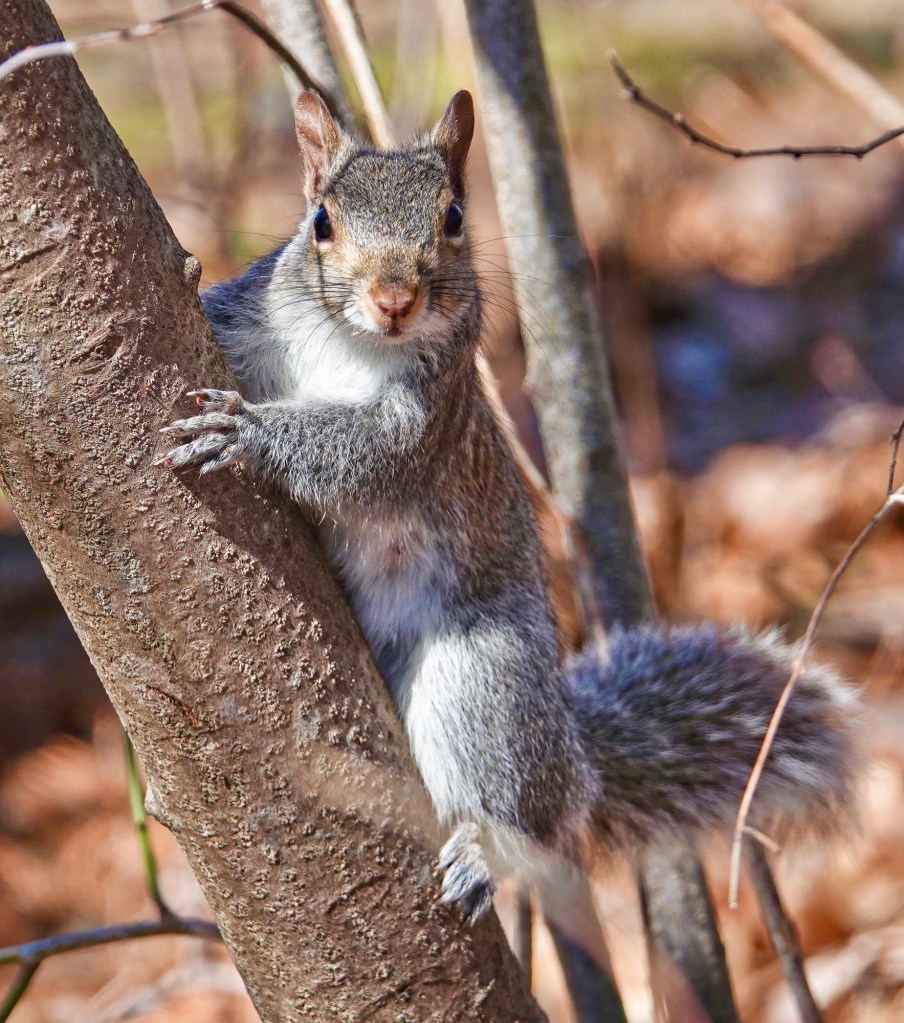
Grey Squirrel, Kennebunk, Maine, USA — Some of the squirrels in our yard are already getting ready for the first litter of the year…the females are getting just a bit plump and, in compromising positions, you can see their nipples swelling. You can just see the first signs here. This is the only time of year I can tell the females from the males. 🙂 Sony Rx10iv at 600mm equivalent from my backyard photo blind. Program mode with my custom birds and wildlife modifications. Processed in Polarr and Apple Photos. ISO 200 @ f4 @ 1/500th.