Posts in Category: flowers
American Lady

American Lady Butterfly: Kennebunk Plains Preserve, Kennebunk, Maine, USA — It is short aster season on the Kennebunk Plains here in Southern Maine, with at least 3 species of small asters in bloom, and large areas heavily carpeted. I found several fairly fresh looking American Ladies working a stand in the sun. They did not want to sit still for photography but I did my best. 🙂 Sony Rx10iv at 600mm equivalent. Program mode with my custom birds and wildlife modifications. Processed in Polarr and Apple Photos and assembled in FrameMagic. ISO 100 @ f4 @ 1/1000th, 1/1000th, 1/640th, and 1/800th.
Bumblebee in the Turtlehead

Someone gave us a few Turtlehead plants many years ago, and they have grown into 4 substantial clumps in the shade of the trees along either edge of our yard. Turtleheads are more commonly a flower of the stream-side. We have the white variety growing wild along the Kennebunk River not from from home. They are such a strange flower, closed in on themselves and not very inviting, but the big bumblebees we have here in Southern Maine seem to like them, and are very busy forcing their ways into the throat of the turtle and back out again laden with pollen. I was out with my iPhone for some macro and semi-macro shots. This one was taken with the Sirui 60mm portrait lens on the Moment thin case at about 2x digital zoom with the standard Apple Camera app. Smart HDR engaged. Processed in Apple Photos.
Sundew!


Sundew, Hidden Valley Nature Center, Jefferson, Maine, USA — As promised, we are here today to celebrate Sundew! Sundew is another carnivorous bog plant. Instead of drowning its prey, as the Pitcher Plant from yesterday does, the Sundew has little sticky spikes on open pads that attract insects. The insects get stuck and the nutrients are absorbed. You can see a couple in the shots here. A tiny back beetle, and small green caterpillar of some sort. Sundew is hard to see, even in a bog full of it. The little sticky, spiky, pads are often all that rises above the level of sphagnum moss, though the first shot above shows more of the plant, and those pads are less than 1/4 inch across. In good light you look for the glitter of the crown of tiny sticky beads of gue on the tips of the spine. And then you get in really close for a photo. The shot that shows more of the plant was taken at 600mm with my Sony Rx10iv from about 3 feet (and that was an exceptionally large plant), but the other two are from my iPhone SE with the Sirui 10x macro lens attached. I had to get down on my knees and elbows and bend over the edge of the floating platform, to get the phone within about 1/4 inch of the plants for those shots. Then I had to get back up…not easy at my age. The things we do. 🙂 Still, I would do it again, just for the privilege of seeing and celebrating the strange and wonderful carnivorous, bog dwelling, Sundew plant!
Pitcher Plant


Hidden Valley Nature Center, Jefferson, Maine, USA — I spent the day with the Holbrook Travel group at Hog Island Audubon Camp yesterday, and presented an afternoon workshop on nature photography. One of the highlights was a visit to the bog platform at Hidden Valley Nature Center in Jefferson. I have never seen a better display of Pitcher Plant. (We also found lots of Sundew plants, which I will feature in another post.) Pitcher Plant is a carnivorous plant. Insects are attracted to the water in the pitcher and then, because of the structure of the plant, can not climb back out. They are digested in the pitcher and the nutrients feed the plant. They have a strange flower that is mostly bract. We have them in the remnant bogs in Southern Maine, but nothing like the display at Hidden Valley…just that much further north. Photos with the Sony Rx10iv at various focal lengths for effective framing. Program mode with my custom birds and wildlife modifications. Processed in Polarr and Apple Photos.
Monarchs in Blazing Star

Monarchs and Northern Blazing Star, Laudholm Farms, Wells, Maine, USA — I stopped by the National Estuarine Research Reserve at Laudholm Farms the other day while out on my eTrike. The staff have planted a native species garden near the entry kiosk and they have a few Northern Blazing Star plants which are exceptionally tall and full, probably because they get watered every day. They are attracting Monarchs. (They also have a field of Milkweed down below the farm buildings so they are working both ends of the Monarch cycle 🙂 Because there was only the one stand of Blazing Star there was a lot of interaction between the Monarchs…that swirling chase they do…and they were often on two sides of the same plant…making for a great photo op. Nikon B700 at ~ 1125mm equivalent. Program mode with some custom tweaks for birds and wildlife. Processed in Polarr and Apple Photos. ISO 100 @ f5.6 @ 1/250th.
White Blazing Star
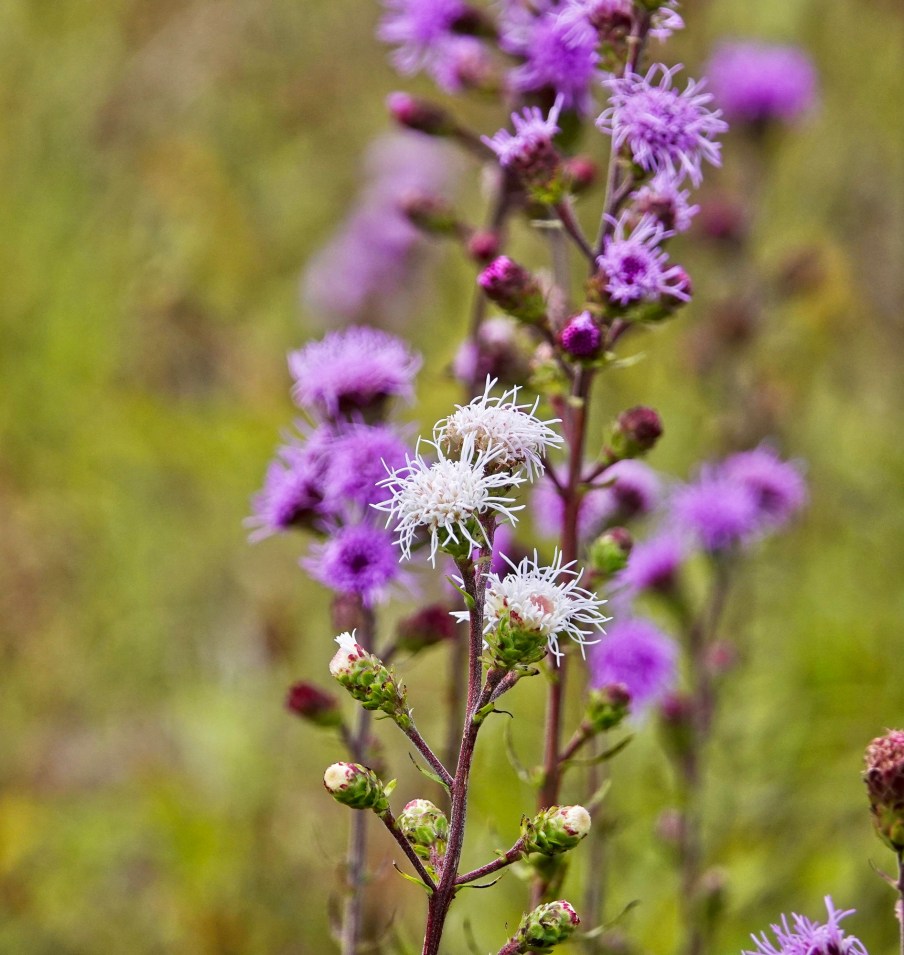
Northern Blazing Star: Kennebunk Plains Preserve, Kennebunk, Maine, USA — I tried to look it up, but I can find no information (in a casual search) on what percentage of Northern Blazing Star flowers are white…but from my experience it can’t be very high. Among perhaps a hundred thousand blossoms on the Kennebunk Plains in August, I have seen 3 plants with white flowers, for a total of less than a dozen flowers. So these white flowers are a rarity even for an already rare plant like Blazing Star. Sony Rx10iv at 600mm equivalent. Program mode with my custom birds and wildlife modifications. Processed in Polarr and Apple Photos. ISO 100 @ f4 @ 1/800th.
Groundnut

Groundnut or Potato Bean (Apios americana): Emmon’s Preserve, Kennebunkport, Maine, USA — This is a new plant for me, at 74 years of age, so either I have not gotten out enough (not true), or there are still things for me to discover even at my age. It is not a particularly rare plant either…just one that I have not come across. It is a vine and produces, as you might guess from the common names (and “Indian Potato” is another, if less culturally sensitive, common name for Apios americana) both edible beans and a large edible tuber. It is native to North American, and historically it was a stable of Indigenous American diets from New England to Florida and west to the Rockies. It is currently cultivated and an important food source in certain regions of Japan, and its medicinal and nutritional benefits have been extensively researched and promoted there. There is an comprehensive and well referenced wikipedia article on the plant if you want more info…but suffice it to say that it is generally recognized to very good for you, better than a potato in many unique curative ways 🙂 It is not cultivated outside Japan largely because it takes two years for the tuber to develop…which means you can get two crops of potatoes for every one crop of groundnuts. The flowers are quite striking…one theory is that it was introduced to Japan as an ornamental. The plants I saw at Emmon’s Preserve appear to be growing wild, on either side of a busy trail at the edge of a big meadow. I have walked that trail hundreds of times, but only saw the plants last week, probably because they were in flower. Sony Rx10iv at 600mm equivalent. Program mode with my custom birds and wildlife modifications. Processed in Polarr and Apple Photos. ISO 800 @ f4 @ 1/500th.
Wood Nympth on Blazing Star

Wood Nympth on Northern Blazing Star, Kennebunk Plains Preserve, Kennebunk, Maine, USA — By far the most numerous butterfly on the Kennebunk Plains during August and Northern Blazing Star season is the Wood Nympth…but then the Wood Nympth is probably the most numerous butterfly in southern Maine all summer. They come out early in spring and are present well into fall, and always in good numbers. This year, as in most creatures in southern Maine, seems to be bumper year. There were hundreds of them in the Blazing Star. They are not the most attractive of butterflies, but it appears to be working for them. Sony Rx10iv at 600mm equivalent. Program mode with my custom birds and wildlife modifications. Processed in Polarr and Apple Photos. ISO 100 @ f4 @ 1/500th.
Another selection of Sandia Crest Wildflowers…

Snowplant, Beardstongue (Pentstimon), and California Cone Flower. Capulin Snowplay Area, Sandia Peak Highway, Albuquerque, New Mexico. The Sandia Mountains rise abruptly above Albuquerque to the east and slope gently (more or less) further to the east on their trailing edge. The updraft from the Rio Grande Valley at their base drops moisture as it goes over the 10,000 foot crest, and makes the forests on the east side some of most well watered in the Southwest. You can tell by the abundant wildflowers, and rich bird life. Here we have another selection of flowers from Capulin Snowplay Area on the slopes of the Sandia, just off the Sandia Crest Highway. Snowplant is a parasitic plant that is fed by a fungus on the roots of trees, similar to the Indian Pipes we have here in Maine, but as you see, much more colorful. The purple Pentstimon replaces the more common red Penstimon of the lower slopes at this elevation, and the California Coneflowers grow in large masses in the wetter meadows and along the edges of parking areas. Sony Rx10iv at 600mm equivalent. Program mode with my custom birds and wildlife modifications. Snowplant at ISO 200 @ f4 @ 1/500th, Pentstimon at ISO 250 @ f4 @ 1/500th, Coneflower at IS0 100 @ f5.6 @ 1/800th.
Yerba Mansa

Yerba Mansa: Leanora Curtin Wetlands Preserve, Santa Fe, New Mexico, USA — The Leanora Curtin Wetlands are a tiny cienega (a natural marsh) just south of Santa Fe, New Mexico, managed by the Santa Fe Botanical Gardens. It features a small pond, boardwalks over the marshy area, some giant Cottonwoods. and acres of wetland plants, including large beds of Yerba Mansa. While comments made by others during our visit lead me to believe that Yerba Mansa might be an invasive exotic, a bit of research this morning indicates that it is indeed native to New Mexico and wetland all the way to the west coast. It is related to the Lizard Tail plants, and the aromatic roots have been used in traditional medicine to treat skin and digestive disorders. The flowers are pure white when new, and get the red spots as they age. Sony Rx10iv at 600mm equivalent. Program mode with my custom birds and wildlife modifications. Processed in Polarr and Apple Photos and assembled in FrameMagic. ISO 100. 1-3 @ f7.1, 4 @ f5.6 @ 1/1000th.