Posts in Category: p&s 4 wildlife
Fall Yellow-rumps!

There can’t be many places that are better for Yellow-rumped Warblers in the fall than Cape May, New Jersey. The birds are abundant, and the birds, busy feeding before crossing Delaware Bay, are fearless. Not that Yellow-rumps ever show much fear. Tom Dunkerton and I stood side by side in a sheltered spot in the shadow of the Hawk Watch Platform at Cape May Lighthouse State Park and shot Yellow-rumps at 15 feet, feeding in the sun and dappled shade of the trees in front of us. At one point I expressed the opinion that I now probably had enough fall Yellow-rumps shots to last me a lifetime! Of course, if I encounter an easy Yellow-rump today, I will undoubtedly shoot some more!
Canon SX50HS. Program with -1/3rd EV exposure compensation. 1800mm equivalent field of view. f6.5 @ 1/1000th @ ISO 640. Processed in Snapseed on the Samsung Galaxy Note 10.1 2014.
House Finch

The House finch is not the most attractive bird in the world but it has character all its own. In the low sun of a late afternoon in October this migrating finch takes on a unique warmth. I was on a photoprowl looking for fallish shots along the Kennebunk Bridle Path when this bird flew up into a tree right beside me. I had the wrong camera of course, but even the relatively short zoom on the Samsung was enough as the bird was that close!
Samsung Smart Camera WB800F in Program. About 500mm equivalent field of view. 1/180th @ f5.9 @ ISO 100. Processed in Snapseed on the Nexus 7.
Long-tailed Skipper

The Long-tailed Skipper is not an attractive butterfly as butterflies go…dull gray with few markings…but it certainly has character. In this shot, from coastal Alabama, you can see the proboscis inserted into the tiny opening in the tiny flower in search of what can only be the tiniest drop of nectar. Not an easy living, but the Long-tailed Skipper, with its long slender and flexible proboscis, is particularly adapted to it.
Samsung Smart Camera WB250F. Program with macro. 482mm equivalent field of view. f5.9 @ 1/250th @ ISO 100. Processed in Snapseed on the Nexus 7.
Fritillary. An alternate view.

As I said a few days ago, there were Fritillaries every where in Coastal Alabama last week, and I brought back, as you might expect, a lit of different views. As the day progressed the wind came up and the Fritillaries had some difficulty hanging on the the waving plants to feed. They achieved some interesting poses, some of which I caught.
I like this unconventional under-wing view. It has a sense of arrested motion that appeals. And i lime the way the bright contrasty light picks out the details on the colorful bug. Or that is the way I see it.
Samsung Smart Camera WB800F. Program and macro. 200mm equivalent field of view. f4.8 @ 1/500th @ ISO 100. Processed in Snapseed on the Nexus 7.
Roseate Skimmer. Happy Sunday!

On Friday I joined the Bayou LA Batre field trip at the Alabama Coastal Birding Festival. We visited several birdy locations in the Bayou La Batre area. I posted an illustrated trip report on gobirding.us. One of the highlights of the trip for me was the number of dragonflies bunched up along the coast as they migrate south for the winter. There were more Black Saddlebags than I have ever seen in one place at one time, a few Red Saddlebags, Green Darners (of course), and lots of Wandering Gliders. The best for me though, were the dozens of Roseate Skimmers I found in a drainage ditch along one of the roads we walked while looking for birds. We don’t get Roseares in Maine. I have only seen them in Texas up to this trip. Lovely bugs!
Canon SX50HS. 1800mm equivalent field of view. Program with iContrast and -1/3EV exposure compensation. Processed in Snapseed on the Nexus 7.
And for the Sunday Thought. With my growing interest in dragonflies added to my interest in butterflies it is becoming obvious that I no longer fit the traditional birder mold. On the Bayou La Batre field trip, I spent as much time looking at and photographing dragonflies and butterflies as I did looking at and photographing birds. I often found myself way behind the group as I was waylaid by an interesting bug. On the long (or short).stretches of trail or roadside between birds and likely birding spots, while the real birders truged and chatted, only half paying attention, I was still on full alert, checking out every bug I came across. I am sure some of the real birders in the group got tired of my pointing out Saddlebags and Skimmers, Fritillaries and Long-tailed Skippers. One lady asked if I were more of an entomologist than a birder. I had to explain that my interest in birds was a keen as ever, but I supposed it was fair to say that I was becoming more of a general naturalist, with interests in bugs and reptiles and wildflowers and trees…with the whole living world. If makes me the odd man out on birding field trips, so be it. If they are not interested in the Roseate Skimmers in the drainage ditch, it is their loss. 🙂
To me it is the natural continuation of the outward turn that birding is part of. Once you get your eyes of yourself and your inner drama, and focused on the wonder and variety of the Creation that we are emersed in, even if you begin, as many do, with birds, how do you stop there? Why would you stop there? There is so much to see and so much to learn. For the naturalist, there is, literally, never a dull moment in the field.
And if, like me, your interest is, in fact, your offering to the Creator God, an act of worship and fellowship, then certainly you would not want to miss the Roseate Skimmers in the ditch.
Happy Sunday!
Fritillary!

I like Fritiallaries. Big and showy, and with their metallic silver patterns on the under hind-wing, they are a treat to see anytime. In Coastal Alabama yesterday, where I am working a birding festival, they were everywhere we went. They are migrating right now and were apparently bunched up along the coast. Okay by me.
I had several good photo ops. I especially like this shot with the contrast of the pink flower and the lovely green bokeh.
Canon SX50HS. Program with iContrast and -1/3EV exposure compensation. 1200mm equivalent field of view. f6.5 @ 1/1000th @ISO 500. Processed in Snapseed on the Nexus 7.
Another Garter Snake (Maine)
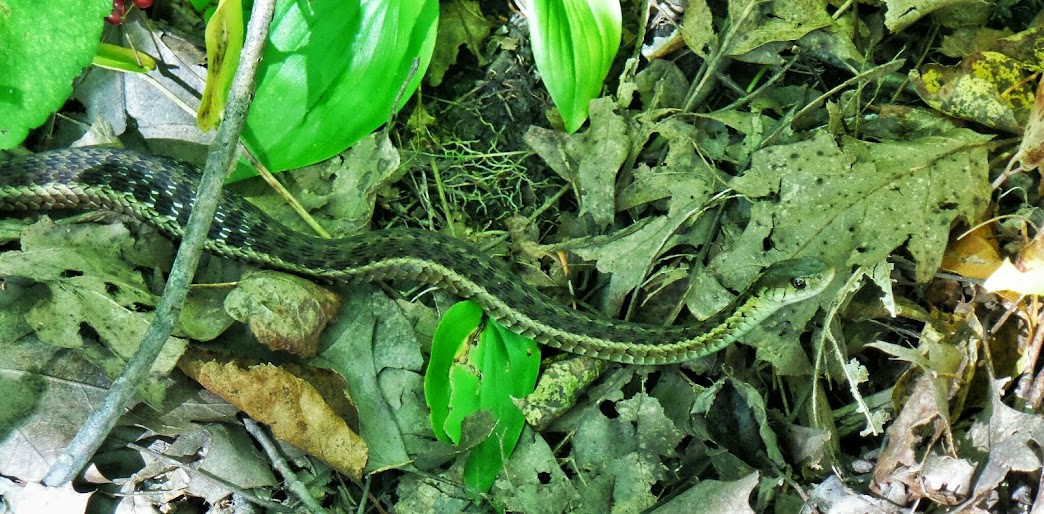
Well, it seems to the the season for Garter Snakes with prey inside…even though the last one I saw was in a bush in Ohio, and this one is on the ground at Emmon’s Preserve in Kennebunkport ME. Other than that, they could be same snake. Same size. Same size lump. Lump in the same spot. And before these two snakes I had never seen the pattern of white scale edges that the distension reveals. Interesting.
Samsung Smart Camera WB800F. Program and macro. 216mm equivalent. f4.8 @ 1/60th @ ISO 400. Processed in Snapseed on the Nexus 7.
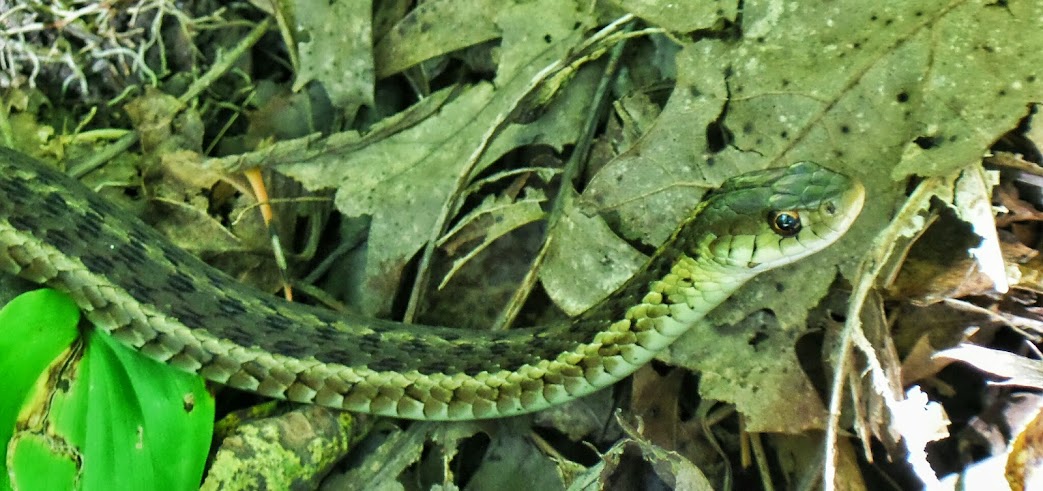
And one at around 500mm equivalent field of view.
A well worn Mourning Cloak

I took Carol to Emmon’s Preserve (The Kennebunkport Land Trust) yesterday for the first time in a long time. I have been telling her about the new trails and all the work they have been doing to improve access, and how much I have enjoyed finding new dragonflies in the meadows there. She wanted to see, so we spent the afternoon exploring. I got out of the car, literally, just in time to see a Black-tipped Darner land for a photo op, and moments later, this Mourning Cloak fluttered into the path to warm itself. It was up and away before I could photograph it, but it returned several times to the path, eventually landing practically on my foot. It is a very well worn bug, clearly in its last few days of flight. I hope it had a good summer.
Canon SX50HS at 1800mm equivalent field of view. f6.5 @ 1/1000th @ ISO 320. Program with iContrast and -1/3EV exposure compensation. Processed in Lightroom.
Unconventional Black and White (Warbler)

Working the Magee Marsh Boardwalk in fall is far different than working it in spring. There are fewer birds…not in total species…but in total individuals; the birds are, in general, higher in the trees; the trees are fully leafed out so the birds are much harder to see; and there are way fewer birders…which translates to easier movement on the boardwalk, but also to far fewer eyes looking…which means you can’t, most of the time, just sidle up to the bird-jams and ask the massed birders what they are looking at.
Still, you do find rapidly moving mixed feeding flocks of warblers, chickadees, nuthatches, and titmice. Warblers, of course, of several different species, and occasionally they are working low enough for some good photography.
This Black and White Warbler, caught in an odd pose (but hardly atypical, if you know B&Ws at all) was along the east end of the walk not far above eye-level, feeding with Blackpoles, Mornings, and a few Magnolias, along with the usual Chickadees and Titmice.
Canon SX50HS. Program with iContrast and -1/3EV exposure compensation. 1200mm equivalent field of view. f6.5 @ 1/1000th @ ISO 640. Processed in Snapseed on the Nexus 7.
Snake in a bush…

Now here is something you rarely see in North America: a snake in a bush. I believe this is a common Garter Snake, and I am certain I have never seen one in a bush or tree of any kind. It was well distended at the mid-point with its last meal, and I am sure it crawled up into the bush (just about eye level) to digest its food in peace. And then we came along: an avid group of birders and nature lovers on a field trip at East Harbor State Park on the shores of Lake Erie in Ohio for the Midwest Birding Symposium, and all had to have a look at the snake. And take pictures. I was a little concerned when folks attempted to fill the screen of their smartphones with snake…I thought they were a tad close for the snake’s comfort, but he/she took it all in stride and we left it digesting where we found it in its bush.
Samsung Smart Camera WB800F at 481mm equivalent field of view. Program and Macro. f5.9 @ 1/30th @ ISO 400. Processed in Snapseed on the Nexus 7 2013.