Posts in Category: wildlife
Eagle, Eagle!

Bald Eagle, Muskrat Pond, Medomak, Maine, USA — This American Bald Eagle was really too far away for photos…but what are you going to do? It was all the way across Muskrat Pond in Medomak, Maine, at least a quarter of a mile, when I visited with the Holbrook Travel group at Hog Island Audubon Camp last this week. Sony Rx10iv at 600mm equivalent…but cropped, upscaled, and recropped for maybe the equivalent of 2000mm. Lots of mist in the air too, and crummy light, which did not help either. Still, we do what we have to. 🙂 Program mode with my custom birds and wildlife modifications. Processed in Polarr, upscaled in Pixomatic Pro, finished in Apple Photos. ISO 250, 500, and 400 @ f4 @ 1/500th.
Black and White
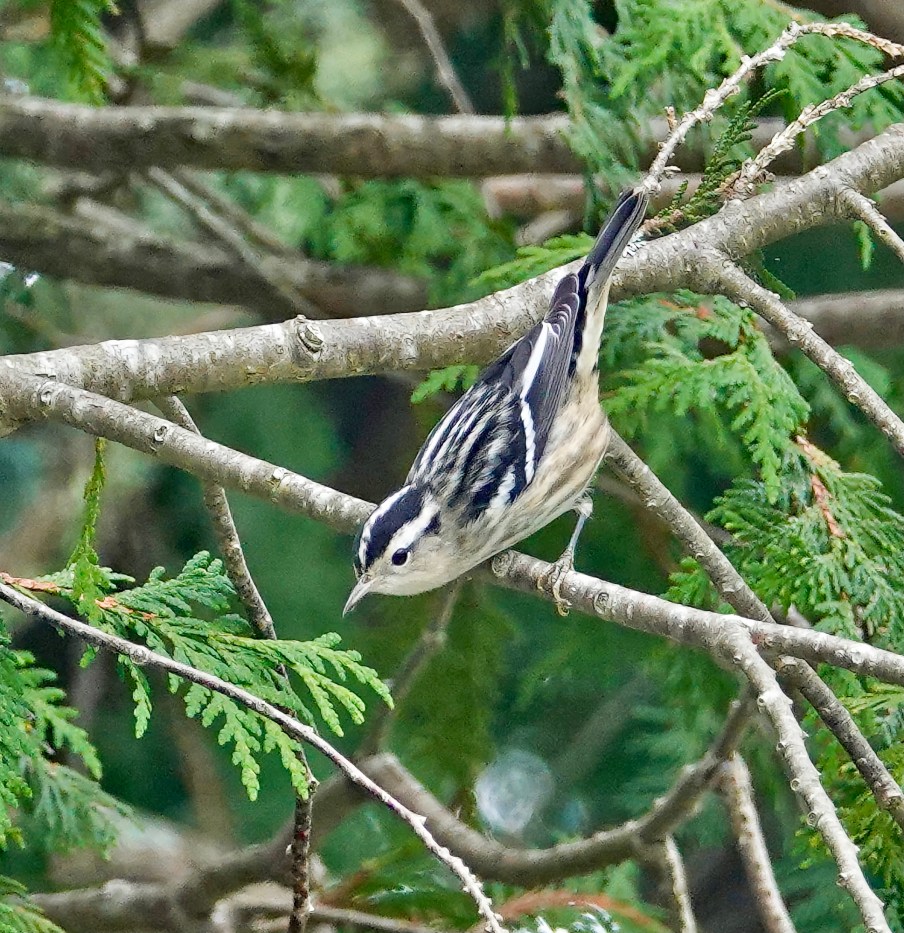
Black and White Warbler: Medomak, Maine, USA — As part of my day with the Holbrook Travel group at Hog Island Audubon Camp, we took a walk around Muscrat Pond in Medomak, a small village just up the coast from Hog Island. There were birds. Not a great many, but more than a few species…not easy to photograph as they foraged in hedgerows and tree tops…typical Maine August birding when the migration is just getting under way. Just that much north of us they do have many nesting warblers that we don’t see all summer here in Southern Maine, like this female Black and White Warbler, who did come out to the edge of the foliage for a few moments while we watched. Sony Rx10iv at 600mm equivalent. Program mode with my custom birds and wildlife modifications. Processed in Polarr, enlarged in Pixelmator Pro and cropped for scale, and finished in Apple Photos. ISO 500 @ f4 @ 1/500th.
Widow Skimmer with sparkles :)

Widow Skimmer: SMMC drainage pond, Kennebunk, Maine, USA — Sometimes it is as much about the setting as it is the dragonfly. This Widow Skimmer was guarding its perch from a Slaty Skimmer, which wanted to take it over. The sparkles off the water behind make for a striking photo. I think. Nikon B700. Program at 1440mm equivalent and ISO 100 @ f6.5 @ 1/320th with -.3 EV exposure compensation. Processed in Polarr and Apple Photos.
Wood Nympth on Blazing Star

Wood Nympth on Northern Blazing Star, Kennebunk Plains Preserve, Kennebunk, Maine, USA — By far the most numerous butterfly on the Kennebunk Plains during August and Northern Blazing Star season is the Wood Nympth…but then the Wood Nympth is probably the most numerous butterfly in southern Maine all summer. They come out early in spring and are present well into fall, and always in good numbers. This year, as in most creatures in southern Maine, seems to be bumper year. There were hundreds of them in the Blazing Star. They are not the most attractive of butterflies, but it appears to be working for them. Sony Rx10iv at 600mm equivalent. Program mode with my custom birds and wildlife modifications. Processed in Polarr and Apple Photos. ISO 100 @ f4 @ 1/500th.
Juvenile Rufous Hummingbird

Rufous Hummingbird: Bear Canyon Campground, Santa Fe National Forest, Santa Fe, New Mexico, USA — I shared one shot if this juvenile Rufous Hummingbird at these flowers in the Bear Canyon Campground above Santa Fe, New Mexico a week or so ago, but I can not leave my New Mexico experience without sharing a couple more poses. The Hummer was very busy and remained around the flowers long enough so that I got a number of keeper shots. In these two you can see the the distinguishing features on the front side of the bird. Sony Rx10iv at 600mm equivalent. Program mode with my custom birds and wildlife modifications. Processed in Polarr and Apple Photos, assembled in FrameMagic. ISO 100 @ f4 @ 1/500th.
All business bee with Blazing Star!

I seem to be photographing a lot of bees this month, both around home, and during our visit to New Mexico. Maybe August is the month of the bee? There are certainly a lot of bees in the Blazing Star boom on the Kennebunk Plains. Mostly Bumble Bees like this one…which is, I am thinking, the Common Eastern Bumble Bee (though there are several others it might be). This shot catches the business end of the bee…ready to prob deeply into the Blazing Star for pollen, and you can see by the pollen sacks on the legs that this bee has already been busy. Bumble Bees to occasionally sting (mostly when trapped or squashed), and I certainly would not want to be on the receiving end of that stinger. This is a shot from the Sony Rx10iv at 600mm equivalent. Program mode with my custom birds and wildlife modifications. Cropped and processed as usual in Polarr and then opened in Pixelmator Pro for enlargement using the Machine Learning Maximum Resolution tool, and recropped to fill the frame, for what amounts to a super-telephoto macro. ISO 100 @ f4 @ 1/640th.
Sandia Crest Red-breasted Nuthatch

Red-breasted Nuthatch: Sandia Crest, Albuquerque, New Mexico, USA — There were hundreds of Red-breasted Nuthatches along the Sandia Crest Nature Trial when we visited last week. New Mexico Nuthatches seem to be quite large by Maine standards. They seem to be pretty much the same size as our White-breasted Nuthatches. In Maine the RBNH is noticeably smaller, by a full size, maybe a size and a half, than the WBNH. The same perky little bird though…always busy. Sony Rx10iv at 600mm equivalent. Program mode with my custom birds and wildlife modifications. Processed in Polarr and given the Machine Learning Maximum Resolution treatment in Pixelmator Pro, then cropped back to fill the fame more, and finished in Apple Photos. I am guessing the net result is a frame of view approximately equivalent to a 2000mm lens on a full frame camera. This is my new method for overcoming the limitations of a 600mm equivalent lens for small birds at a distance. 🙂 ISO 100 @ f4 @ 1/500th.
Cassin’s Finch


Cassin’s Finch: Capulin Snowplay Area, Sandia Crest Highway, Albuquerque, New Mexico, USA — As near as I can figure this is a juvenile male Cassin’s Finch. From the right angle you could see just a blush of reddish on the chest. There was another bird with it that was probably the adult female. Both sat above the water drip at the Snowplay area for most of the time we sat there…going on an hour. We left primarily because I came to the suspect we were keeping them from their drink (and partially because our two non-birders had exhausted the entertainment factor of the old road through the picnic area). Sony Rx10iv at 600mm equivalent. Program mode with my custom birds and wildlife modifications. Processed in Polarr and Apple Photos. ISO 160 @ f4 @ 1/500th.
Santa Fe Lizards

New Mexico Whiptail 
New Mexico Whiptail 
Chihuahuan Spotted Whiptail 
Desert Grassland Whiptail 
Little Striped Whiptail 
Plateau Fence Lizard
In the six days we spent in and around Santa Fe, New Mexico, we encountered several different lizard species. The trouble is that all but one were whiptails, and I do not know enough about whiptails in general, and New Mexico whiptails in particular, to reliably distinguish them where the species overlap as they do in Santa Fe. Also there are several possible Fence Lizards in New Mexico. I have captioned the images with my best attempt at an ID based on the resources I could find on the web and in apps. Anyone who really knows their Southwestern Lizards can feel free to correct me. 🙂 To complicate matters, the New Mexico Whiptail is a fertile, female only, hybrid between the Little Striped Whiptail and the Desert Grassland Whiptail, both of which also occur in Santa Fe. So. All photos with the Sony Rx10iv at or near 600mm equivalent. Program mode with my custom birds and wildlife modifications. Processed in Polarr and Apple Photos.
Green-tailed Towhee

Green-tailed Towhee: Capulin Snowplay Area, Sandia Crest Highway, Albuquerque, New Mexico, USA — My daughter Sal who lives in Albuquerque took us up Sandia Crest Highway to get away from the high temperatures and wildfire smoke settled over the city and to find some birds to photograph. We stopped at the Capulin Snowplay Area and walked down to the springs where there is water drip that attracts all kinds of birds depending on the time of day. This Green-tailed Towhee came and took several baths in the unaccustomed heat. Sony Rx10iv at 600mm equivalent. Program mode with my custom birds and wildlife modifications. Processed in Polarr and Apple Photos. ISO 100 @ f4 @ 1/500th.