Posts in Category: wildlife
Juvenile Boat-billed Heron

Juvenile Boat-billed Heron, Cuero y Salado WR, Honduras
One of the problems with Point and Shoot photography, or, for that matter, photography of any kind, in the tropics is the density of the foliage. It makes focus difficult and the low light levels push any camera to the limits of what can be done without flash. So this is not a great shot of a Boat-billed Heron…an immature bird we found deep in the mangroves overhanging the waters in Cuero y Salado Wildlife Refuge in Honduras…but it is pretty good considering that it was taken hand-held from a boat in such dim light. 🙂
Sony HX400V at 1200mm equivalent field of view. I had to dial the shutter speed all the way down to 1/160th to get a reasonable exposure of ISO 2500 at f6.3. Processed in Lightroom on my Surface Pro 3 tablet.
Blue-crowned Motmot. Happy Sunday!

Blue-crowned Motmot, Lodge at Pico Bonito, Honduras
The Motmots of Central America are among the most colorful of birds in a region renowned for colorful birds. There are several species to add interest. They are, according to WiKi, relatives of the Kingfishers, Bee-eaters, and Rollers, all colorful birds in their own right, and like their kin, nest in holes and tunnels in steep banks. They perch low in the canopy, and except for the Turquoise-browed, which apparently favors more open country, are difficult to photograph in the perpetual half-light under the dense foliage. This shot was digiscoped…taken through the 30x wide-field eyepiece on a ZEISS DiaScope 65FL spotting scope, with a small Canon s120 advanced Point and Shoot camera. The combination gave me the equivalent of about an 850mm lens on a full-frame digital camera. The low light levels pushed the camera to its limits, but I am happy to have a record of this amazing bird.
While the ZEISS VICTORY SF Experience hiked through the rainforest looking for birds like the Motmot, the subject of how such spectacuarly strange birds “evolved” came up. Looking at Motmot’s for instance, there are many features of structure and plumage that are difficult to explain from a “survival of the fittest” stand point. If you assume that every feature of the creature has to have provided evolutionary advantage, then you soon get lost in rambling speculation, since there is often no obvious advantage to such intricate design. At one point I simply laughed and said, ” I am not looking for evolutionary advantage. I take each feature as evidence of design.” You can believe that caused a dead silence in the group. In truth they might have felt pity for me…since I was obviously one of those backward fork who what to see intelligent design in nature…a creative intelligence responsible for the creatures we see. Imagine if I had gotten as far as saying a “loving intelligence” who “loves” the Motmot and all creatures into existence. Because of course that is what I believe. It makes me the odd-man-out in the birding circles that I frequent, but that is okay. Every bird I see is another reason to give thanks to the Creator…to celebrate both creation and love. It makes birding, like every aspect of a life lived in the spirit, an act of worship…both the joyful, song-filled, revitalizing kind of Sunday worship, and the deep meditative worship of reflection. I only wish I could share more of that worship with my fellow birders. And of course, I am secretly attributing the joy they feel in the presence of birds to the movement of the spirit in them. It costs them nothing and it increases my pleasure in what we are doing together. Happy Sunday. And may something as wonderful as a Motmot in the rainforest enrich your day.
Bare-throated Tiger-Heron

Bare-throated Tiger-Heron. From the train to Cuero y Salado Refuge
I mentioned that we rode the toy train (banana train) from La Union to the Cuere y Salado Wildlife Refuge Visitor Center and the boats on which we explored the mangroves in the river delta…this is another bird we saw, and stopped for, along the tracks. Tiger-Herons are Neotropical wading birds clearly related to the rest of the Heron tribe. The Bare-throated is common in Central America from southern Mexico south. Every one I have seen…all two of them…have been in trees, but I am confident that they do get down and wade at least on occasion. 🙂
Sony HX400V at 1200mm equivalent field of view. Shutter preferred. 1/640th @ ISO 500 @ f6.3. Processed in Lightroom on my Surface Pro 3 tablet.
Bat Falcon

Bat Falcon. From the train to Cuero y Salado Wildlife Refuge
We rode the narrow gauge, toy train 9 km from La Union to the Visitor Center at Cuero y Salado Wildlife Refuge in Honduras. It is actually the train used to haul fruit and workers to and from the plantations to the real railroad, when the fruit plantations were active…but they have preserved it as a local tourist attraction, and for the convenience of those who live in the isolated dwellings down by the sea beyond the Refuge. We saw lots of birds from the train, and even though there were local paying passengers, we stopped often to get off and have a better look. This Bat Falcon stopped the train for a good half hour. 🙂 It is a trim little bird, as most falcons are…and certainly worth a long look.
Sony HX400V at 1200mm equivalent field of view. 1/640th @ ISO 100 @ f6.3. Processed in Lightroom on my Surface Pro 3 tablet.
Tiger Heliconian

Tiger Heliconian. Cuero y Salada Wildlife Refuge, Honduras
There are apparently several of these orange and black long-wings possible in Central America, but I am pretty sure this is, indeed, the Tiger Heliconian…pretty sure because the name seems to be applied to several different species. This shot was at the visitor center after our boat exploration of the junction of the Cuero and Salado rivers a few hundred yards inland from the Caribbean sea. It is a great habitat for birds…mangroves and huge trees lining quiet waters. The visitor center has a small yard and garden and I chased the Heliconian down among the flowers.
Sony HX400V at just over 600mm equivalent field of view. 1/800th @ ISO 640 @ f5.6. Processed and cropped for scale and composition in Lightroom on my Surface Pro 3 tablet.
Collared Aricari picks a berry!

Collared Aricari: The Lodge at Pico Bonito, Honduras
The Lodge at Pico Bonito is a rain-forest lodge and has lots of birds and wildlife right on the grounds…enough to keep anyone busy for many days. We found a small flock of Collard Aricari, relatives of the Toucans, feeding on berries relatively close to the ground, and I had a happy few moments of photographing them.
Sony HX400V at just under 1200mm equivalent field of view. ISO 2500 @ 1/640th @ f6.3. Processed in Lightroom on my Surface Pro 3 tablet.
Flight! Happy Sunday.

Common Tern, Merritt Island NWR
Birds in flight hold a fascination for most of us. Photographs of birds in flight…photographs that capture the dynamic of wing, feather, and air…the miracle of wing, feather, and air…are particularly fascinating. Such photographs are a wonder and a challenge. Photographically they are among the most difficult to capture…especially with anything short of a full blown DSLR and a medium to long telephoto lens…equipment costing many thousands of dollars and encompassing a daunting weight when carried into the field where the flying birds are.
All of which is why I feel so blessed to have an effective Sports Mode on my cameras of choice…the inexpensive, compact, versatile superzoom Point and Shoots that I carry. Sports Mode makes birds in flight a possibility…and a pleasure. I spent a delighted 45 minutes at Merritt Island National Wildlife Refuge photographing a small group of Common Terns as they fed. Such fun.
Flight is a spiritual dream for most of us…we picture angels with wings for good reason. The freedom and miracle of flight suits our spirits…represents a state of grace we can aspire to…because, of course, we feel like we should be able to fly, like we were born to fly. We dream of flying. Our spirits soar when we are in contact with the divine. We know that one day…one eternity…by grace in faith…we will indeed fly. Free. Happy Sunday!
GBH Display

Great Blue Heron displaying on the nest. Ritch Grissom Memorial Wetlands, Viera FL
One of the features of the World Digiscopers Meet at the Space Coast Birding Festival this year was a day long competition with teams of two digiscopers in the field all day. The next day we all submitted 10 images per team for an informal show-down. All that was involved was bragging rights but the day produced some outstanding work. I teamed up with Jerry Jourdan, another ZEISS digiscoper. This shot is from our efforts on the day. This might be the most photographed Great Blue Heron in the world. It builds a nest on this particular palm stump at the Ritch Grissom Memorial Wetlands every year. The tree is only yards from the berm and tour loop, so it generally attracts a cluster of cars and several long lenses set up on tripods.
ZEISS DiaScope 85FL, 40x fixed wide-field eyepiece, Sony RX100, and the Digidapter for ZEISS. Effective focal length equivalent was 1238mm. 1/1600th @ ISO 400. Processed in Lightroom on my Surface Pro tablet.
Sitting Shrike

Loggerheaded Shrike. Blackpoint Wildlife Drive, Merritt Island NWR
When all my flights going home to the blizzard hitting Maine got canceled for two days running, I rescheduled for late in the day on Wednesday, hoping against hope that the weather would be cleared out, and the airlines somewhat caught up. That meant that I did not have to be in Orlando until 2PM. I planned, after many days in the field and lots of images captured, to spend the time in my hotel room resting and catching up…but when the sun came up on a relatively calm day, I could not resist packing up, checking out, and spending my final hours in Florida back out on Wildlife Drive at Merritt Island. I had time for two loops of Blackpoint, and it was well worth the effort. On my second loop, still being ahead of schedule by almost an hour, I parked at the rest area and walked out as far as the observation tower on the Cruickshank Trail, messing about with my new digiscoping rig, and generally having fun. This Loggerheaded Shrike graced the trail with its presence…and it sat while I photographed it with the Sony HX400V (here) and while I set up and digiscoped it. What a bird!
Sony HX400V at just over 1000mm equivalent field of view. 1/640th @ ISO 80 @ f6.3. Processed in Lightroom on my Surface Pro 3 tablet.
Snipe Hunt!
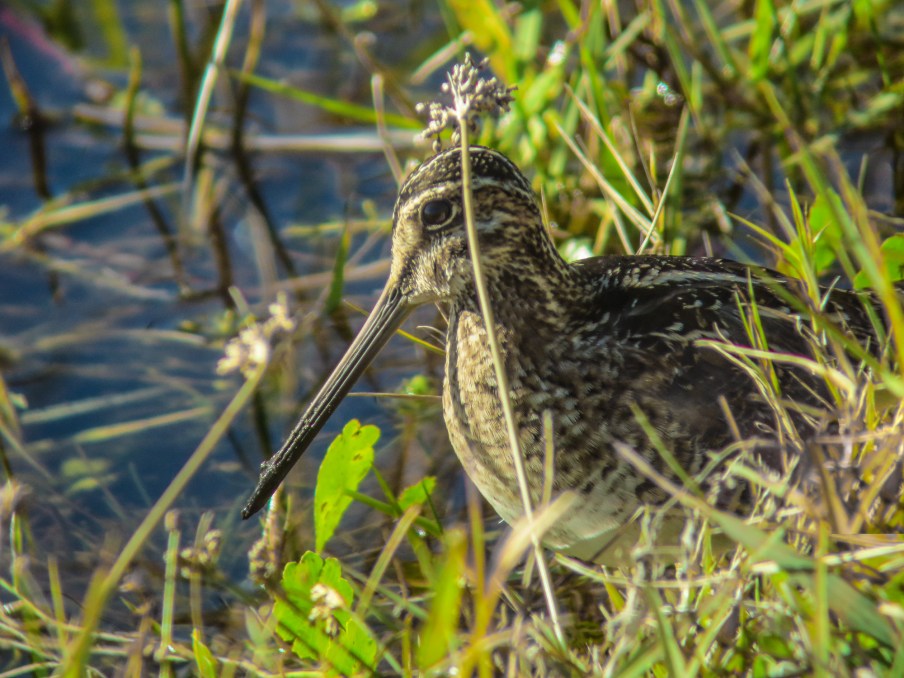
Wilson’s Snipe. Ritch Grissom Memorial Wetlands, Viera FL
Yesterday I spent the day photographing with my friend Paul Sayeh. This was Paul’s first trip to Florida, and I had a lot of fun showing him the birds and other critters at Viera Wetlands and Merritt Island (he likes Alligators and loved Armadillos). At one point I let him out of the car to photograph some White Ibis along the berm at Viera while I did some email and housekeeping in the car. When I finally decided to get out and see what he was up to, as I turned to close the car door, I caught a glimpse of a small bird like thing right at the water’s edge at the foot of the berm, tucked in some weedy growth. “Nah…” I thought, “that can’t be a snipe.” But it was! Snipe are never easy to see, and notoriously difficult to photograph. The most common view is going overhead at about 25 feet and 30 miles per hour. So I was just a little excited to find this one sitting. I got off some shots with the Sony at 1200mm equivalent, and when it still sat there, I got out the digiscoping kit and took several views at slightly higher magnifications.
ZEISS DiaScope 65FL with the Canon SD320HS behind the ZEISS 30x wide-field eyepiece on the Digidapter for ZEISS (made by the afore mentioned Paul Sayeh). Approximately 1300mm equivalent field of view. 1/500th @ ISO 200. Processed in Lightroom on my Surface Pro 3 tablet.