Goldfinch in song


American Goldfinch, Kennebunk, Maine, USA — I find these photos particularly amusing because of the contrast of how hard the Goldfinch tries to sing, and how tiny the actual sound is. I published this little poem a few days ago, but it bears repeating here. 🙂
The Goldfinch sings such a wispy tune,
a whisper song, an absent-minded twitter
totally without conviction. It takes a flock
of them to make much noise, and then
it has all the coherence of a string ensemble
behind a closed door tuning. I want to say,
“hey, Goldfinches, you can do better!” but
then, considering the numbers coming to our
feeders, their song, no matter how deficiently
soft and un-melodic to my untrained ear, must
be perfectly sufficient to Goldfinch needs.
Got to give them points for effort as well. Sony Rx10iv at 600mm equivalent. Program mode with my custom birds and wildlife modifications. Processed in Polarr and Apple Photos.
Brown Creeper


Brown Creeper, Kennebunk, Maine, USA — I am seeing a lot of Brown Creepers this spring. I saw one in early March at Roger’s Pond Park (when the park was still open, pre-pandemic closures), and I have seen them in April in the forest on both sides of lower Brown Street on my neighborhood walks. Yesterday, to my surprise and delight, one came and worked the Pines right in front of my photo blind. Still not as close as I would like and no easier to catch as it moved rapidly up the tree trunks, but as close as I have ever seen one (not counting the window stunned creeper we found on the deck one morning last year). Great little bird. I have lots of photos of their near relatives, probably a dozen different species, from Central and South American rain and cloud forests…but they are much bigger birds and easier to see, since the move in mixed feeding flocks with the bright and vocal tanagers. Our creeper is solitary and mostly silent. Sony Rx10iv at 600mm equivalent. Cropped considerably. Program mode with my custom birds and wildlife modifications. Processed in Polarr and Apple Photos.
Worm-eating Pine Warbler
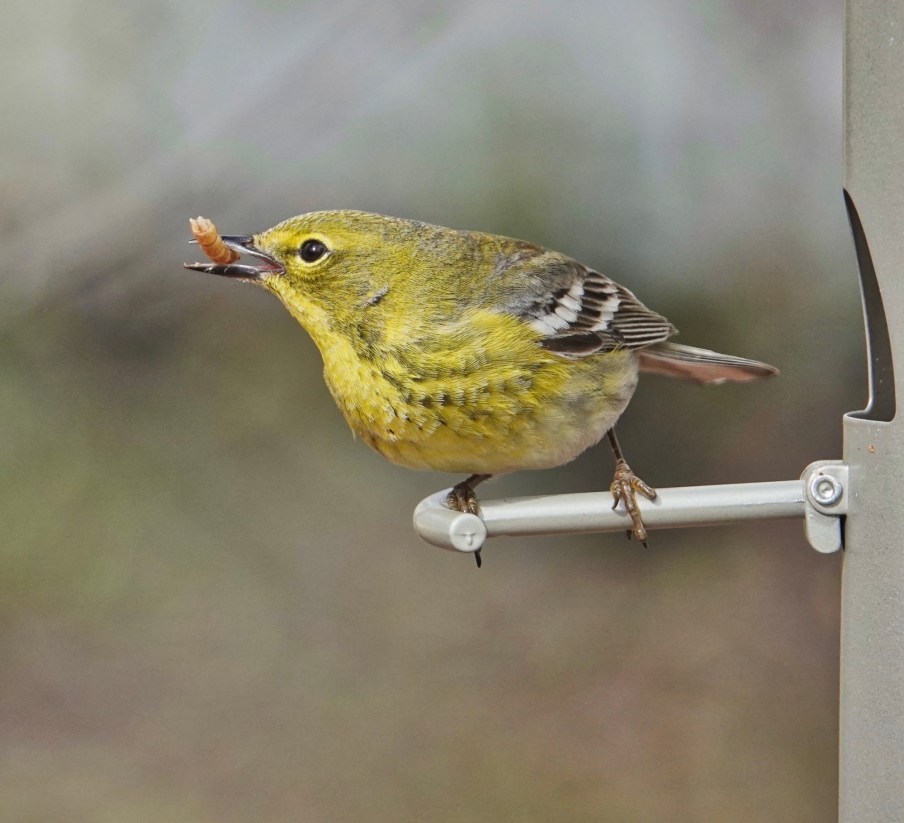
Pine Warbler, Kennebunk Maine, USA — Pine Warblers have a reputation, among the wood warblers of North America, of being one of the few who will come to feeders…specifically to suet. The Pines we are hosting this spring also seem to be quite fond of dried mealworms. They pick at the broken bits in the feeder, but they will take a whole mealworm away to work on it in private, as this one is in the process of doing. Taken from my backyard photo blind feeder station. Sony Rx10iv at 600mm equivalent (cropped to 1680mm equivalent). Program mode with my custom birds and wildlife modifications. Processed in Polarr and Apple Photos.
Male and female bluebirds


Eastern Bluebird, Kennebunk, Maine, USA. — My backyard photo blind provides a great opportunity to observe and photograph the common birds of my neighborhood. Here are the male and female of one of the pairs of Eastern Bluebirds that frequent the mealworm feeders in our yard. The two photos were taken moments apart at the same feeding station, so the light is uniform, and you can really see and appreciate the plumage differences. Sony Rx10iv at 600mm equivalent. (880mm cropped). Program mode with my custom birds and wildlife modifications. Processed in Polarr and Apple Photos.
Singing Pine Warbler
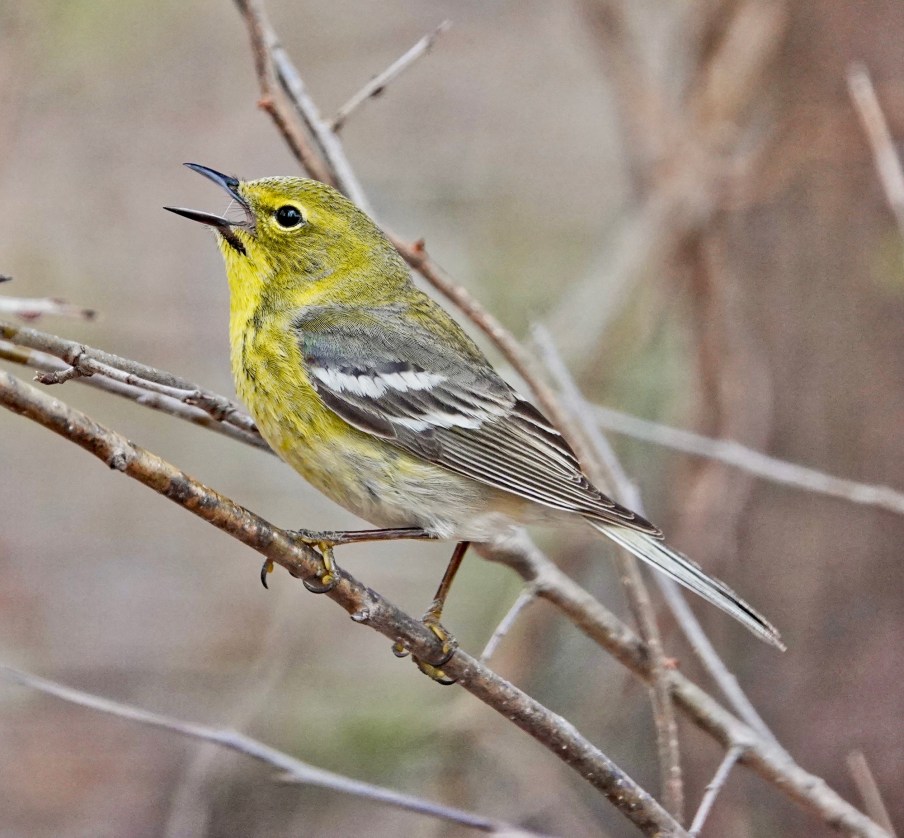
Pine Warbler, Kennebunk, Maine, USA. Only a few days ago I was surprised to see a Pine Warbler in our yard at all…a first-ever-event…now we have them coming to our deck, right outside the windows, and singing by the blind. How great is that! Sony Rx10iv at 600mm equivalent (cropped to yield something like a 1700mm field of view). Program mode with my custom birds and wildlife modifications, Processed in Polarr and Apple Photos.
Bluebird at the bath


Eastern Bluebird, Kennebunk, Maine, USA. The hanging bird bath (Audubon brand from Amazon) has been a big hit so far at my feeding station by my photo blind. I have yet to see a bird bathing in it, but they drink from it every day. This male Eastern Bluebird was heavy enough to make the hanging bath rotate slowly as the bird hopped around, but it is remarkably stable. Sony Rx10iv at 600mm equivalent. Program mode with my custom birds and wildlife modifications. Processed in Polarr And Apple Photos. Check out the blue on this remarkably blue male. In close up photos like these you can see the texture of the blue. To the naked eye it is just eye-poppingly blue!
Chipping Sparrow


We have several Chipping Sparrows coming to the new feeders near the photo blind. They come up on the deck too, much more this year than in year’s past. I am sure, that is, at least in part, because until this spring I fed only Black-oil Sunflower seeds…this spring, mainly due to the difficulty in obtaining bird seed with a “stay at home” order in place…I am feeding a mix. The sparrows and the finches seem to greatly prefer the mix. I have lots of natural perches around the feeders by the blind, which makes for some nice shots as the birds come and go. Sony Rx10iv at 600mm equivalent. Program mode with my custom birds and wildlife modifications. Processed in Polarr and Apple Photos.
Nuthatch with the prize
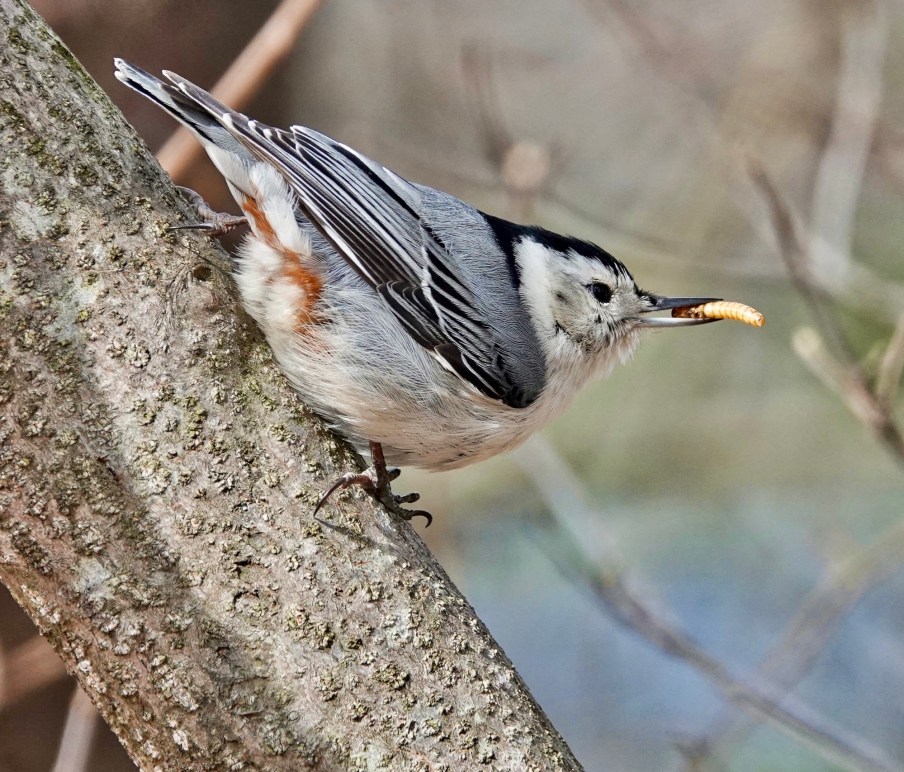
White-breasted Nuthatch, Kennebunk, Maine, USA.
We put the mealworms out, of course, for the bluebirds. We have had bluebirds frequenting our yard for the past 4 years. But (also of course) the other birds, Titmice, Chickadees, and Nuthatches also eat the mealworms. A mealworm is quite a mouthful for the smaller White-breasted Nuthatch. The Titmice and Chickadees only take the broken bits. A bluebird can swallow a mealworm whole. 🙂 This White-breasted Nuthatch took his prize up to a nearby branch to figure out how to deal with it. Sony Rx10iv at 600mm equivalent. Program mode with my custom birds and wildlife modifications. Processed in Polarr and Apple Photos.
Song Sparrow
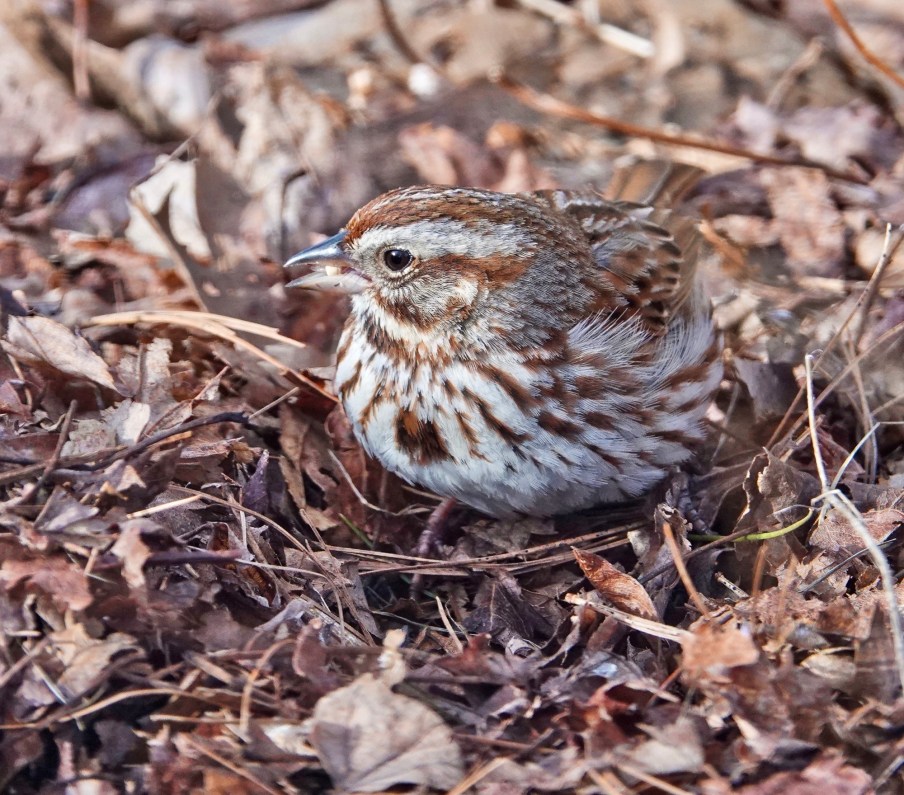
Song Sparrow, Kennebunk, Maine, USA While Song Sparrows are common in the fields and even along the beach access road a few miles from home, we have seen very few in our yard…until this year, with the addition of the feeding station under the trees by my new photo blind. Now we have them daily, harvesting the spilled seed under the feeders. There is at least a pair, since I have seen them together. This one was about 8 feet from my blind where I had intentionally spilled some seed while filling the feeders. Sony Rx10iv at 600mm equivalent. Program mode with my custom birds and wildlife modifications. Processed in Polarr and Apple Photos.
Criminal intent…


The Grey Squirrels use my bird feeder setup near my photo blind as a jungle gym. All my feeders are, at least to the extent possible given modern technology, squirrel proof, and they have not yet solved the problems presented, so my seed is, for the moment, safe…but that does not stop them from trying. This squirrel is already, by the look of it, getting plenty to eat, so it can just leave my seed for the birds, thank you very much. Sony Rx10iv at 600mm equivalent. Program mode with my custom birds and wildlife modifications. Processed in Polarr and Apple Photos.