Posts in Category: animals
Geoffroy’s Tamarin


Geoffroy’s Tamarin: Canopy Tower, Panama, July 2022 — Tamarins are among the smallest of primates, and the Geoffroy’s is small for a Tamarin (1.1 pounds). It is also the only Tamarin in Panama. There are at least three families of Tamarin’s who live on Semaphore Hill and visit the Canopy Tower several times a day. The kitchen and dinning staff enjoy putting out bananas for them, sending the bananas out on a kind of pulley string to a branch at eye-level, or swinging a banana out on a string to drape over an even closer branch. If there are no bananas out, a single Tamarin may come and wait for one, but as soon as the banana appears the whole family comes running through the canopy to join in. At first glance the Tamarins are more cat-like than monkey-like, but they have long prehensile tails and definitely use their “hands” as we do, for grasping and grooming, and generally holding on to things. They are always calling to each other, and their habit of pulling their lips back to show their row of tiny, very sharp teeth, give them a somewhat fierce appearance. They are great fun to watch as they clamber over the trees, and each other. One of the families had a two “toddlers” and they are, if possible, even cuter than the the adults. Sony Rx10iv at various focal lengths for framing. Program mode with my custom birds and wildlife modifications. Processed in Pixelmator Photo and Apple Photos.
Greatest Sloth encounter ever!

Three-toed Sloth: Canopy Tower, Panama, July 2022 — This Three-toed Sloth climbed up into a tree right by the tower the first day I was here, and has been in the same tree until yesterday, when it disappeared. Late in afternoon yesterday while playing my flute on the tower, it emerged from behind a big bunch of leaves where it had been hidden in the next tree over, and I watched it sipping water from various leaves and flower clusters as it moved down one limb and up another over the course of 15 minutes. I even got video! The light was great, the sloth was as active as I have ever seen one, and I was at eye-level. Could not get any better! Sony Rx10iv at 526mm equivalent. Program mode with my custom birds and wildlife modifications. Processed in Pixelmator Photo and Apple Photos. ISO 500 @ f4 @ 1/500th.
Stoat!

Stoat: Kennebunk, Maine, USA, June 2022 — Sad story warning! I am pretty sure this is a Stoat, or Short-Tailed Weasel, often called an Ermine in the winter when its coat, with the exception of the black tip of the tail, turns bright white. The only other possibility is the Long-tailed Weasel, which we also have in Maine. I think the white feet, just visible at the front, and the length of the tail make this a Stoat. I will admit, until yesterday I did not know we had Stoats in Maine. This one, as you can see, was sitting exactly in the middle of the road, just a few houses down from us, when I was leaving on my eTirke for a grocery run. I quickly circled back and around to see what it was. I was thinking weasel, or mink, or maybe a young fisher. I was sure it would be gone from the road by the time I got my camera out, but it stayed there, alert but apparently in no hurry to get off the yellow line. It even sat there, unmoving, as a truck and several cars came by, missing it by inches. When I showed my photo to Google Lens, the intelligence in the cloud suggested Stoat, so of course, I had to do more research, and discovered that they are quite common in Maine, even here along the coast. My only other Stoat encounter was in the pages of Kenneth Grahame’s “Wind in the Willows”, where, if you remember, the Stoats and Weasels are cast as the bad guys. As you might imagine, this real-life story did not end well for the Stoat in the middle of the road. Eventually a driver jigged when he or she probably intended to jag, the Stoat panicked and moved off the yellow line, and went under the wheel. With a good deal of sadness (and not a little guilt about what I might have done differently to save the Stoat), I moved it off the road, but it was too late. Later, after discovering it had been a Stoat, in memory of the Stoats of Wild Wood in “The Wind in the Willows”, I took a shovel out and buried it in our own wild wood across the street. While I am sure Stoats are ruthless hunters, and I would not want one in my hen run (if I had a hen run), they are beautiful little creatures, and this one certainly deserved better. And let this be a lesson to all Stoats. Cars do, on occasion, cross the yellow line!
White-face Capuchin


White-faced Capuchin Monkey: Neily, Costa Rica — After two nights at Danta Corcovado Lodge on the Osa Peninsula, we loaded the bus and headed for San Vito and the Wilson Botanical Gardens on the Las Cruces Biologial Research Station of the Organization for Tropical Studies. Along the way we stopped at long bridge in Neily. These shots of the White-faced Capuchin monkeys were taken from mid-bridge. The second shot was very difficult lighting…with the monkey back in the deep shade against the trunk of the tree, in a little hollow in the foliage, surrounded by really bright sun, barely visible to the naked eye. I added 1.7EV exposure compensation to penetrate the shadows, but that totally burned out the fonds in the sun. I did my best to adjust it in post processing, and it is an okay shot to record the memory…but not something I an inordinately proud of 🙂 The Capuchins were are our 4th primate for the trip. Sony Rx10iv at 600 and 517mm equivalent. Program mode with my custom birds and wildlife modifications. Processed in Pixelmator Photo and Apple Photos. The first shot is ISO 320 @ f4 @ 1/500th, the second is at ISO 800 @ f4 @ 1/500th with, as I mentioned, + 1.7EV.
Red-eyed Leaf Frog

Red-eyed Leaf Frog: Danta Corcovado Lodge, Osa Peninsula, Costa Rica — I posted a comparison post a while back now, featuring the different varieties of the Red-eyed Leaf Frog found we found at Selva Verde Lodge in the Sarapique River Valley in the Caribbean lowlands, and the Red-eyed Leaf Frogs we found at Danta Corcovado Lodge on the Osa Peninsula in the Pacific lowlands. There are 5 species of Leaf Frog found in Costa Rica, but there are apparently at least 5 distinct color variations of the Red-eyed Leaf Frog. The one you see almost exclusively in photos, with orange feet and bright blue flank bars, is the variety we found on the Caribbean slope. This one on the Osa Peninsula, with greeny-grey feet and almost black and white flank bars, is “variety A” (according to my field guide). I find it interesting that I could only find a single reference to the color variations in the Red-eyed Leaf Frog in a google search, and that was in a scientific paper on variations in defense peptides in the skins of the species. All of the more accessible internet sources, from Wikipedia to National Geographic, picture and describe only the orange-footed variety. I can be forgiven then, for thinking, for a moment there, that this might be a separate species. 🙂 Sony Rx10iv at 600mm equivalent. Program mode with wildlife modifications and multi-frame noise reduction. Taken by the light of a flashlight. Processed in Pixelmator Photo and Apple Photos. Equivalent ISO 5000 @ f4 @ 1/500th.
Fitzinger’s Rain Frog (Robber Frog?)

I think this is a Fitzinger’s Rain Frog, aka Fitzinger’s Robber Frog. Danta Corcovado Lodge, Osa Peninsula, Costa Rica — Rain Frogs, often also called Robber Frogs, are common all over Costa Rica. Pinning down the exact species is best left to those who really know their amphibians…which is not me. This was the first critter we encountered on our “night walk” our second night at Danta Corcovado Lodge on the Osa Peninsula. Taken by the light of a flashlight, using multi-frame noise reduction on the Sony Rx10iv at 600mm equivalent. Program mode with wildlife modifications and multi-frame noise reduction. Processed in Pixelmator Photo and Apple Photos. Equivalent ISO 4000 @ f4 @ 1/500th.
Osa Howlers


Howler Monkeys: Rio Rincon near Danta Corcovado Lodge, Osa Peninsula, Costa Rica — The Osa Peninsula is home to all 4 of Costa Rica’s primate species. We encountered a troop of Howler Monkeys along the bed of the Rincon well into Corcovodo National Park, near the Ranger Station. The Howler is the second largest monkey in Costa Rica, but as mentioned before, it always manages to look bigger than the larger Spider Monkey, perhaps due to its relatively massive proportions…all body and tail, and not so much legs and arms. Sony Rx10iv at 600mm equivalent. Program mode with my custom birds and wildlife modifications. Processed in Pixelmator Photo and Apple Photos. ISO 500 and 250 @ f4 @ 1/500th.
Spider Monkey!
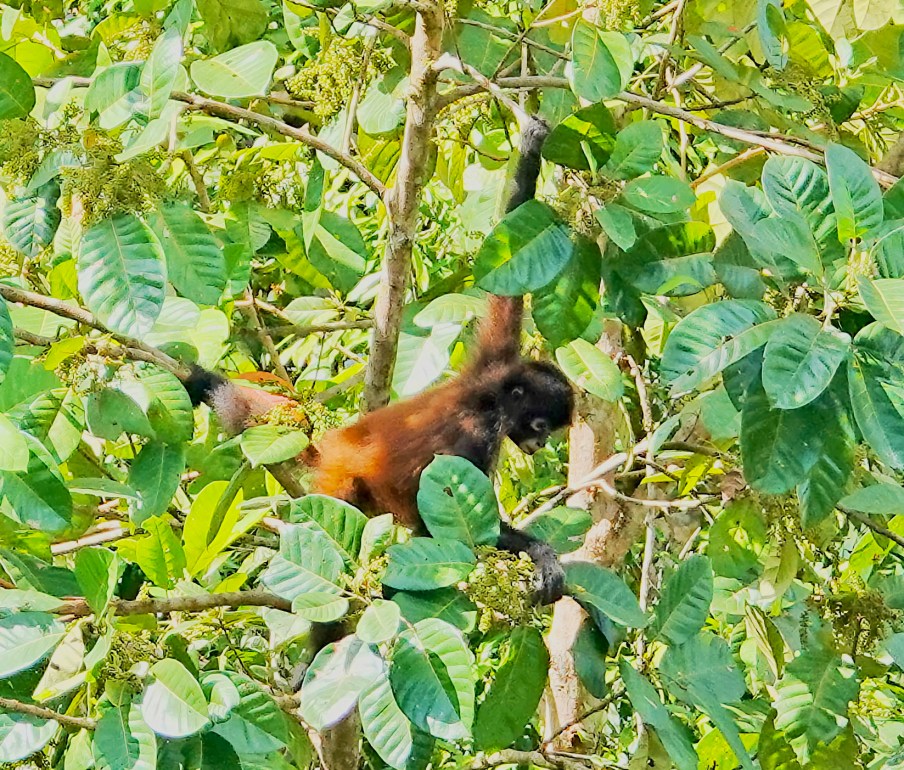

Spider Monkey: Rio Rincon near Danta Corcovado Lodge, Corcovado National Park, Osa Peninsula, Costa Rica — I had never seen the Spider Monkey in Costa Rica…and on my one trip to the Amazon, I was sick aboard the river boat when they were seen in Peru…so I was delighted when we spotted a few in a very tall tree beside the Rincon as we drove our tractor and wagon up the riverbed on our way deep into Corcovado National Park. The Spider Monkey, despite it’s somewhat delicate look when compared to the more common Howler Monkey, is actually the largest of the primates in Costa Rica. Though we never got a really unobstructed view of the Spider, you can see the length of the arms and at least glimpse the length of the tail. This is an animal made for moving rapidly through the canopy. Sony Rx10iv at 600mm equivalent. Program mode with my custom birds and wildlife modifications. Processed in Pixelmator Photo and Apple Photos. ISO 125 @ f4 @ 1/500th.
Squirrel Monkeys


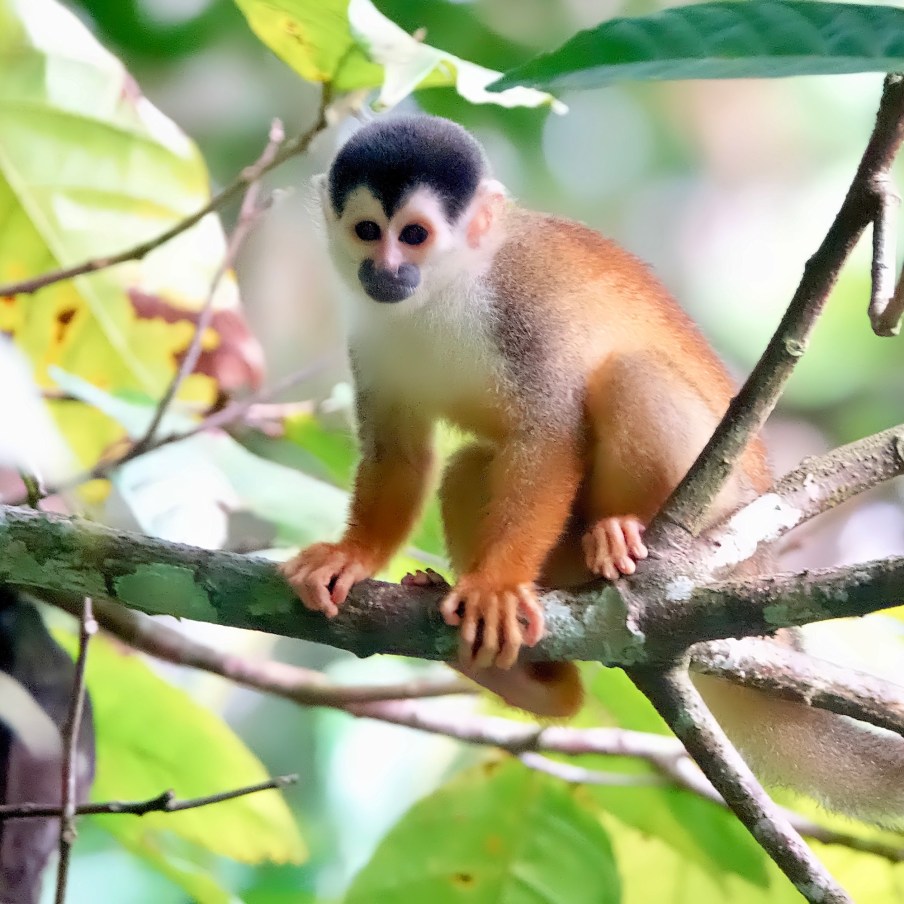
Squirrel Monkeys: Danta Corcovado Lodge, Puerto Jimenez, Costa Rica (Osa Peninsula) — Very active monkeys in very bad light. 🙂 This troop of Squirrel Monkeys comes to hand out in the prickly palms over the main lodge buildings at Danta Corcovado each evening…bordering on full dark. These conditions push any camera to its limits. This was our first night at the lodge, and we were on our way back from sunset on the observation tour on the hill behind the lodge. Sony Rx10iv at 458, 124, and 493mm equivalents. Program mode with wildlife modifications and multi-frame noise reduction. Processed in Pixelmator Photo and Apple Photos.
Howlers of the Sarapique


Howler Monkeys: Sarapique River at Puerto Viejo, Costa Rica — the Howler Monkey is by far the most abundant primate in the lowland rain forests of Costa Rica, at least on the Caribbean slope. The resident troop woke us up most mornings at 4am as the males greeted the day and proclaimed their dominance. We saw this troop from the safari boat on the Sarapique River, upstream from the docks at Puerto Viejo. The big male is pretty obvious. The female with the baby was good to see, and the young male was very active. There were several more in the troop, but they stayed deeper in and out of sight. Sony Rx10iv at 509mm equivalent (trying to get the tails in :). Program mode with my custom birds and wildlife modifications. Processed in Pixelmator Photo and Apple Photos. Mostly ISO 800, one at ISO 1000 and one at 640. f4 @ 1/500th.