Posts in Category: Africa
Red Elephants of Tsavo East


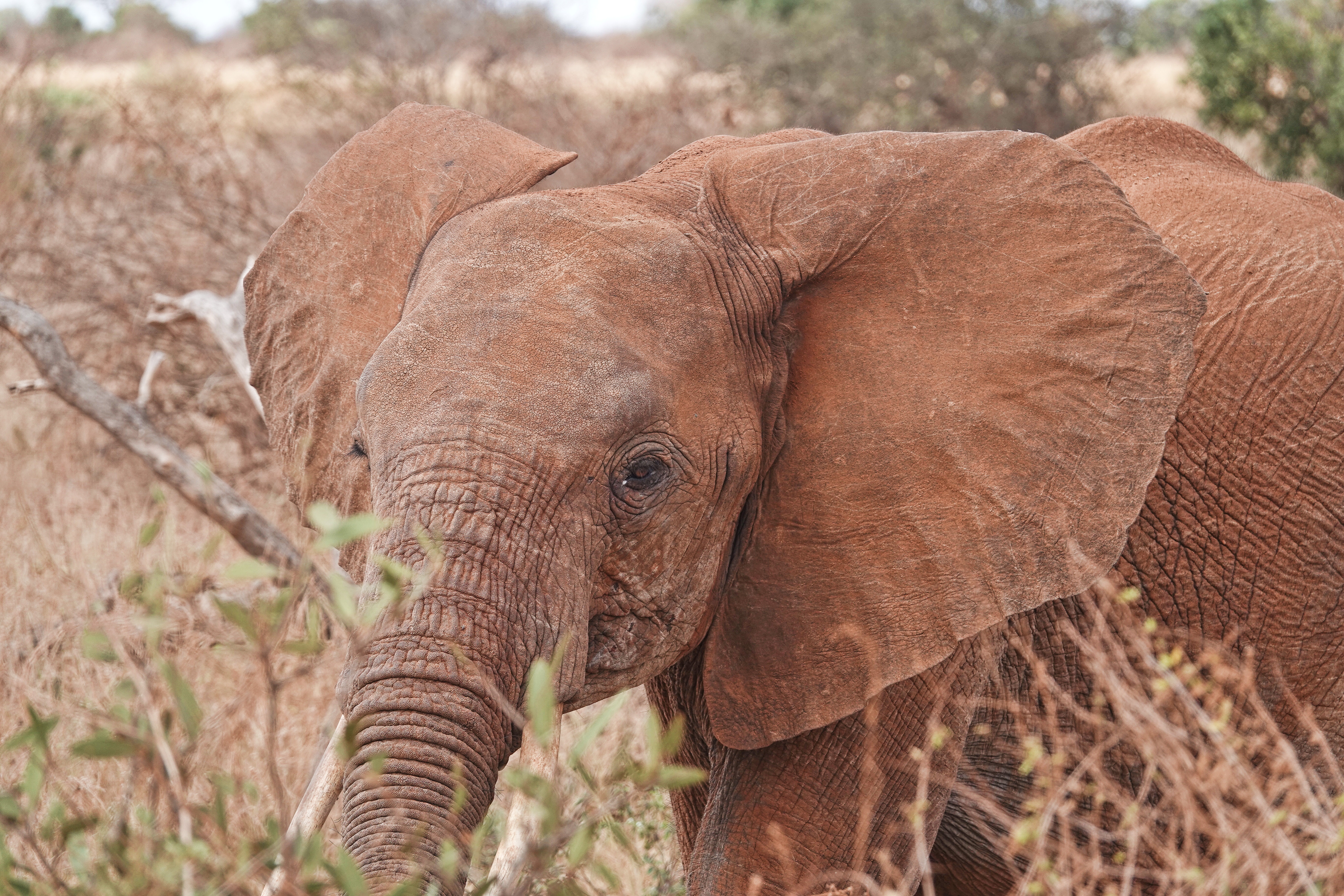

Tsavo East National Park in Kenya is famous for its “red elephants” and big tuskers. The elephants are not red of course, but the soil is full of red clay, and when the elephants are freshly “dusted”, and in the right light, they certainly look red. Elephants dust or mud themselves to protect their skin from the sun and insects. All elephants do it. It is just that the soil of Tsavo East turns them red when they do. The big tusks of Tsavo East are more of a mystery. Elephants with big tusks are increasingly rare in other areas of Kenya and Tanzania, but many remain at Tsavo East. No one knows exactly why. Sony RX10iv at 90mm, 350mm and 600mm. Program mode. Processed in Polarr. Note the corrugated tongue on the close-up. 🙂
Hippopotamuses in the water


I will admit to being somewhat startled when a pod of Hippopotamuses surfaced beside our small boat on Lake Naivasha. The boatman obviously expected it, and had brought us into this particular little cove for just that purpose…but still…he might have warned us. Hippopotamuses are big. Swamp-a-boat-easily big. And they just appear there, right beside you. So fast I could barely get the camera around to capture a few shots before they submerged again. The boatman stopped the boat, and we watched them for a few moments, enjoying themselves. Hippos spend the day submerged, coming up to breathe, or in mud flats where they can cover their sensitive skin with a layer of mud as sun-screen. They come out to browse the short grasses along the lake-shore at night. We stayed at Elsamere on Lake Naivasha, and one of its selling points (along with most of the other lodges on the shore) is that Hippos come out on the lawn at night. If you go to Africa, someone is sure to tell you that Hippopotamuses kill more people per year than any of the big five…than all of the big five added together…and it is true. It is easy to underestimate these huge, placid animals and get too close, or between them and their retreat to the water. They don’t tolerate that. So, I guess if you have to get close, in a boat is the way to do it. Sony RX10iv at 600mm equivalent. Program mode. Processed in Polarr.
Cape Buffalo among the Flamingos

Lake Nakuru National Reserve is one of the “fenced” reserves of the Rift Valley. The animals are not free to come and go…which is not the norm in Kenya. In fact the unfenced reserves and parks are, in my opinion, one of the main differences between the experience of Kenya and, say, South Africa, where the larger Kruger complex…though huge…is totally fenced. Nakuru is fenced to protect surviving small numbers of both endangered Black and White Rhinoceros…from wandering and from poachers…and a thriving herd of the comparatively rare Rothschild’s Giraffes, which were introduced to the park for their own protection. When lake levels are right, the lake also attracts large numbers of Lesser Flamingos, which, as here, feed in the shallows. The Cape Buffalo are on a little spit of more solid land that runs out into the lake. Our guide lamented the fact that the lake is being polluted with runoff from Nakuru Town, on its northern edge, which he feels is reducing the numbers of Flamingos, and pushing them to the far south edge of the lake. Sony RX10iv at 600mm equivalent. Program mode. Processed in Polarr.
Masai Giraffe: October 1


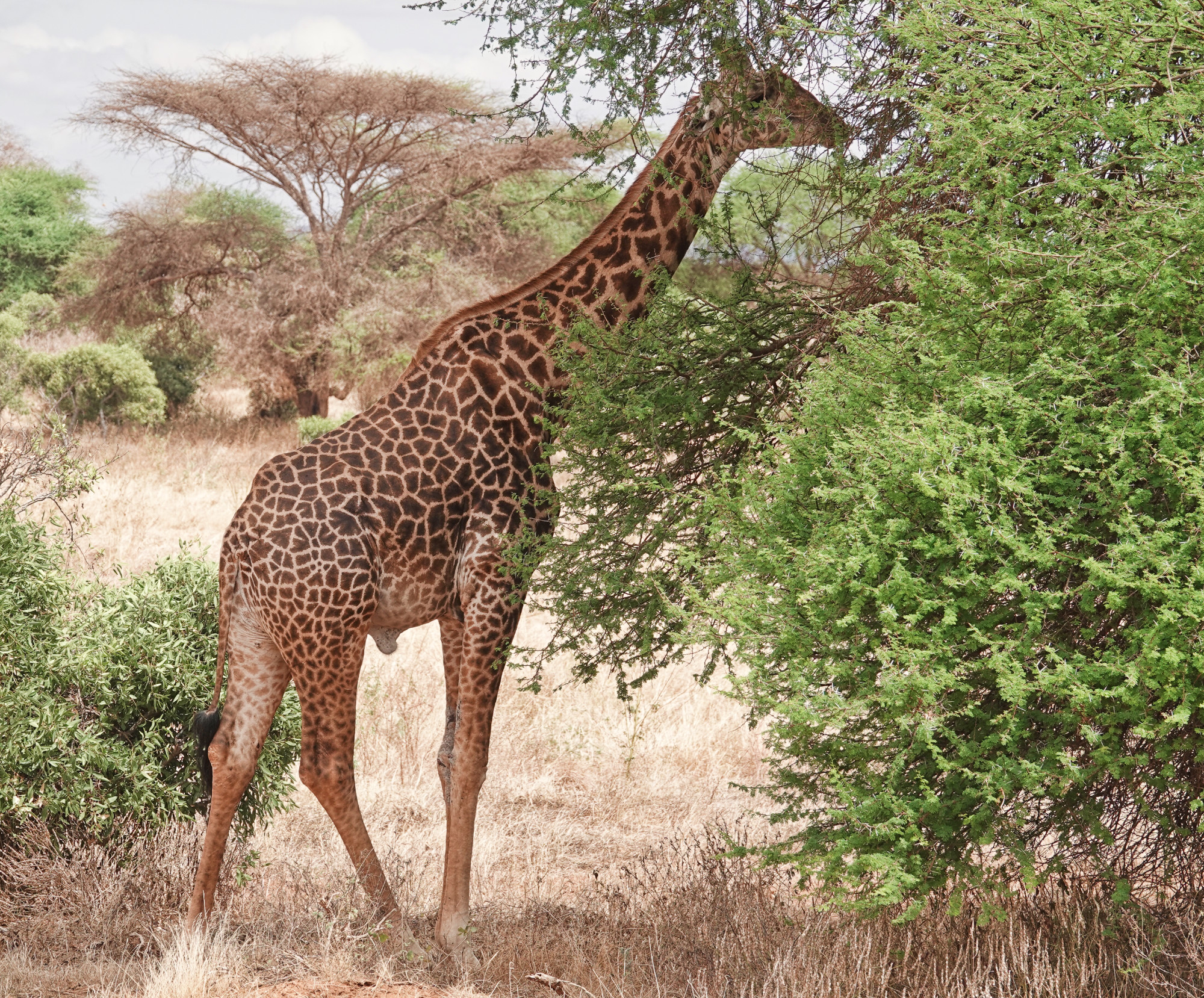
Masai Giraffe
For the first several days of our safari, through Tsavo East and West, and Amboseli, the one animal we did not have close encounters with was the Giraffe. This is as close as we got: a Masai Giraffe (the most common in East Africa), at Tsavo East. (Some spell it “Maasai Giraffe” though I have not seen Masai spelled that way except in the name of this Giraffe.) You can tell it is a Masai by the irregular shapes of the patches. It is a male, and even if you could not see the obvious, the horns have no feathering. We did get closer (much closer) to Masai Giraffes on Crescent Island on Lake Naivasha, but, though living wild now, they were introduced there for the filming of “Out of Africa.” And we saw Rothschild’s Giraffes, also introduced, at Lake Nakuru, where the rarest of the African Giraffes maintains a healthy herd. Most authorities still consider the three varieties of Giraffes in Africa as sub-species or even “varieties” of the same species, through some have proposed full species status for each of them. They do freely hybridize where their ranges overlap. As to the interesting question of why the Giraffe has such a long neck…most, including Darwin, theorized that it developed due to a competitive advantage in reaching the highest foliage. That makes sense. However more recent thinking is that the longer necks and heavier heads of the biggest males provide a much more direct advantage to males who have them…in that “necking” (see a previous post of two Giraffes at Hell’s Gate doing that) is their only form of combat…and more successful males get more opportunities to mate. Of course, it could just be that the creator needed a big tall browser to keep the acacia trimmed to those classic African umbrella shapes across the African savannas…as this fellow is busy doing. Sony RX10iv at 200 and 600mm equivalents. Program mode. Processed in Polarr.
Full

Young lions, Tshakudu Game Reserve, South Africa
Two of the young lions from the pride at Tshakudu Game Reserve, recovering from what seeded like it might have been a hard fought kill of a young giraffe. All the lions were somewhat worse for wear and the adult female was limping badly. You might be able to see how gorged these lions are.
Sony RX10iii in Amti-Motion Blur Mode. Processed in Lightroom.
Tusker

Bull Elephant, Kruger National Park, South Africa
This good sized male Elephant at Kruger National Park looped his trunk up over his tusk while on the march. I am not sure if this a common behavior…I only saw it this once…but it seems like it might take some of the strain off the prehensile muscles while on the move.
Sony RX10iii at 165mm equivalent field of view. 1/500th @ ISO 100 @ f4. Processed in Lightroom.
Hippo grazing

Hippopotamus, Kruger National Park, South Africa
I somewhat maligned the Hippopotamus yesterday when I included it among Africa’s Big Five…the five animals that have no fear of a man on foot, and therefore are considered “dangerous game”. The fifth member of that group is actually the Cape Buffalo. However, as was pointed out to us several times during our stay, the Hippo kills more people in South Africa every year than any of the actual members of the Big Five. They are not aggressive at all, but you do not want to be caught between a Hippo and the water when Hippos are on the move, or between a Hippo mother and her calf at any time.
This image represents a somewhat rare sighting. Hippos have very sensitive skin, and can not stand long exposure to the direct sun, which is why they spend the day submerged in water, and only graze at night. Conditions in Kruger are so bad that this Hippo was out in full daylight, looking for food. Sadly the remaining grasses of Kruger after their long drought can not support the numbers of Hippos in the park. Dead Hippos are becoming a common sight in Kruger as they are dying of starvation at up 30 per week. The day I left South Africa they made the heartbreaking decision to cull 300 Hippos in Kruger and distribute the meat to surrounding villages. This image brings mixed feelings, to say the least.
Sony RX10iii at 485mm equivalent field of view. 1/250th @ ISO 250 @ f4. Processed in Lightroom.
Dwarf Mongoose

Dwarf Mongoose, Tshukudu Game Reserve, South Africa
We visited Tshukudu Game Lodge on the Tshakudu Game Reserve for a sundowner game drive…an afternoon/early evening excursion into the bush of Tshukudu. Tshukudu has the big five…the five African animals what do not fear a man on foot…Elephant, Rhino, Hippo, Lion, and Leopard…but the animals I liked best were the Dwarf Mongoose, seen here doing what Mongooses do in a pile of Elephant dung. Like all Mongooses, the Dwarf is a very social animal, and their interaction with each other, and with the world, is very interesting to watch. As you see, this is a late light shot, maybe a half hour before sunset, and I like the way the oblique sun lights the Mongooses (Mongeese?…no I don’t think so) and the dung.
Sony RX10iii at 600mm equivalent field of view. 1/250th @ ISO 200 @ f4. Processed and cropped slightly for composition in Lightroom.
Elephants in the bath

Elephants, Kruger National Park, South Africa
As I have mentioned before, Kruger National Park is suffering the worst drought in a generation right now. It is easy to find Elephants. They are clustered around any water source. This dam is one of the few that still has standing water, and the Elephants come to drink and bath. Elephants love mud. They coat their hides with it daily, I assume as some protection from the sun. It is fascinating to watch these huge creatures apparently at play in the water.
Sony RX10iii at 600mm equivalent field of view. 1/640th @ ISO 100 @ f4. Processed and cropped slightly in Lightroom.
Greeting the sun…

Vervet Monkey, Tremisana Lodge, Balule Game Reserve, South Africa
Early every morning, just after sunrise, the Vervet Monkeys around Tremisana Lodge in Balule Game Reserve in South Afirca would climb high into the trees to bask in the first warmth of the day, well before the sun made it way down to ground level. If I was out before breakfast I was sure to see them, posted like lookouts on the new day. This fellow was distracted by my attention. Unlike most animals, Vervet monkeys are clearly not disturbed by direct eye contact with humans. 🙂
Sony RX10iii at 600mm equivalent field of view. 1/500th @ ISO 100 @ f4. Processed in Lightroom.