Posts in Category: wildlife
Maine spring edition: Immature Red-tailed Hawk??

Immature Red-tailed Hawk (I think): Arundel, Maine, USA, April 2022 — I think! This is one of those birds, or one of those birding situations, where I can not be 100% confident of my naming. I saw it fly over the road while out on my eTrike. My first impression was just a raptor with big wide wings…and then when I got off to the side of the road and got my camera out…all it would give me is this back view…and the angle of the shot, and the way the bird was perched, makes it hard to judge the body proportions and especially the length of the tail. For what it is worth, the several photo based AI birding assistants I have access to give Red-tailed Hawk about a 70% chance of being right. And Red-tailed Hawk is certainly the most likely as we have more of them than any other hawk…which is probably why I wanted it to be something else…something more exciting. Still, any perched hawk is a good bird. 🙂 And I did do my due-diligence…checked every field guide I own…and studied several of the photos I took. I have blurry shot of the underside of one wing which mostly supports Red-tailed, but that is as good as I can say. Anyone who know better, feel free to correct me. Always willing to be corrected. Sony Rx10iv at 600mm equivalent. Program mode with my custom birds and wildlife modifications. Processed and enlarged in Pixelmator Photo and Apple Photos. ISO 160 @ f4 @ 1/500th.
Buff-throated Saltator

Buff-throated Saltator: Las Cruces Biological Research Station (OTS), San Vito, Costa Rica, December 2021 — The Buff-throated Saltator is one of the most common birds around feeding stations in Costa Rica, on both the Caribbean and Pacific slopes…from the lowlands well up into the foothills…so not so exciting to see it at Las Cruces, but still a good bird 🙂 Sony Rx10iv at 591mm equivalent. Program mode with wildlife modifications and multi-frame noise reduction. Processed in Pixelmator Photo and Apple Photos. Equivalent ISO 2500 @ f4 @ 1/500th.
Maine spring edition: Downy Woodpecker

Downy Woodpecker: Kennebunk, Maine, USA, April 2022 — Of course we have had Downy Woodpeckers all winter, coming to the suet and sunflower seeds on the deck…but there is nothing like a shot that was not taken through thermal-pane double glazing 🙂 From my back-yard photo blind in late afternoon light, with the sun just about on the horizon behind me. Sony Rx10iv at 580mm equivalent. Program mode with my custom birds and wildlife modifications. Processed in Pixelmator Photo and Apple Photos. ISO 100 @ f4 @ 1/640th.
Fiery-billed Aracari: my best side?


Fiery-billed Aracari: Las Cruces Biological Research Station (OTS), San Vito, Costa Rica — Another visit from the Fiery-billed Aracaris. This bird seemed to want to show us every side. Aracaris are active birds…never still…always hopping around on the branch. And they are very focused…intent on food mostly…but also very aware of the other birds of the flock. Sony Rx10iv at 595mm equivalent. Program mode with wildlife modifications and multi-frame noise reduction. Processed in Pixomator Photo and Apple Photos. Equivalent ISO 2000 @ f4 @ 1/500th.
Female Scarlet-rumped Tanager (with bonus bird)

Scarlet-rumped Tanager (female) and Golden-hooded Tanager, Las Cruces Biological Research Station, San Vito, Costa Rica, December 2021 — I mentioned that the Passerini’s and Cherrie’s Tanagers were considered separate species, each with an isolated range on either cost of Costa Rica (no overlaps)…at least for a while. They were once considered the same species, named Scarlet-rumped Tanager…and then the AOU (the bird naming committee) decided they were different, based on range, and on the obvious differences in the plumage of the females (the males are identical), but recently ornithologist have come up with a new method to study species, called the “playback method”. They play recorded songs and calls of an apparently closely related species, to determine if the birds under study respond as they do to their own calls and songs. In the case of Passerini’s and Cherrie’s Tanagers, both respond equally as well to the other’s songs and calls…making it very likely that they are the same species, or at least that they would interbreed if their ranges overlapped. This inspired genetic studies to follow up…and indeed they appear to be the same species, just separated by a mountain range. The Golden-hooded Tanager just had to get into the photo. Sony Rx10iv at 591mm equivalent. Program mode with wildlife modifications and multi-frame noise reduction. Processed in Pixelmator Photo and Apple Photos. Equivalent ISO 2500 @ f4 @ 1/500th.
Maine spring edition: Red-winged Blackbird (female)
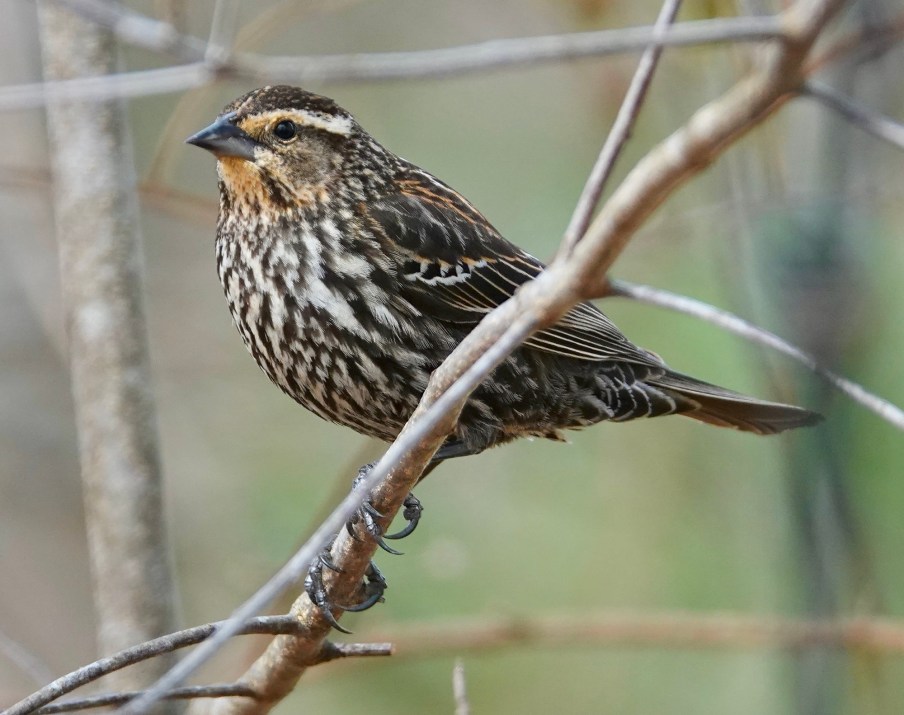
Red-winged Blackbird (female): Kennebunk, Maine, USA, April 2022 — This is clearly a Red-winged Blackbird, and I am pretty sure it is a female, and not a first-year male, because I see no patch at all on the shoulder. The eyebrow is a bit bold for a female, but still. What really surprised me is the feet…take a close look at those feet. I have added a heavy crop from another photo to show the detail. Now there is foot made for wrapping around cat-tail reeds. 🙂 Sony Rx10iv at 600mm equivalent. Program mode with my custom birds and wildlife modifications. Processed in Pixelmator Photo and Apple Photos. ISO 500 @ f4 @ 1/500th.

Blue-headed Parrot


Blue-headed Parrot: Las Cruces Biological Research Station, San Vito, Costa Rica, December 2021 — It really is amazing how many different parrot species we saw at the Wilson Botanical Gardens at Las Cruces. What is more amazing, is the we were seeing so many good birds that no one really remarked on the number of parrots 🙂 This is the Blue-headed Parrot…for obvious reasons…terrible lighting, and way too far away, but still great to see. These took special effort in post-processing 🙂 Sony Rx10iv at 600mm equivalent. Program mode with my custom birds and wildlife modifications. Processed in Pixelmator Photo and Apple Photos. ISO 200 @ f4 @ 1/500th. +2EV exposure compensation for the strong backlight (and then a lot of pumping up and black-point adjustment, as well as deep cropping and enlargement, in post).
Maine Spring edition: Pine Warbler


Pine Warbler: Kennebunk, Maine, USA, April 2022 — last year we only had glimpses of the Pine Warbler as it passed through, stocking up before finding more suitable nesting habitat. The year before it was here for a week or more, visiting the feeders under the pine, and a few times on the deck. This year both a full adult (probably a male) and a first year bird (probably a female, but it could, of course, be the other way around…or they might both be males or females???) have been on the deck several times a day for the past few days. The bright bird visits the suet feeder and the first year bird sticks to the deck and rail under the feeder, picking up crumbs. Sony Rx10iv at 600mm equivalent. Program mode with my custom birds and wildlife modifications. Processed in Pixelmator Photo and Apple Photos. (Taken through the double pane thermal glass doors in the kitchen on a deeply overcast day.) ISO 1600 @ f4 @ 1/500th.
More action over papaya

Golden-crowned Euphonia (male and female), Scarlet-rumped Tanager: Las Cruces Biological Research Station (OTS), San Vito, Costa Rica, December 2021 — The male Golden-crowned Euphonia seems to think the papaya rind belongs to him and his mate, while the Scarlet-rumped Tanager begs to differ. I will probably share more on this in another post, but the Scarlet-rumped Tanager was considered two species until recently, Passerini’s on the Caribbean slope and Cherrie’s on the Pacific. This would be a Cherrie’s. Sony Rx10iv at 591mm equivalent. Program mode with wildlife modifications and multi-frame noise reduction. Processed in Pixelmator Photo and Apple Photos. Equivalent ISO 3200 @ f4 @ 1/500th.
Maine Spring edition: White-throated Sparrow

White-throated Sparrow: Kennebunk, Maine, USA, April 2022 — I still have lots of Costa Rican birds and wildlife to share but spring in southern Maine is definitely happening right now…so this is a special edition of Pic for today. Yesterday at dawn the first White-throated Sparrow scouts arrived out under our backyard pines, and by late afternoon the leaf litter under the pines was host to at least two dozen White-throated Sparrows. I say at least, because I have no idea if this was a coherent flock or individual birds from a stream passing through. There is nothing more “perky” than a White-throated Sparrow in fresh spring plumage. Sony Rx10iv at 600mm equivalent. Program mode with my custom birds and wildlife modifications. Processed in Pixelmator Photo and Apple Photos. ISO 320 @ f4 @ 1/500th.