Posts in Category: birds
Rufous-tailed Jacamar
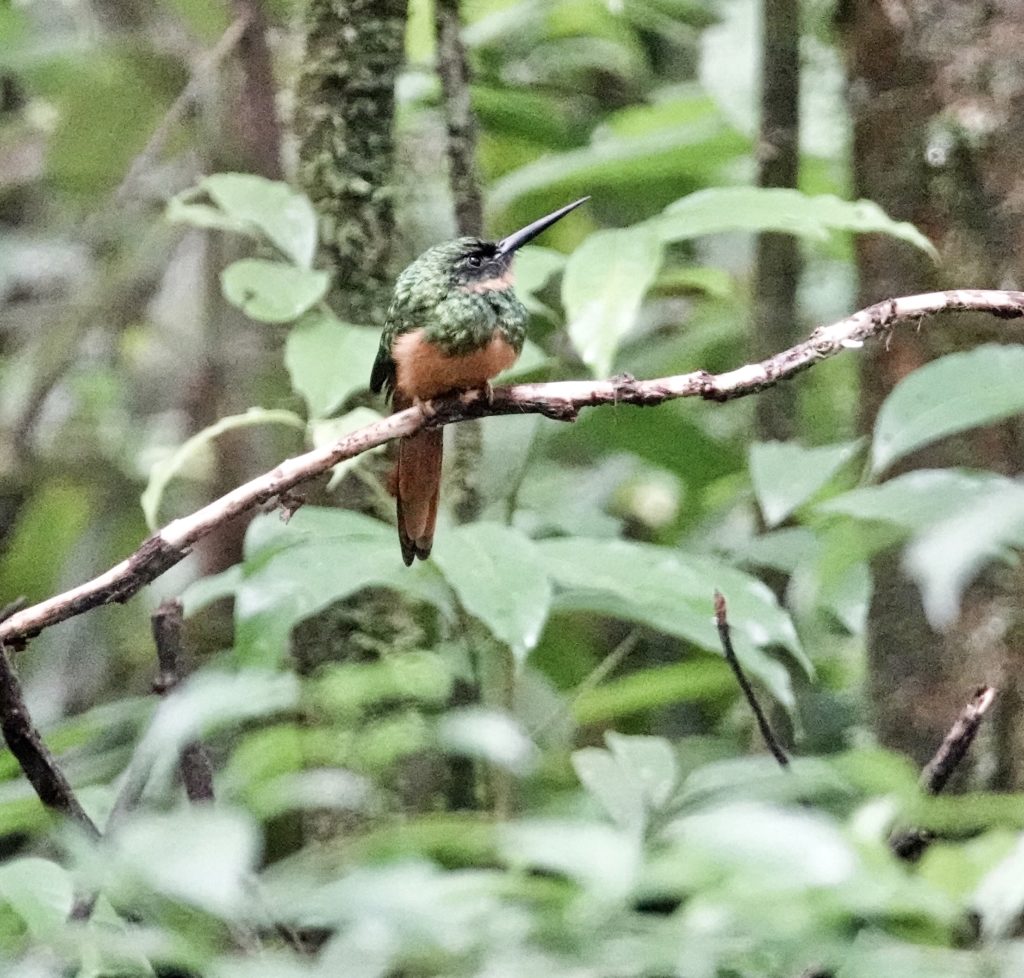


I can’t seem to get a break when it comes to Jacamars. I have seen the Rofous-tailed Jacamar in Honduras, Costa Rica, and Panama, but never in good light, and never as close as I would like. This bird was buried in the heavy undergrowth at La Selva Biological Research Station in the Sarapiqui region of Costa Rica, along one of the trails in the 2nd growth forest. It was dark enough in under there to require ISO 6400, though I did use Anti-motion Blur to improve image quality. The Jacamar is a strange bird. It looks, to some, like a giant hummingbird, but it is actually more closely related to Puffbirds. In fact Jacamars and Puffbirds from their own family. On the other hand, it behaves, and looks somewhat like, the European and African Bee Eaters…except that Jacamars specialize in moths and butterflies. Sony RX10iv at 600mm. Exposure as above. Processed in Polarr.
Flame-colored Tanager


Perhaps because the Flame-colored Tanager is one of the most common feeder birds in the highlands of Costa Rica, I came back with far too few photos of it. Ah, just another Flame-colored Tanager! It is however, one of the most beautiful birds of the mountains. The range of oranges…from almost red, to almost yellow…is amazing, and each bird seems unique in its shade of orange. And there is enough variation in the plumage of any individual bird to justify the “flame” name, as the color seems to flicker just as a flame does. These shots are at Savegre Mountain Resort in San Gerardo de Dota, Costa Rica, at about 7000 feet in the Talamanca Mountains. Sony RX10iv at 600mm equivalent. Birds and wildlife modifications of Program Mode. Processed in Polarr.
White-throated Mountain Gem

The White-throated Mountain Gem inhabits the higher elevations of Costa Rica, from about 6000 feet to timberline, mostly in the Talamanca Mountains south of the Central Valley and San Jose. We encountered this one at Batsu Garden on the mountain side above Savegre Mountain Resort in San Gerardo de Dota on the west slope of the mountains. It used to be called the Gray-tailed Mountain Gem. Sony RX10iv at 600mm equivalent. My custom birds and wildlife modifications of Program mode. Processed in Polarr and assembled in FrameMagic.
Oropendolas

As I have said before, Dave and Dave’s Costa Rican Nature Park is one of the best places for bird photography in the Sarapiqui region. Perched right on the edge of a high bluff above the river, at tree-top level for the trees growing below, they get a unique mix of canopy and understory feeding birds. Montezuma’s Oropendolas (on the right in the panel) are easy to see in the Caribbean lowland rainforests of Costa Rica. They come to the feeders at Selva Verda Lodge every day, but the Chestnut-headed Oropendola (on the left) is much more difficult. Here, at Dave and Dave’s we had them both at the same time, only a few feet apart. I could not quite fit them in the same frame, but it was close. The Oropendolas are giant orioles, and make giant oriole style nests that hang 2-3 feet below supporting branches. The Oro in their name comes from the yellow tail feathers (gold), and the pendola comes from the hanging nests. Both the Chestnut-headed and Montezuma’s are striking birds. Their burbling liquid calls are one of the most recognizable sounds of the rainforests. Sony RX10iv at 560mm equivalent. Anti-motion Blur Mode. Processed in Polarr and assembled in FrameMagic.
Stripe-throated Hermit

The Stripe-throated Hermit, like most Hermit Hummingbirds, rarely perches where anyone can see it…or get a photo of it. Even field-guide photos are mostly flight shots. And, unlike the other Hermits, it is small…one of the smaller hummingbirds of Central America, so it is not easy to catch in flight. This is my best shot from 16 days in Costa Rica, taken at Dave and Dave’s Costa Rican Nature Pavilion in La Virgen. Sony RX10iv at 600mm equivalent. My custom flight mode modifications of Program. 1/1000th. Processed in Polarr.
Yellow-throated Toucan

If you sit on the dinning hall deck above the feeders at Selva Verde Lodge on the Sarapiqui River in Costa Rica long enough on any given day, the Toucans will come. Yellow-throated Toucans. They were, until recently the Chestnut-mandibled, or maybe Black-mandibled Toucans, but the bird name gods have been at work, and somehow decided that Yellow-throated was better…despite the fact that the other big toucan in Central America, the Keel-billed Toucan, also has a bright yellow throat…as do several other South American species. Yellow-throated actually lumps both Chestnut and Black-mandibled into a single species with two races, divided north and south. These big, bright birds are emblematic of the tropics. Seeing them in flight it is hard to imagine how they manage to carry that bill out in front…but I am told that it is very thin and light. Sony RX10iv at 600mm equivalent. Anti-motion Blur mode (due the very dim light at the feeders). Processed in Polarr and assembled in FrameMagic.
Olive-backed Euphonia and Clay-colored Thrush

As we cruised down the Sarapiqui River in the Caribbean lowlands of Costa Rica, we found the national bird of Costa Rica, the Clay-colored Thursh, keeping company with a pair of Olive-backed Euphonias as they searched for seeds or bugs among the mosses growing on the otherwise exposed bank of the river. The Clay-colored Thrush earned its “national bird” distinction because of its pervasive and melodious song, not certainly because of its physical beauty…the clay of the river bank shows just how aptly the Thrush is named. The Euphopnias, on the other hand, are all named for their clear pleasing songs…though they do tend to be more colorful. “Olive-backed” does not really do justice to the beauty of this bird, especially in contrast to the Thrush. This is a long distance shot, taken at 600mm equivalent on the Sony RX10iv and cropped heavily as I processed it in Polarr. Program mode with my custom Birds and Wildlife modifications.
So Emerald!

It was nice of the Emerald Toucanet to pose so perfectly in front of the bright orange flowers after the afternoon rains, when the colors are deep and true. We were visiting Batsu Gardens on the mountain-side above Savegre Mountain Hotel in San Gerardo de Dota, Costa Rica…a must stop for anyone interested in photographing (or seeing) the birds of the Talamanca Mountains. The Emerald Toucanet is not the most sought after bird in this high valley…that honor goes to the Replendent Quetzal…but the fact that the Emerald Toucanet is an “also ran” here says something pretty special about the place. Sony RX10iv at 600mm equivalent. Program mode with my custom bird and wildlife modifications. Processed in Polarr.
First Brown Creeper in our yard

On Christmas Eve day I was looking out at the feeding station on our back deck behind the kitchen when I spotted a tiny bird on the deck below the feeders, gleaning among the fallen seed. It was a Brown Creeper, the first I have seen in our yard in over 20 years of living here in Kennebunk, and maybe only my third in Maine. It few off into the trees along the treeline between our house and the neighbors, where it stayed long enough for me to call my daughter Sarah, who is visiting for Christmas, to see scattering up a trunk. Yesterday it returned to the feeders…first on the suet and then on the fallen seed, and I managed a few shots of it before it flew off. It is apparently part of a mixed feeding flock which includes at least 6 Eastern Bluebirds, a Purple Finch (also a rare yard bird), White-breasted and at least one Red-breasted Nuthatch, a Downy Woodpecker, and numerous Black-capped Chickadees and Tufted Titmice. Such excitement! But the Brown Creeper is the real treat. Sony RX10iv at about 800mm and 1000mm equivalent (600mm optical and bit of Clear Image Zoom). Program mode. Processed in Polarr.
Resplendent Quetzal

No one knows, exactly, what function the extended tail coverts on the Resplendent Quetzal serve in the male’s life…though the suspicion is that they are purely decorative…and serve only in attracting the right females. They loose them after breeding season. This male posed nicely in the breeze, giving us the full effect. Sony RX10iv at 3.5 frames per second and 600mm. Program mode. Assembled to an animated gif by Google Photos, and edited in ImgPlay.