Posts in Category: birds
Stuhlmann’s Sunbird


Stuhlmann’s Sunbird: Mgahinga National Park, Uganda, August 2022 — This used to the the Rwenzori Double-collard Sunbird, and is almost identical to the Northern Double-collared Sunbird. It is just just slightly larger and has a longer tail and a bit more red on the breast and is yet another Albertine Rift endemic, found only at high elevations in the mountains of western Uganda down through Rwanda, Burundi, and into Tanzania. We saw this one in the same area as the previous birds, just beyond the ranger station at Mgahinga. Notice the little bit of yellow just at the corner of the wing in brushy shot. That is, according to the field guides, rarely seen. I will remember this bird as the one I stood in fresh Buffalo dung to photograph…not by choice…I was just so intent on the bird that I did not look where my feet were. The nice folks at Birdnest Resort on lake Bunyonyi, where we spent the night, did a wonderful job of cleaning my shoes, but not the memory! Sony Rx10iv at 526mm and 567mm equivalent. Program mode with my custom birds and wildlife modifications. Processed in Pixelmator Pro and Apple Photos. With flowers: ISO 100 @ f4 @ 1/640th. Without: ISO 1250 @ f4 @ 1/500th.
Crested Oropendola

Crested Oropendola: Las Cruces Biological Station, OTS, San Vito, Costa Rica, December 2022 — Our first morning at the Las Cruces Biological Station, which is owned and managed by the Organization for Tropical Studies, we gathered on the deck behind the dinning hall and put out a few bananas for the birds. The sun was not fully on the deck yet when a pair of Crested Oropendolas came in. The Crested Oropendola has an extensive range in South America, pretty much at the mid-elevations surrounding the whole Amazon Basin, but it only reaches as far north in Central America as the border between Panama and Costa Rica…just into Costa Rica in the extreme south west. I had distant views of the bird in 2021 from the same deck at Wilson Botanical Gardens at Las Cruces, but this was my first close view. Wile not as large as the Montezuma Oropendola, it is still an impressive bird. A member of the Oriole family. The Las Cruces station is one of 3 in Costa Rica dedicated to providing habitat and housing for tropical research. OTS acquired the Wilson Botanical Gardens, formerly a commercial garden, when the Wilson’s retired. At least a good portion of there support these days comes from hosting birding and photography groups like ours in the rooms they provide for students. It is always a privilege to visit. Sony Rx10iv at 361mm equivalent. Program mode with my custom birds and wildlife modifications. Processed in Pixelmator Pro and Apple Photos. ISO 100 @ f4 @ 1/500th. Plus .3EV.
Uganda Edition: Rwenzori Batis

Rwenzori Batis: Mgahinga National Park, Uganda, August 2022 — Unlike the last two birds from Mgahinga, we had to dig this Rwenzori Batis out of the thich undergrowth tangle and it was not in the sun. It lurked about 4 feet inside the tangle and was only visible in little windows through the foreground vegetation. This one is, I think, a feamale…the males have a more yellow eye-ring. The Rwenzori Batis, is, as the name suggests, another Albertine Rift endemic. Sony Rx10iv at 580mm equivalent. Program mode with my custom birds and wildlife modifications and multi-frame noise reduction. Processed in Pixelmator Pro and Apple Photos. Equivalent ISO 6400 @ f4 @ 1/250th.
Fork-tailed Flycatcher

Fork-tailed Flycatcher: Calle Gamba, Costa Rica, December 2022 — Our plan was to bird Calle Gamba on our way from the Osa Peninsula to the foothills around San Vito, but we got pretty much rained out. Calle Gamba runs away from the highway through wet pastures to a section of forest…all of which can be very productive on a good day. We didn’t get the day. This Fork-tailed Flycatcher was pretty much the highlight of out visit. Sony Rx10iv at 600mm equivalent. Program mode with my custom birds and wildlife modifications. Processed in Pixelmator Pro and Apple Photos. ISO 125 @ f4 @ 1/500th.
Uganda Edition: Dusky Crimsonwing in the sun!
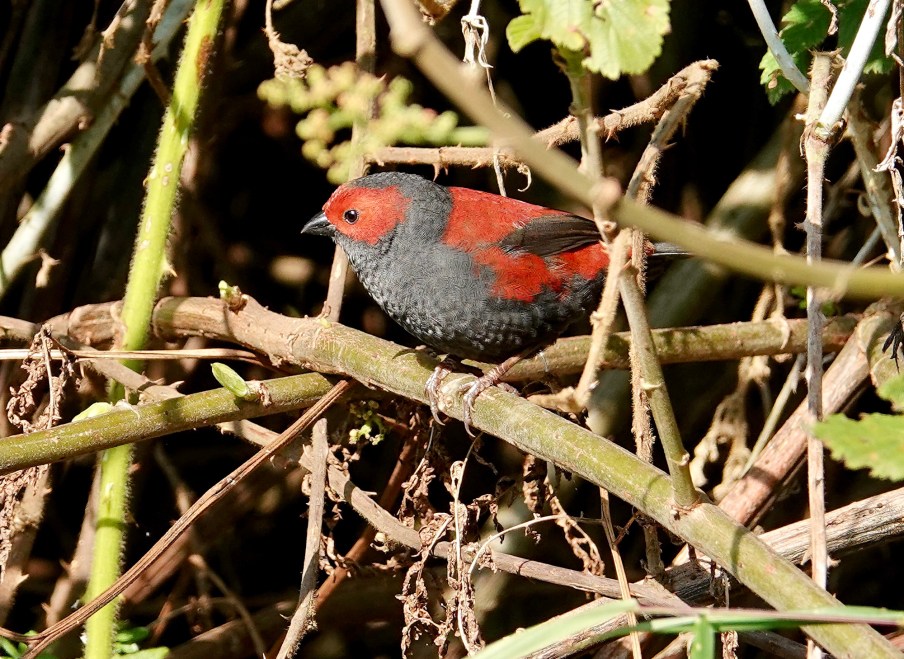
Dusky Crimsonwing: Mgahinga National Park, Uganda, August 2022 — The Regal Sunbird was not the only bird that hand been challenging at Bwindi that was easy at Mgahinga. We also had Dusky Crimsonwing out in the sun just beyond the ranger station…in the same tangle of brush as the Regal, only lower to the ground. Still skulking and still moving to fast to for great photos…but I caught one! (Crimsonwing, not great photo 🙂 Sony Rx10iv at 600mm equivalent. Program mode with my custom birds and wildlife modifications. Processed in Pixelmator Pro and Apple Photos. ISO 200 @ f4 @ 1/500th.
Yellow-throated Toucan

Yellow-throated Toucan: Danta Corcovado Lodge, Osa Peninsula, Costa Rica, December 2022 — We were on the van leaving Danta Corcovado Lodge to travel to Las Cruces Biological Research Station and the Wilson Botanical Gardens for the next adventure, but we did not get out of the driveway before we had to stop for this Yellow-billed Toucan eating palm nuts right beside the road…in the open…in the sun! Needless to say, we all piled out for some photos. Toucans, when you come right down to it, are not “nice” birds…they raid the nests of their neighbors for both eggs and chicks…but they certainly are big and bold and colorful. That bill is a hollow, fairly fragile, shell…otherwise they would be even more aerodynamically challenged than they are. Sony Rx10iv at 591mm equivalent. Program mode with my custom birds and wildlife modifications. Processed in Pixelmator Pro and Apple Photos. ISO 100 @ f7.1 @ 1/1000th.
Regal Sunbird in the sun, singing


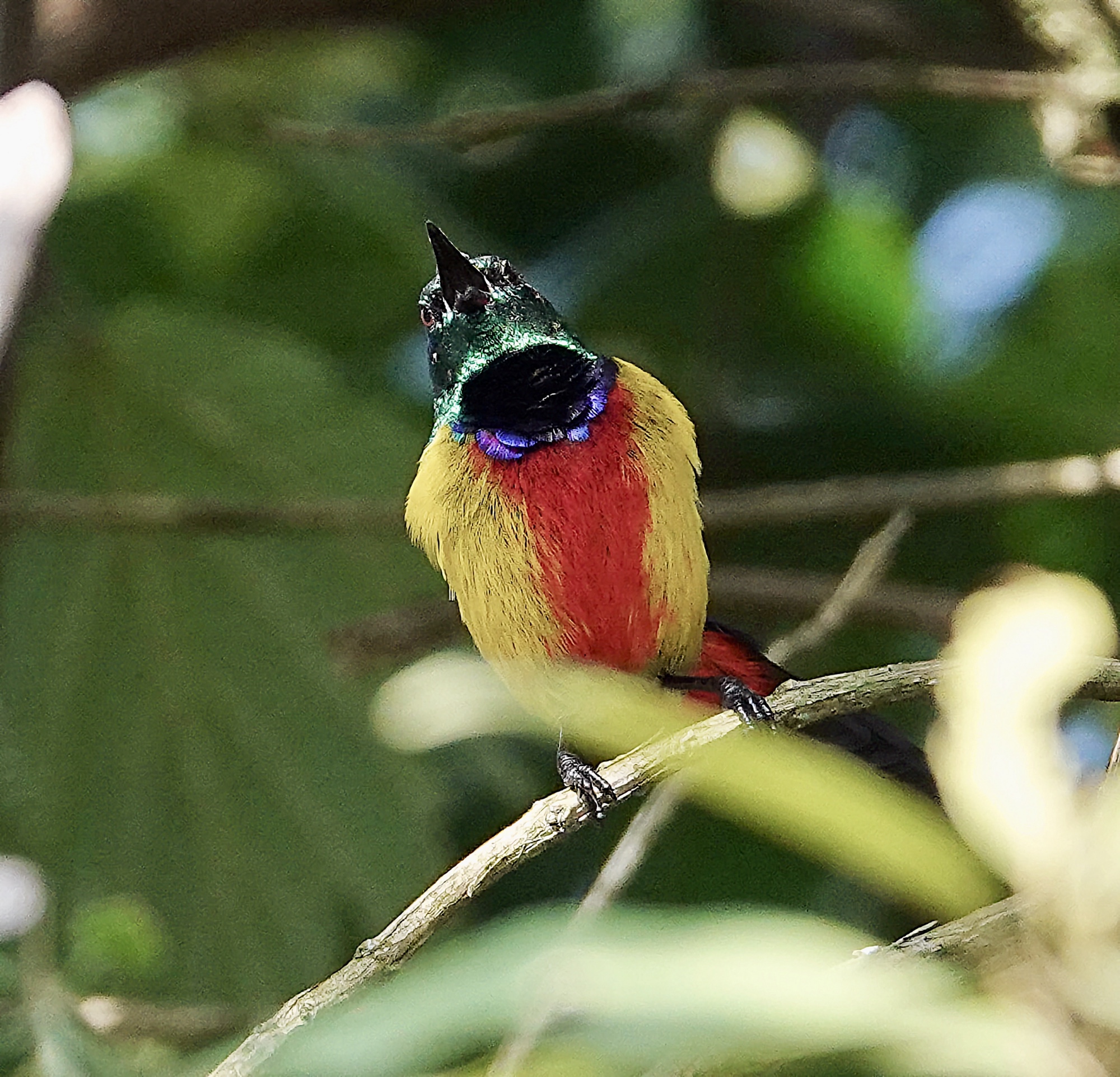

Regal Sunbird: Mgahinga National Park, Uganda, August 2022 — Of course you will never forget your first sighting of a Regal Sunbird, especially when you slithered down the side of mountain to get it, and Bwindi will always have that honor for me…but here we are a day later, just beyond the ranger station at Mgahinga National Park, and we have one singing in the sun! Each of these photos deserves a closer look. Such a bird! Sony Rx10iv at 600mm equivalent. Program mode with my custom birds and wildlife modifications. Processed in Pixelmator Pro and Apple Photos. ISO 640, 500, and 400 in the changing light @ f4 @ 1/500th.
One last set of Scarlet Macaws


Scarlet Macaws: Playa Blanco, Osa Peninsula, Costa Rica, December 2022 — One last set of Scarlet Macaws before we leave Playa Blanca and the beach behind. This bird was in a tree on the ocean side of the road, right on the beach, and more exposed to the winds off the water. More light, not necessarily better light. Sony Rx10iv at 600mm equivalent. Program mode with my custom birds and wildlife modifications. Processed in Pixelmator Pro and Apple Photos. ISO 100 @ f4 @ 1/500th. Plus .3EV for the backlight.
Uganda Edition: Kandt’s Waxbill

Kandt’s Waxbill: Mghinga National Park, Uganda, August 2022 — Moving on from Bwindi to Mghinga National Park. We were scheduled for the Golden Monkey trek at Mghinga, but considering our trail experiences at Bwindi, I made an executive decision to forgo the trek in favor of some birding around the trailhead and up the trail for a mile or so. For one thing, close encounters with the Golden Monkeys had been rare for the past few days, with some groups not seeing them at tall, and for another, we were all pretty tired after Bwindi, and, I was assuming the Golden Monkey Trek would easier…no so! All in all it was a good decision. We saw lots of birds, many right around the ranger station. There was a flock of Kandt’s Waxwings…not easy to photograph because they are so active…but in great light! Sony Rx10iv at 600mm equivalent. Program mode with my custom birds and wildlife modifications. Processed in Pixelmator Photo and Apple Photos. ISO 250 @ 4 @ 1/500th.
Double-toothed Kite


Double-toothed Kite: Playa Blanco, Osa Peninsula, Costa Rica, December 2022 — It is, according to the field guides and eBird, rare to see a Double-toothed Kite perched…and I would guess even rarer to see one perched in amongst a flock of noisy Scarlet Macaws, but this bird was perched on the lower branches of the same tree the Macaws were in…bold a brass! The guides also say it can be “quite tame” when perched and it certainly was. It allowed us to move around under it and take as many photos as we wanted. I have included a deep crop of the head to show off the double-tooth, which again, according to the field guides, is “rarely seen.” It is pretty clear in this shot. Sony Rx10iv at 600mm equivalent. Program mode with my custom birds and wildlife modifications. Processed in Pixelmator Photo and Pro and Apple Photos. ISO 640, 400, and 500 in the shade dappled light @ f4 @ 1/500th.