Lesser Violet-ear Hummingbird


This used to be the Green Violet-ear Hummingbird, which distinguished it from the closely related Brown Violet-ear of slightly lower elevations, but in the wisdom of the bird name gods, it is now the Lesser Violet-ear. (Can it be long before the Brown Violet-ear becomes the Greater Violet-ear? Who knows.) The Lesser Violet-ear was by far the most common hummingbird around Savegre Mountain Resort and the Batsu Garden in San Gerardo de Dota this year. You can see in the first image where they get the Violet-ear name. They often flare the ear patch in a dominance display. Each of these images deserves a full screen view. All were taken at Batsu Garden on the mountain side above Savegre Mountain Resort. Sony RX10iv at 600mm equivalent. My birds and wildlife modifications of Program mode. Processed in Polarr. (In the last two, there was a visually distracting over-exposed leaf in the bottom right corner which I edited out in Touch Retouch.)
White-necked Jacobin


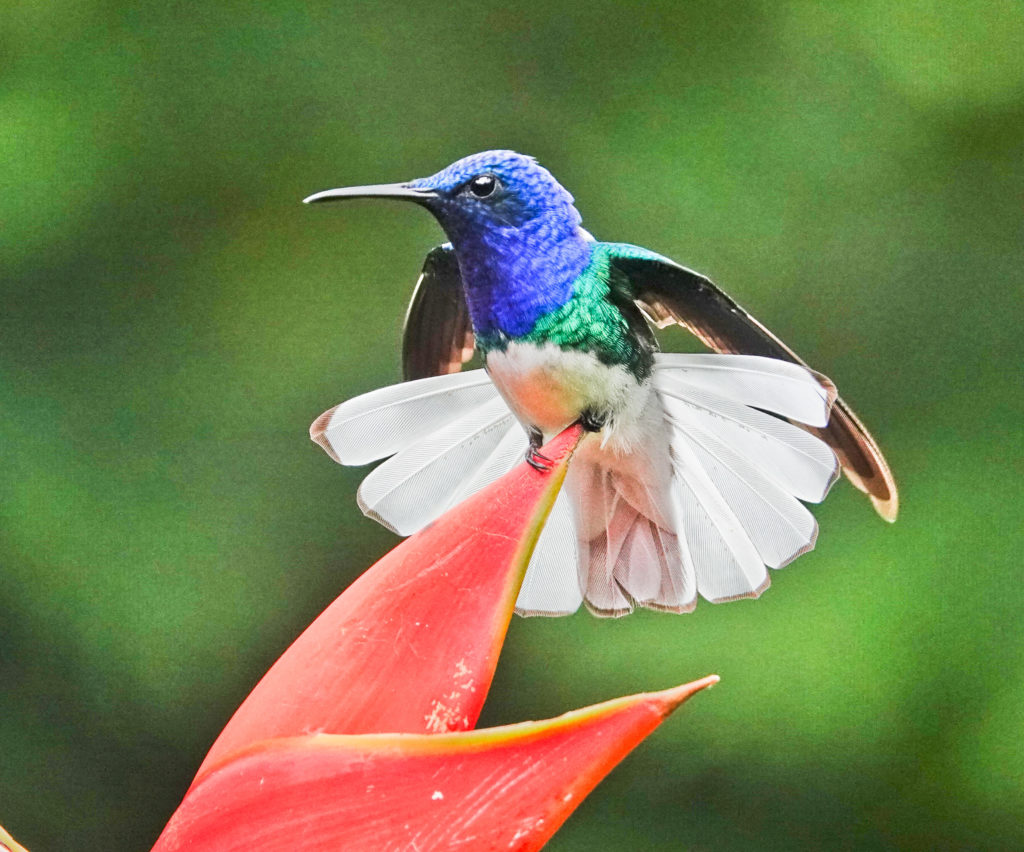

Among the most active hummingbirds at Dave and Dave’s Costa Rican Nature Park were the White-necked Jacobins…a beautiful hummer that often flares it pure white tail in a dominance display. Light is always an issue in the rainforest, so these shots were all at high ISO, especaily as I wanted a high shutter speed to freeze action. I used my custom Birds in Flight and Action modifications of Program mode, which includes a Auto ISO Minimum Shutter Speed setting to keep the shutter speed above 1/1000th. All shots were processed in Polarr.
Golden-hooded Tanager


You have to be impressed by the variety and the amazing colors of Central America’s tanagers. If you lump in the Honeycreepers, which are really tanagers, you have a range of color variation that just might be unequaled in the avian world. This is the Golden-hooded Tanager, one of my favorites. It is less frequently seen at feeders in Costa Rica, and therefore more of a treat when you do see it. The photo in the vegetation is from La Selva Biological Station and the photo on the branch is from Dave and Dave’s Costa Rican Nature Park, both in the Sarapiqui River drainage in the Caribbean lowlands, and both a short drive from Selva Verde Lodge where we were staying. Sony RX10iv at 600mm equivalent. My birds and wildlife modifications of Program mode. Processed in Polarr.
Bare-throated Tiger-Heron


On our way from Selva Verde lodge to Savegre Mountain Resort in Costa Rica, we stopped along the Rio Sucio (I think that was the name of the river) to look once more for Sunbittern before heading up into the mountains. We did not find the Sunbittern, but we did find other birds of interest, including this Bare-throated Tiger-Heron. On the way back to the bus, the Tiger-Heron was sunning itself. I am not sure whether it was trying to cool off or to warm up…or perhaps the pose was to kill mites in the feathers. At any rate it was interesting. Sony RX10iv at 600mm equivalent. My birds and wildlife modifications of Program mode. Processed in Polarr.
Rufous-tailed Jacamar
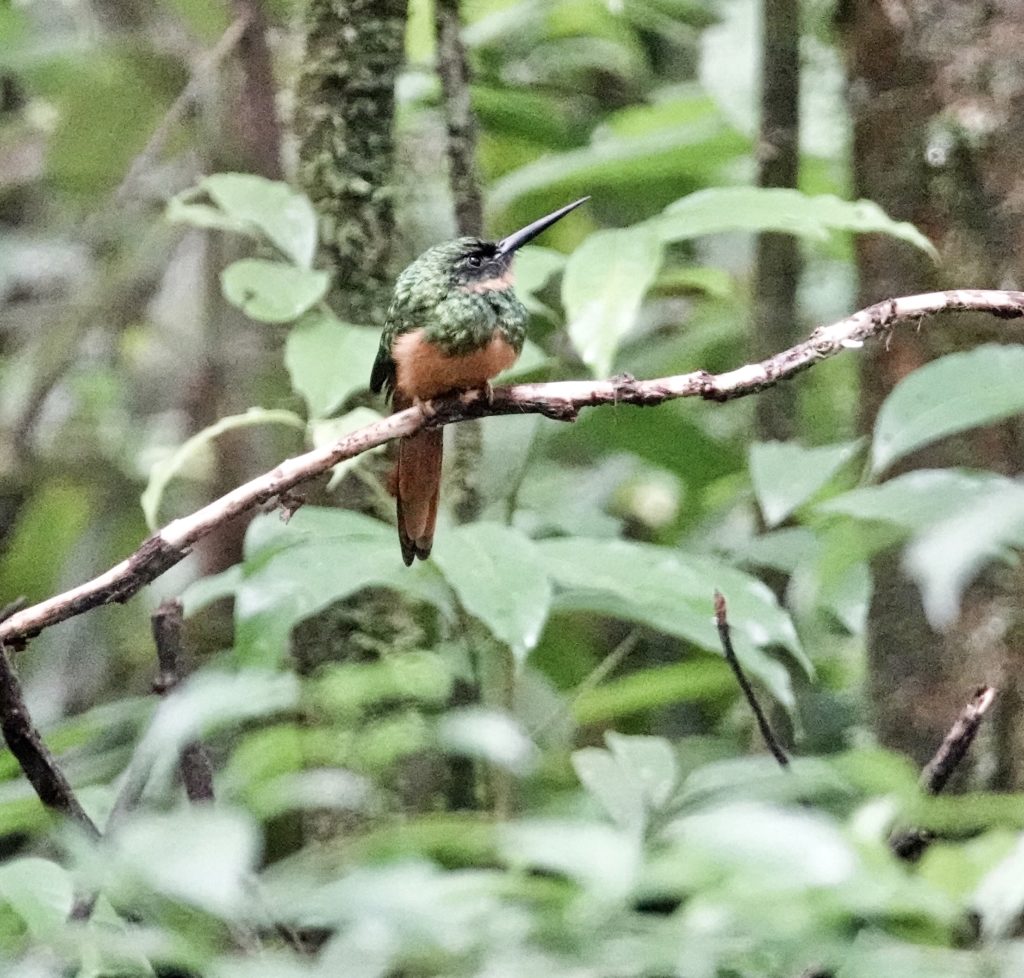


I can’t seem to get a break when it comes to Jacamars. I have seen the Rofous-tailed Jacamar in Honduras, Costa Rica, and Panama, but never in good light, and never as close as I would like. This bird was buried in the heavy undergrowth at La Selva Biological Research Station in the Sarapiqui region of Costa Rica, along one of the trails in the 2nd growth forest. It was dark enough in under there to require ISO 6400, though I did use Anti-motion Blur to improve image quality. The Jacamar is a strange bird. It looks, to some, like a giant hummingbird, but it is actually more closely related to Puffbirds. In fact Jacamars and Puffbirds from their own family. On the other hand, it behaves, and looks somewhat like, the European and African Bee Eaters…except that Jacamars specialize in moths and butterflies. Sony RX10iv at 600mm. Exposure as above. Processed in Polarr.
Flame-colored Tanager


Perhaps because the Flame-colored Tanager is one of the most common feeder birds in the highlands of Costa Rica, I came back with far too few photos of it. Ah, just another Flame-colored Tanager! It is however, one of the most beautiful birds of the mountains. The range of oranges…from almost red, to almost yellow…is amazing, and each bird seems unique in its shade of orange. And there is enough variation in the plumage of any individual bird to justify the “flame” name, as the color seems to flicker just as a flame does. These shots are at Savegre Mountain Resort in San Gerardo de Dota, Costa Rica, at about 7000 feet in the Talamanca Mountains. Sony RX10iv at 600mm equivalent. Birds and wildlife modifications of Program Mode. Processed in Polarr.
Three-fingered Sloth, Mother and child


I posted a gallery of shots of the male Three-fingered Sloth taken at Cope’s home in La Union, Costa Rica a few days ago. This is the female with her child, from our visit the week before. Always something fascinating at Cope’s. Again, the sloth was so close the photos were taken at 120-140mm equivalent (except for the close up of the face, which was at 600mm equivalent). And again, it was very dark under the heavy canopy so these were all taken in Anti-motion Blur mode. Notice how green the fur of the female sloth is…that is, of course, algae growing in the fur. We were close enough to see the moths that feed on the algae. I am calling this a Three-fingered Sloth in line with the new naming convention, instead of the more traditional Three-toed Sloth, since, again, both tree sloths of Central and South America have three toes on each hind foot. Processed in Polarr.
White-throated Mountain Gem

The White-throated Mountain Gem inhabits the higher elevations of Costa Rica, from about 6000 feet to timberline, mostly in the Talamanca Mountains south of the Central Valley and San Jose. We encountered this one at Batsu Garden on the mountain side above Savegre Mountain Resort in San Gerardo de Dota on the west slope of the mountains. It used to be called the Gray-tailed Mountain Gem. Sony RX10iv at 600mm equivalent. My custom birds and wildlife modifications of Program mode. Processed in Polarr and assembled in FrameMagic.
Oropendolas

As I have said before, Dave and Dave’s Costa Rican Nature Park is one of the best places for bird photography in the Sarapiqui region. Perched right on the edge of a high bluff above the river, at tree-top level for the trees growing below, they get a unique mix of canopy and understory feeding birds. Montezuma’s Oropendolas (on the right in the panel) are easy to see in the Caribbean lowland rainforests of Costa Rica. They come to the feeders at Selva Verda Lodge every day, but the Chestnut-headed Oropendola (on the left) is much more difficult. Here, at Dave and Dave’s we had them both at the same time, only a few feet apart. I could not quite fit them in the same frame, but it was close. The Oropendolas are giant orioles, and make giant oriole style nests that hang 2-3 feet below supporting branches. The Oro in their name comes from the yellow tail feathers (gold), and the pendola comes from the hanging nests. Both the Chestnut-headed and Montezuma’s are striking birds. Their burbling liquid calls are one of the most recognizable sounds of the rainforests. Sony RX10iv at 560mm equivalent. Anti-motion Blur Mode. Processed in Polarr and assembled in FrameMagic.
Stripe-throated Hermit

The Stripe-throated Hermit, like most Hermit Hummingbirds, rarely perches where anyone can see it…or get a photo of it. Even field-guide photos are mostly flight shots. And, unlike the other Hermits, it is small…one of the smaller hummingbirds of Central America, so it is not easy to catch in flight. This is my best shot from 16 days in Costa Rica, taken at Dave and Dave’s Costa Rican Nature Pavilion in La Virgen. Sony RX10iv at 600mm equivalent. My custom flight mode modifications of Program. 1/1000th. Processed in Polarr.