The RBNH is back again!

Red-breasted Nuthatch, Kennebunk, Maine, USA — As I have probably said before, any day with a Red-breasted Nuthatch in it is a good day! I only catch them at the feeders every once in while, though they likely come sometime every day. This one showed up in relatively good light for a change as well. Sony Rx10iv at 600mm equivalent. Program mode with my custom birds and wildlife modifications. Processed in Polarr and Apple Photos. ISO 320 @ f4 @ 1/500th.
and a big girl too…

Hairy Woodpecker: Kennebunk, Maine, USA — to accompany yesterday’s shot of a large male Hairy Woodpecker…they come in jumbo size in southern Maine…here is his mate at the same feeder…though from a slightly better angle. The female is, if anything, a bit larger than the male. Sony Rx10iv at 600mm equivalent. Program mode with my custom birds and wildlife modifications. Processed in Polarr and Apple Photos. ISO 125 @ f4 @ 1/500th.
Who’s the big boy?

Hairy Woodpecker: Kennebunk, Maine, USA — We have very large Hairy Woodpeckers here in Maine…perhaps topping out the scale of relative Hairy Woodpecker sizes, which vary regionally. They are not generally as frequent at our feeders as the smaller Downy Woodpeckers, but during very active feeding days, which we get periodically, they can be at the suet once an hour. They are more skittish than the very tame Downies, so I am always happy to get a photo of one…even like this one with the obstructing branch. The photo does give you a good impression of just how massive that beak is. Sony Rx10iv at 600mm equivalent. Program mode with my custom birds and wildlife modifications. Processed in Polarr and Apple Photos. ISO 200 @ f4 @ 1/500th.
Winter chipper

The chipmunks are all sound asleep in our yard, or at least I have not seen them in a month or more, but on my walks through deeper forest, I have seen several chipmunks moving around recently, despite the cold. I caught this one scampering back to its borrow. It stopped on what appears to be its own doorstep to assess my intentions. I took a few photos and then moved on so it could finish whatever business brought it out on a January afternoon. Sony Rx10iv at 1200mm equivalent (600mm optical and 2x Clear Image Zoom). Program mode with my custom birds and wildlife modifications. Processed in Polarr and Apple Photos. ISO 2000 @ f4 @ 1/500th.
Titmouse at the park

Tufted Titmouse: Roger’s Pond Park, Kennebunk, Maine, USA — it is always nice to see my backyard birds away from my backyard. I say it is “nice” but this time of year they are about the only birds I am likely to see on my walks around town, since my backyard gets a good representation of the birds that winter in Southern Maine. At least in York County. This Tufted Titmouse was with a mixed feeding flock that works the river on both sides a mile upstream from our house, maybe a quarter of a mile downstream from the Route 1 bridge. The gentle light, the framing branches, and the interesting bokeh give this shot some visual integrity. Sony Rx10iv at 600mm equivalent. Program mode with my custom birds and wildlife modifications. Processed in Polarr and Apple Photos. ISO 100 @ f4 @ 1/500th.
Thistle addict

American Goldfinch: Kennebunk, Maine, USA — The numbers of Goldfinches coming to our thistle feeder is increasing daily. This is the first year we have had them in December and January. They make a change from the chickadees, titmice, nuthatches, and woodpeckers. And the bluebirds. In fact, we have good variety of winter birds this year. I would love to have the cardinals that I see occasionally in other parts of town, but I am happy with the goldfinches. 🙂 Sony Rx10iv at 600mm equivalent. Program mode with my custom birds and wildlife modifications. Processed in Polarr and Apple Photos. ISO 640 @ f4 @ 1/500th.
What? I only took one!

Tufted Titmouse: Kennebunk, Maine, USA — Okay, this is total projection, but I could not resist. This Titmouse looks so guilty! Caught in the act of stealing sunflower seeds on our back deck. 🙂 The bird is apparently unaware that, while I actually put the seeds on the deck for the squirrels, who have been very good recently about leaving my feeders alone, I certainly am not going to begrudge a sunflower seed for a titmouse. Sony Rx10iv at 600mm equivalent. Program mode with my custom birds and wildlife modifications. Processed in Polarr and Apple Photos. ISO 640 @ f4 @ 1/500th.
Wild Bluebird

Eastern Bluebird: Kennebunk, Maine, USA — Wild, in the sense that this is not a yard-bird. 🙂 I encountered a few bluebirds at Roger’s Pond Park on the Mousam River off Main Street in Kennebunk. They are part of a mixed flock, along with Cardinals, Chickadees, Titmice, and Downy Woodpeckers that feed in that area of town. Later in the winter they may be joined by a flock of Robins and Cedar Waxwings…or rather one flock of Robins and another of Cedar Waxwings since they don’t really mix. All of these birds are “different” than the mixed flock that frequents our back yard, though in a straight line I am less than a mile from Roger’s Pond. I can tell because we have a unique partially melanistic male Titmouse that hangs with our flock. 🙂 Sony Rx10iv at 1200mm equivalent (600mm optical plus 2x Clear Image Zoom). Program mode with my custom birds and wildlife modifications. Processed in Polarr and Apple Photos. ISO 500 @ f4 @ 1/500th.
Confiding squirrel
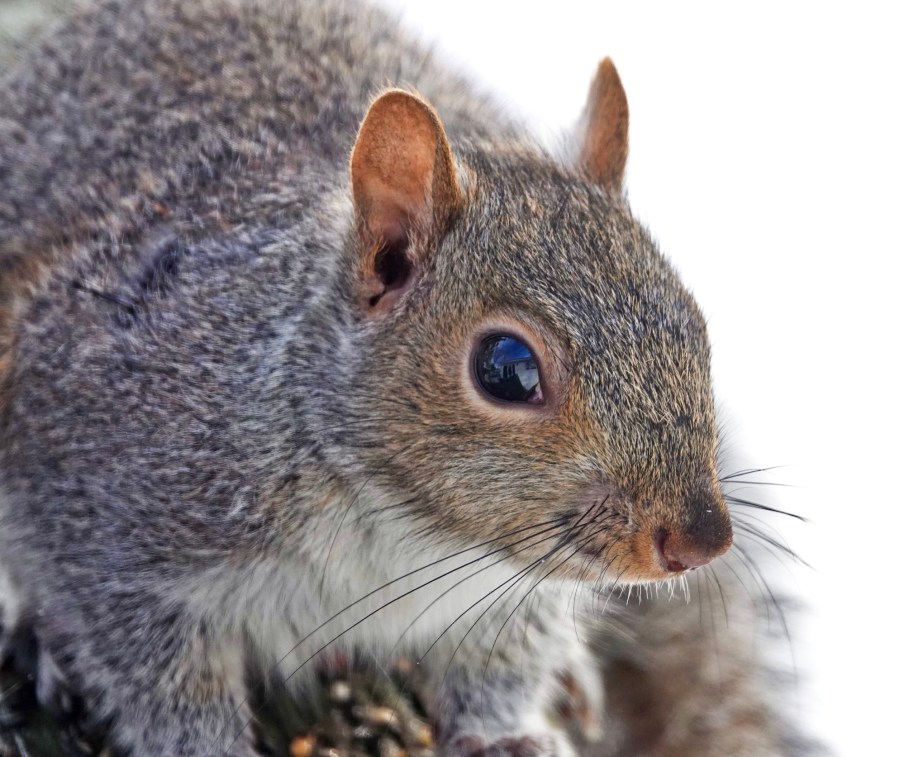
Eastern Grey Squirrel, Kennebunk, Maine. I was taking photos of the birds out my back deck door, standing in the open slide, when this squirrel hopped up on the rail and came pretty much right up to me. This was taken at about 3 feet. Sony Rx10iv at 600mm equivalent. Program mode with my custom birds and wildlife modifications. Processed in Polarr and Apple Photos. ISO 400 @ f4 @ 1/500th.
and still the Cardinals…

Northern Cardinal: Kennebunk, Maine, USA — I know there are Cardinals in Kennebunk all winter. They just don’t come to our neighborhood. The pair that nest between our house and the railroad tracks evidently are “summer folk”, and a have a winter home elsewhere. I found this one at Roger’s Pond Park beside the Mousam River in downtown Kennebunk. It was, of course, across the whole width of the river, so not much of a shot. More of a record really. The Cardinals are still with us. 🙂 Sony Rx10iv at 1200mm equivalent (600mm plus 2x Clear Image Zoom). Program mode with my custom birds and wildlife modifications. Processed in Polarr and Apple Photos. ISO 640 @ f4 @ 1/500th.