Posts in Category: birds
African Darter


African Darter: Murchison Falls National Park, Uganda, August 2022 — The tour boat to the base of Murchison Falls from the old ferry crossing (and new bridge) on the Nile is always productive. This year we had afternoon rains to contend with, so part of the journey was spent huddled under the awnings on the boat, but still, we saw many birds and quite a bit of wildlife from the water. This stretch of river is good for the African Darter…the African species of Anhinga. (The Anhinga of North America is sometimes called the American Darter), The four species of Anhinga world-wide, American, African, Oriental (or Asian) and Australian are distinguished primarily by region. Front and back view here…probably female and male, and quite possibly with some juvenile plumage on the male. Sony Rx10iv at 600mm equivalent. Program mode with my custom birds and wildlife modifications. Processed in Pixelmator Photo and Apple Photos. ISO 100 @ f4 @ 1/640th and 1/800th.
Juvenile European Bee-eater

Juvenile European bee-eater: Murchison Falls National Park, Uganda, August 2022 — This is clearly a juvenile of some Bee-eater. At the time we called it a European and that is still most likely because of the rufous on the head and the light yellow wash on the throat, and because of the on-the-spot id by our guide who is familiar with the species as it appears in Uganda. Merlin, bless its little AI heart, does not give European as the first choice with either photo of this bird that I have, so I had to consider both Blue-checked and Swallow-tailed, which are very similar, according to the field guides and the few internet photos I could find, in juvenile plumage. Still, I am fairly confident this is an immature European Bee-eater, which is a common migrant bird all across Uganda and all of East and South Africa. As always, I am willing to be corrected by anyone who knows better 🙂 Sony Rx10iv at 600mm equivalent. Program mode with my custom birds and wildlife modifications. Processed in Pixelmator Photo and Apple Photos. ISO 100 @ f6.3 @ 1/1000th.
Abyssinian Ground Hornbill action


Abyssinian Ground Hornbill: Murchison Falls National Park, Uganda, August 2022 — There was more than one group of Abyssinian Ground Hornbills near the Hippo Pools at Murchison Falls National Park when we visited in August. I thought at first that I was seeing a female and a chick…with some begging going on, but looking at the photos both female birds appear to be full grown adults, and I took the picture of the two males walking in a line only a few yards away, so this is more likely two pairs, and the females are just having a little spat. 🙂 Sony Rx10iv at 600mm equivalent. Program mode with my custom birds and wildlife modifications. Processed in Pixelmator Photo and Apple Photos. ISO 100 @ f4 @ 1/800th and 1/1000th.
Thick-knees

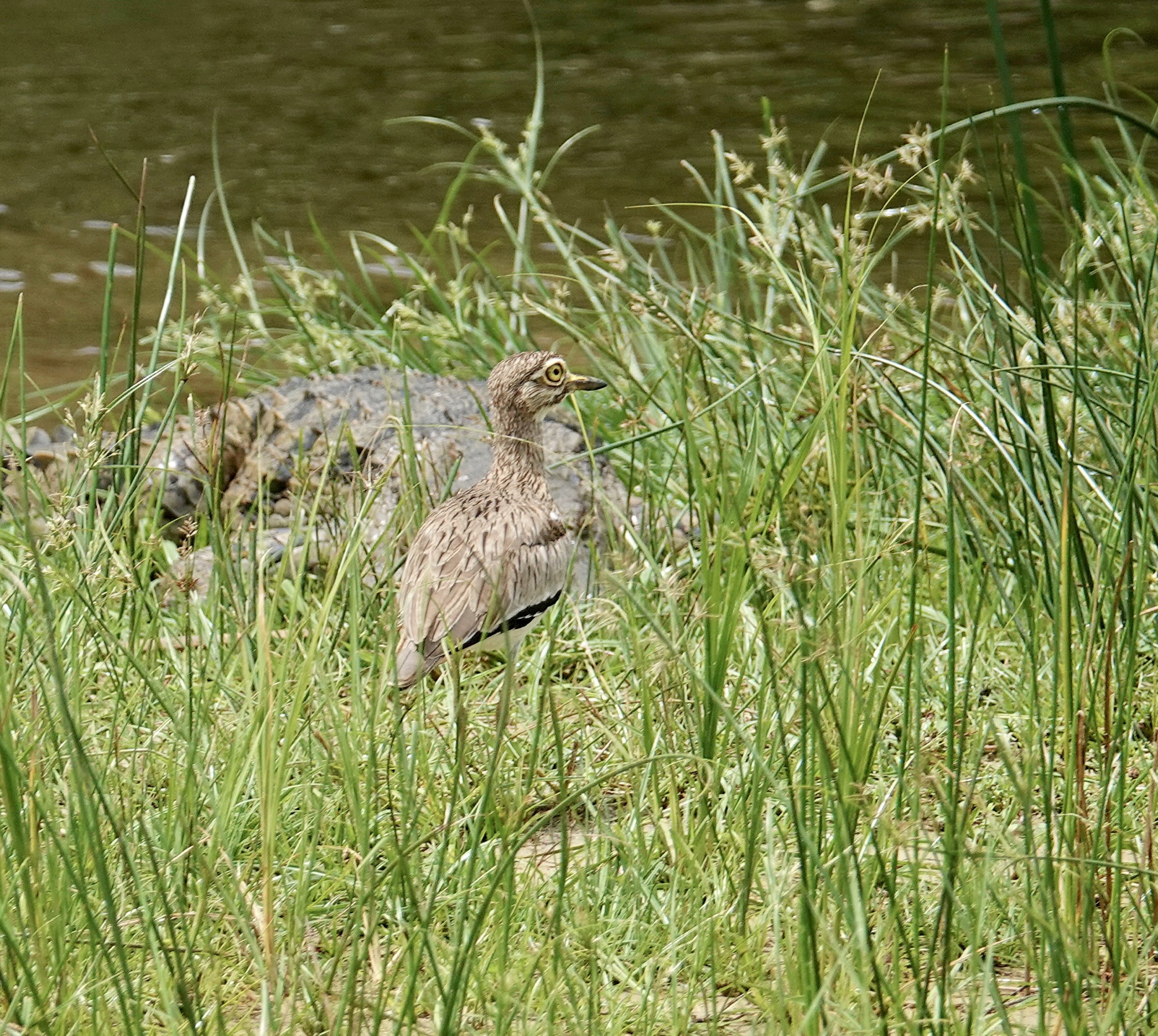
Water and Senegal Thick-knees: Murchison Falls National Park, Uganda, August 2022 — These photos were taken a few miles, and a few hours, apart, one from the shore of the Nile at the Hippo Pools in Murchison Falls National Park in late morning, and one from the tour boat to the base on Murchison Falls on the Nile in the afternoon. I am pretty sure I have both possible Thick-knees here, the Water Thick-knee on the shore, and the Senegal Thick-knee from the boat. (The AI engine in Merlin agrees, for what it is worth 🙂 They are easy to tell apart in the East African Birds guide, but neither bird here looks like the illustration of the Water Thick-knee in the book. (In fact, I can not find a photo of the Water Thick-knee anywhere that looks like the bird in the book. The ones in Merlin certainly do not???) I am totally willing to be corrected by anyone who knows better. Sony Rx10iv at 600mm equivalent. Program mode with my custom birds and wildlife modifications. Processed in Pixelmator Photo and Apple Photos. ISO 100 @ f4 @ 1/1000th and 1/800th.
Hadada and Sacred Ibis

Partly because I was with two avid birders, and partly because that is just how it worked out, I took a lot of photos of birds and not as many as of big game on my trip to Uganda this year. I will be doubling up on my bird posts for next few days to keep my posts mostly in order as the encounters happened. 🙂 Two more birds from the Hippo Pools area of Murchison Falls National Park…where the Albert and the Victoria Niles join. This was our first good view of a Sacred Ibis, which happened to be feeding with a Hadada Ibis at the time. The black head and neck on the Sacred Ibis is actually bare skin…not black plumage, and evidently there is a bare patch of red skin under the wings that can be seen in flight. Of course, I had to google the bird to see why it is called the Sacred Ibis, and found that it is one of those birds with a still active controversy over its species status…one, four, or more? Some suspect that it is actually the same species as the Asian Sacred Ibis and the Australian White Ibis. The Sacred part though comes from the ritual of offering a mummified Ibis to the god Thoth…the Egyptian god of knowledge and truth. Historians estimate that up to 8 million Sacred Ibis were mummified and entombed over the course of the worship of Thoth, and, ironically, there are today no Sacred Ibis left in Egypt. Sony Rx10iv at 573mm equivalent. Program mode with my custom birds and wildlife modifications. Processed in Pixelmator Photo and Apple Photos. ISO 100 @ 4 @ 1/800th.
African Open-bill Stork

African Open-bill Stork: (or just African Open-bill) Murchison Falls National Park, Uganda, August 2022 — Another bird from our visit to the Hippo Pools area of Murchison Falls National Park. in Uganda. The African Open-billed Stork is unmistakable in any view close enough to see the bill. Otherwise it is just a dark stork. In the right light, there is apparently a green screen to the uniquely structured display feathers on the chest, but I have yet to see that in the wild. According to the latest theories, the gap in the bill allows the Open-bill to extract snails and small mollusk from their shells…very like the bill on the unrelated Limpkin, which has a similar specialized diet. They work like a tweezer. Sony Rx10iv at 600mm equivalent. Program mode with my custom birds and wildlife modifications. Processed in Pixelmator Photo and Apple Photos. ISO 100 @ f4.5 @ 1/1000th.
Saddle-billed Stork


Saddle-billed Stork: Murchison Falls National Park, Uganda, August 2022 — Near the Hippo Pools on the banks of the Nile in Murchison Falls National Park we came up on a pair of Saddle-billed Storks. It was only this morning, when doing a bit of research for this post, that I realized that I had a photo of both the male and the female. The differences are subtle. The yellow iris of the female stands out boldly against the black face…while the brown iris of the male trends to blend in with the black. The female is also slightly smaller, but both are big birds (with their necks stretched out, the tallest of the storks of Africa) and the size difference is really hard to see. Sony Rx10iv at 573mm equivalent. Program mode with my custom birds and wildlife modifications. Processed in Pixelmator Photo and Apple Photos. ISO 100 @ f4 @ 1/640th.
Shorebirds on the Nile


Spur-winged and Black-headed Lapwings, and African Jacana: Murchison Falls National Park, Uganda, August 2022 — There is a rest stop on the game drive trails of Murchison Falls National Park (complete with toilets) on the banks of the Victoria Nile, just above where it joins the Albert Nile at the head of Lake Albert. It is called, variously, the Delta or the Hippo Pools area, and it is a good place for shorebirds (as well as hippos, as the name suggests). Three that posed nicely for us were the Spur-winged Lapwing and the African Jacana (which we had already seen in the marshes at Mabamba, though not on the shore) and the Black-headed Lapwing (which was new at that point for us). Sony Rx10iv at 600mm equivalent. Program mode with my custom birds and wildlife modifications. Processed in Pixelmator Photo and Apple Photos. ISO 100 @ f4 @ 1/640th.
Northern Carmine Bee-eater


Northern Carmine Bee-eater: Murchison Falls National Park, Uganda, August 2022 — I have mentioned my fascination with Bee-eaters before. They are one of 3 families of birds that I am always on the look-out for in Africa…along with Sunbirds and Kingfishers. Of course, I am happy to see any African bird, but there is something about those three families that captures my imagination…or at least my attention. And this is one of my favorites. The Northern Carmine Bee-eater’s range in Uganda is limited to the area right around Murchison Fall National Park. There has been a suggestion that the range is limited by the availability of secondary loess deposits in which they build their tunnel nests. Sony Rx10iv at 600mm equivalent. Program mode with my custom birds and wildlife modifications. Processed in Pixelmator Photo and Apple Photos. ISO 100 @ f4 @ 1/1000th. Plus .3EV. (For those of you who follow my images on my blog, this is my second post on the Northern Carmine Bee-eater…though Facebook was giving me fits posting from Uganda, so this is the bee-eater’s first appearance in my Facebook posts. 🙂
Abyssinian Ground Hornbills

Abyssinian Ground Hornbill: Murchison Falls National Park, Uganda, August 2022 — Ground Hornbills are most often seen in family groups, male, female, and generally a single chick to sub-adult bird. The male and female often walk through the savannah grasses next to each other. These are big birds, the size of a North American turkey. They prefer to walk or “lumber” even when threatened, but you do catch them in flight occasionally, mostly moving up to or down from a roost in the lower branches of well grown trees, and they have striking white patches on the wings. You can just see a bit of white poking out on the male’s wing in this photo. There is a Southern Ground Hornbill, which replaces the Abyssinian (or Northern) in Kenya and the rest of Africa south and east of there. They tend to be very local…but we saw several families on this trip to Murchison. This family happened to be close to our track along the edge of the Nile near where the Albert and Victoria Niles join. Sony Rx10iv at 554mm equivalent. Program mode with my custom birds and wildlife modifications. Processed in Pixelmator Photo and Apple Photos. ISO 100 @ f4 @ 1/500th.