Posts in Category: birds
Silverbird

Silverbird: Murchison Falls National Park, Uganda, August 2022 — The Silverbird, named for its silverish back, is one of the three paradise flycatchers possible in Uganda. It is locally common in scrub lands. When it is seen it is seen well, since it likes to sit up in brush at eye-level hunting for insects on the ground. We found it beside the track in early morning light on our last morning in Murchison Falls National Park. Sony Rx10iv at 591mm equivalent. Program mode with my custom birds and wildlife modifications. Processed in Pixelmator Photo and Apple Photos. ISO 100 @ f4.5 @ 1/1000th. Assembled in FrameMagic.
Red-cheeked Cordon-bleu


Red-cheeked Cordon-bleu: Murchison Falls National Park, Uganda, August 2022 — The aptly named Red-cheeked Cordon-bleu is a common small finch, closely related to the Blue-waxbill. It is almost everywhere, generally feeding on the ground, except in interior forest, through most of West and East Africa in a wide band across the continent south of the Sahara. The Ugandan birds are the nominate race (out of 4 races which vary by the amount of red on the face of the females), and the same race as the West African birds. One shot here is from the grounds of Pakuba Lodge and the other is from beside the track in the open savannah. They feed pretty exclusively on grass seeds. These are both males. Sony Rx10iv at or about 600mm equivalent. Program mode with my custom birds and wildlife modifications. Processed in Pixelmator Photo and Apple Photos. One shot was just about after sunset, and the other was just after sunrise, so both in subdued light. ISO 1250 (grass) and 1000 @ f4 @ 1/500th.
Great Egret views


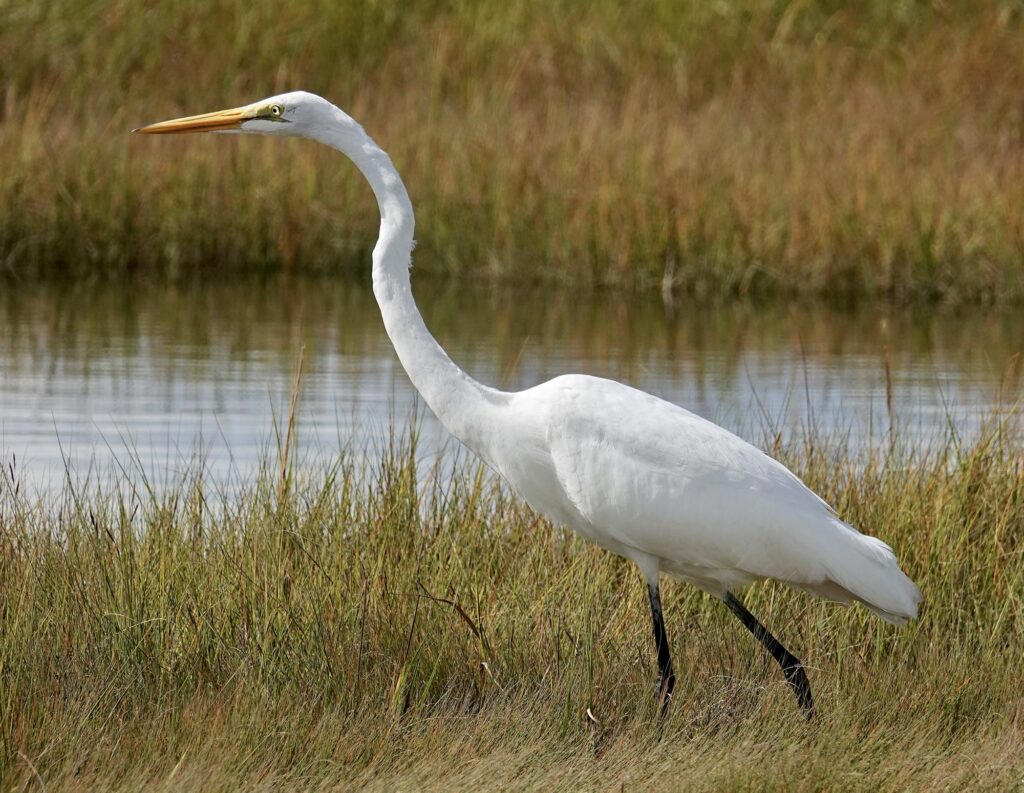
Great Egret: Kennebunk, Maine, USA, September 2022 — While I have been sharing my photos from Uganda, of course life here in Maine has been going on. The other day I rode my eTrike on one of my loops and took a detour down to our local beach. There were a dozen or more Great Egrets in the marshes behind the dunes…this one quite close to the road. While I watched, it flew from one side of the road out over the tidal creek and back to the other side, even closer. These shots were taken without getting off my trike. 🙂 There was also a constant stream of Monarch Butterflies and Green Darner Dragonflies coming through headed south. I have a feeling that if I had time to sit and count them I would have totaled in the thousands for both for the day. Sony Rx10iv at 600mm equivalent. Program mode with my custom birds and wildlife modifications. Processed in Pixelmator Photo and Apple Photos. ISO 100 @ f4.5, f5, and f5.6 @ 1000th.
Grey-headed Kingfisher


Grey-headed Kingfisher: Murchison Falls National Park, Uganda, August 2022 — Sometimes it just all comes together. Great bird, great place, great light. This Grey-headed Kingfisher was perched up right beside the road on our way out of Murchison Falls National Park, still with early morning light on it. It just does not get any better! The Grey-headed Kingfisher is one of the few Kingfishers which does not fish…though it still dependent on riverbanks for its nest sites (sandy banks where it digs it tunnel nests), is not an aquatic bird. Sony Rx10iv at 600mm equivalent. Program mode with my custom birds and wildlife modifications. Processed in Pixelmator Photo and Apple Photos. ISO 200 @ f4 @ 1/500th.
Immature Bateleur


Immature Bateleur: Murchison Falls National Park, Uganda, August 2022 — We must have seen a dozen immature Bateleurs. The adult Bateleur is a very distinctive African Hawk-Eagle, mostly black with bright orange-red bill and cere, and deep rust between the wings on the back. Both male and female have grey wing coverts on the shoulder and the female as a grey panel across the flight feathers. Along with the short tailed, big headed look, it is a very striking and unmistakable bird. The immatures share the shape, but are plain brown with a pale bluish bill and cere. Not nearly as exciting :). Still we were always happy to see them…especially since each sighting fueled our hope of seeing an adult in the area…but we never did. Sony Rx10iv at 600mm equivalent. Program mode with my custom birds and wildlife modifications. Processed in Pixelmator Photo and Apple Photos. ISO 250 @ f4 @ 1/500th.
Juvenile Abyssinian Ground Hornbill

Abyssinian Ground Hornbill: Murchison Falls National Park, Uganda, August 2022 — This is my third post on the Abyssinian Ground Hornbill, from a fourth encounter. This is probably the rarest of my Hornbill shots: a juvenile. Hornbills, as I mentioned in a previous post, only successfully breed every 5-9 years, and only raise one chick per-nest. This bird has, so far, beaten the odds to reach this stage of its young life. Note the limited casque and the small grey wattle. This bird is also, uncharacteristically, showing a lot of the white flight feathers. The bird was right beside the road…so close I had to zoom out to get the full body in. Sony Rx10iv at 266mm equivalent. Program mode with my custom birds and wildlife modifications. Processed in Pixelmator Photo and Apple Photos. ISO 800 @ f4 @ 1/500th.
Giant Kingfisher


Giant Kingfisher: Murchison Falls National Park, Uganda, August 2022 — Though the Giant Kingfisher has a range that covers pretty much all of sub-Sahara Africa, I saw my first one on the Nile River in Murchison Falls National Park from the tour boat to the base of the Falls. It is not an uncommon bid, but evidently there are never large numbers, they are very local and maintain a relatively small territory, and the pairs move around a lot, relocating their territory regularly. This is a male. The female has the rufous band lower on the belly and the streaking on the throat and upper chest. The Giant makes the 9th of the 11 possible Kingfishers of Uganda, and 15 of East Africa, that I have seen. The Giant, the Dwarf, and the Blue-breasted were new for me on this trip. 🙂 Always happy to see a new Kingfisher! Sony Rx10iv at ~550mm equivalent. Program mode with my custom birds and wildlife modifications. Processed in Pixelmator Photo and Apple Photos. The shot with green background was at ISO 160 @ f4 @ 1/500th. The other one was at ISO 100 @ f4 @ 1/800th, plus 1.7EV to capture detail against the backlight.
Yellow-billed Stork

Yellow-billed Stork: Murchison Falls National Park, Uganda, August 2022 — A very wet and bedraggled Yellow-billed Stork on the banks of the Nile from the tour boat to the base of Murchison Falls…showing the pink blush on the wing coverts and pink legs of breeding plumage very nicely. The Yellow-storks must breed in Uganda, since Murchison Falls NP is pretty far from major breeding areas in Kenya, but there are actually no known breeding sites in Uganda. The Yellow-billed Stork is one of four storks in a closely related group…which includes the American Wood Stork and the Milky and Painted Storks of Asia. Yellow-billed, Milky, and Painted all look very alike, while the Wood Stork lacks the bright colors. Sony Rx10iv at 600mm equivalent. Program mode with my custom birds and wildlife modifications. Processed in Pixelmator Photo and Apple Photos. ISO 200 @ f4 @ 1/500th.
Red-throated Bee-eater

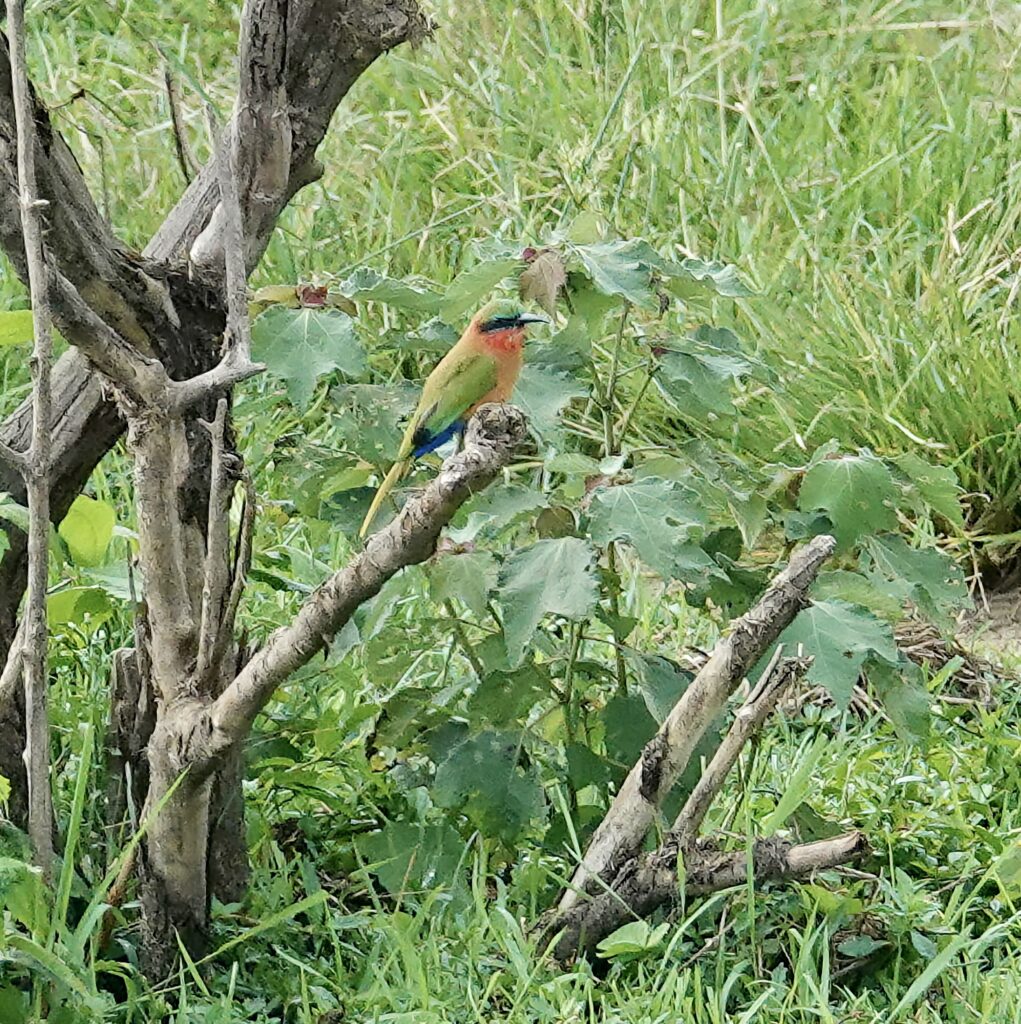
Red-throated Bee-eater: Murchison Falls National Park, Uganda, August 2022 — Red-throated Bee-eaters nest in a clay bank on the Nile a few miles upstream from the bridge at Murchison, and a few miles downstream from the falls. In 2019 when I visited, there were several hundred birds on that bank, and Red-throated Bee-eaters were all along the river. In 2022 we were a week earlier in the year, and while the Red-throateds were in the area and we saw them here and there (never very well as the photos attest), they had not yet congregated for nesting. Various range maps show them as resident in Murchison, but the locals consider them a seasonal bird, only appearing in large numbers during nesting season. Sony Rx10iv at 600mm equivalent. Program mode with my custom birds and wildlife modifications. Processed in Pixelmator Photo and Apple Photos. ISO 100 @ f4.5 @ 1/1000th and ISO 400 @ f4 @ 1/500th.
Why is it a Darter?

African Darter: Murchison Falls National Park, Uganda, August 2022 —A companion post for teday’s Pic for today. Why is called a Darter? Ask the catfish 🙂 This bird passed just under the bow of our tour boat on the Nile below Murchison Falls in Murchison Falls National Park in Uganda, still carrying its prize. Sony Rx10iv at 567mm equivalent. Program mode with my custom birds and wildlife modifications. Processed in Pixelmator Photo and Apple Photos. ISO 100 @ f5 @ 1/1000th.