More of Amboseli’s Elephants on the move…


On our first afternoon drive at Amboseli National Park in Kenya, it was obvious that our driver was on a mission. He did not tell us what the mission was, but you tell that he was more or less killing time until something happened, and that he needed to be in right place at the right time for us to see it. As the sun started to set, the CB radio came alive with excited chatter and the final race was on. It is evidently a matter of some pride among the drivers to get their clients as close to the spot where the elephants choose to cross the road on that particular afternoon on their way to the slightly higher ground in the north section of the park to spend the night. There are several trails. As a guide, you can’t afford to guess wrong and have your clients miss the whole thing…and you can’t come late or they will be at the very back of the press of safari vans with not much of a view, and you can’t come early since your vehicle in the path might turn the herd to another trail. Timing is everything. You need among the first to arrive after the herd is committed to a trail. We were one van length from the trail they used that day. A bit crazy perhaps. I had to wonder would happen if one of those huge creatures decided to come through us instead of through the gap…but they all thundered through 20 feet from us. The shot above is of one of the “pioneer” elephants who was already across the road when we arrived, but within the next 10 minutes the heard joined him and they moved off to the north. The link below is to a video slideshow of the experience.
Wild Turkey

There are more Wild Turkeys in Southern Maine this fall than I have seen in many years. I have seen at least 4 different flocks of 20 or more along the back roads as I ride my eBike. Maybe there are always that many, and they just stay more hidden, but it seems like a lot. These were in the Senior Housing Condos behind Rt. 1 near the Wells line. Sony RX10iv at 600mm. Program mode. Processed in Polarr.
Red Elephants of Tsavo East


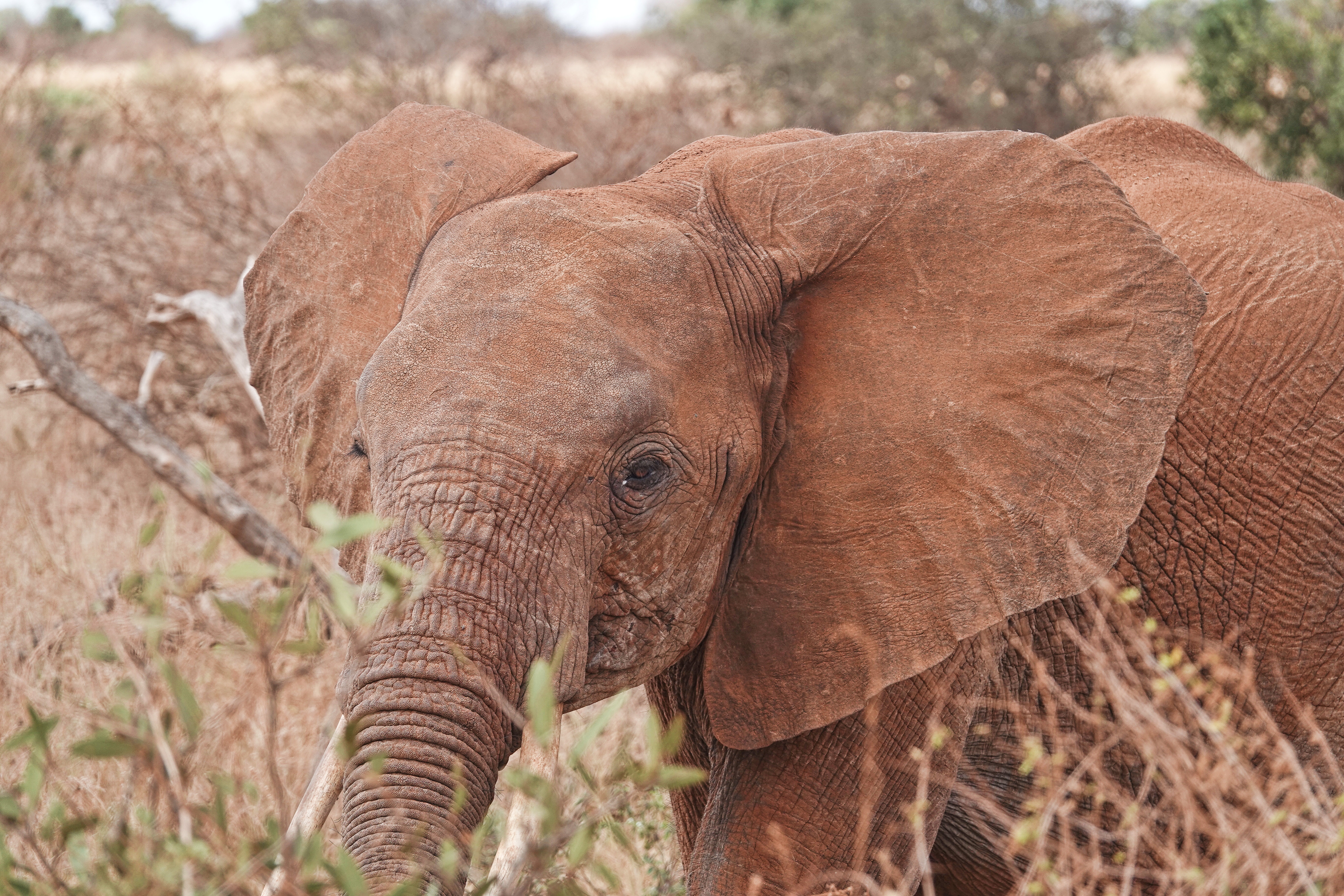

Tsavo East National Park in Kenya is famous for its “red elephants” and big tuskers. The elephants are not red of course, but the soil is full of red clay, and when the elephants are freshly “dusted”, and in the right light, they certainly look red. Elephants dust or mud themselves to protect their skin from the sun and insects. All elephants do it. It is just that the soil of Tsavo East turns them red when they do. The big tusks of Tsavo East are more of a mystery. Elephants with big tusks are increasingly rare in other areas of Kenya and Tanzania, but many remain at Tsavo East. No one knows exactly why. Sony RX10iv at 90mm, 350mm and 600mm. Program mode. Processed in Polarr. Note the corrugated tongue on the close-up. 🙂
Hippopotamuses in the water


I will admit to being somewhat startled when a pod of Hippopotamuses surfaced beside our small boat on Lake Naivasha. The boatman obviously expected it, and had brought us into this particular little cove for just that purpose…but still…he might have warned us. Hippopotamuses are big. Swamp-a-boat-easily big. And they just appear there, right beside you. So fast I could barely get the camera around to capture a few shots before they submerged again. The boatman stopped the boat, and we watched them for a few moments, enjoying themselves. Hippos spend the day submerged, coming up to breathe, or in mud flats where they can cover their sensitive skin with a layer of mud as sun-screen. They come out to browse the short grasses along the lake-shore at night. We stayed at Elsamere on Lake Naivasha, and one of its selling points (along with most of the other lodges on the shore) is that Hippos come out on the lawn at night. If you go to Africa, someone is sure to tell you that Hippopotamuses kill more people per year than any of the big five…than all of the big five added together…and it is true. It is easy to underestimate these huge, placid animals and get too close, or between them and their retreat to the water. They don’t tolerate that. So, I guess if you have to get close, in a boat is the way to do it. Sony RX10iv at 600mm equivalent. Program mode. Processed in Polarr.
Cape Buffalo among the Flamingos

Lake Nakuru National Reserve is one of the “fenced” reserves of the Rift Valley. The animals are not free to come and go…which is not the norm in Kenya. In fact the unfenced reserves and parks are, in my opinion, one of the main differences between the experience of Kenya and, say, South Africa, where the larger Kruger complex…though huge…is totally fenced. Nakuru is fenced to protect surviving small numbers of both endangered Black and White Rhinoceros…from wandering and from poachers…and a thriving herd of the comparatively rare Rothschild’s Giraffes, which were introduced to the park for their own protection. When lake levels are right, the lake also attracts large numbers of Lesser Flamingos, which, as here, feed in the shallows. The Cape Buffalo are on a little spit of more solid land that runs out into the lake. Our guide lamented the fact that the lake is being polluted with runoff from Nakuru Town, on its northern edge, which he feels is reducing the numbers of Flamingos, and pushing them to the far south edge of the lake. Sony RX10iv at 600mm equivalent. Program mode. Processed in Polarr.
Oryx


Oryx
Actually the “Fringe-eared Oryx”. I was surprised to find that there are two Oryxs possible in East Africa and Kenya, and that the “Fringe-eared” is more likely in Tsavo East National Park were we found these. I had to look closely at the photos, but they do indeed have the distinctive fringe of dark hair on the ears. We evidently did not get far enough north to see the other Oryx: the Beisa Oryx, very similar but without the ear-fringe. Sony RX10iv at 600mm equivalent. Program mode. Processed in Polarr.
Masai Giraffe: October 1


Masai Giraffe
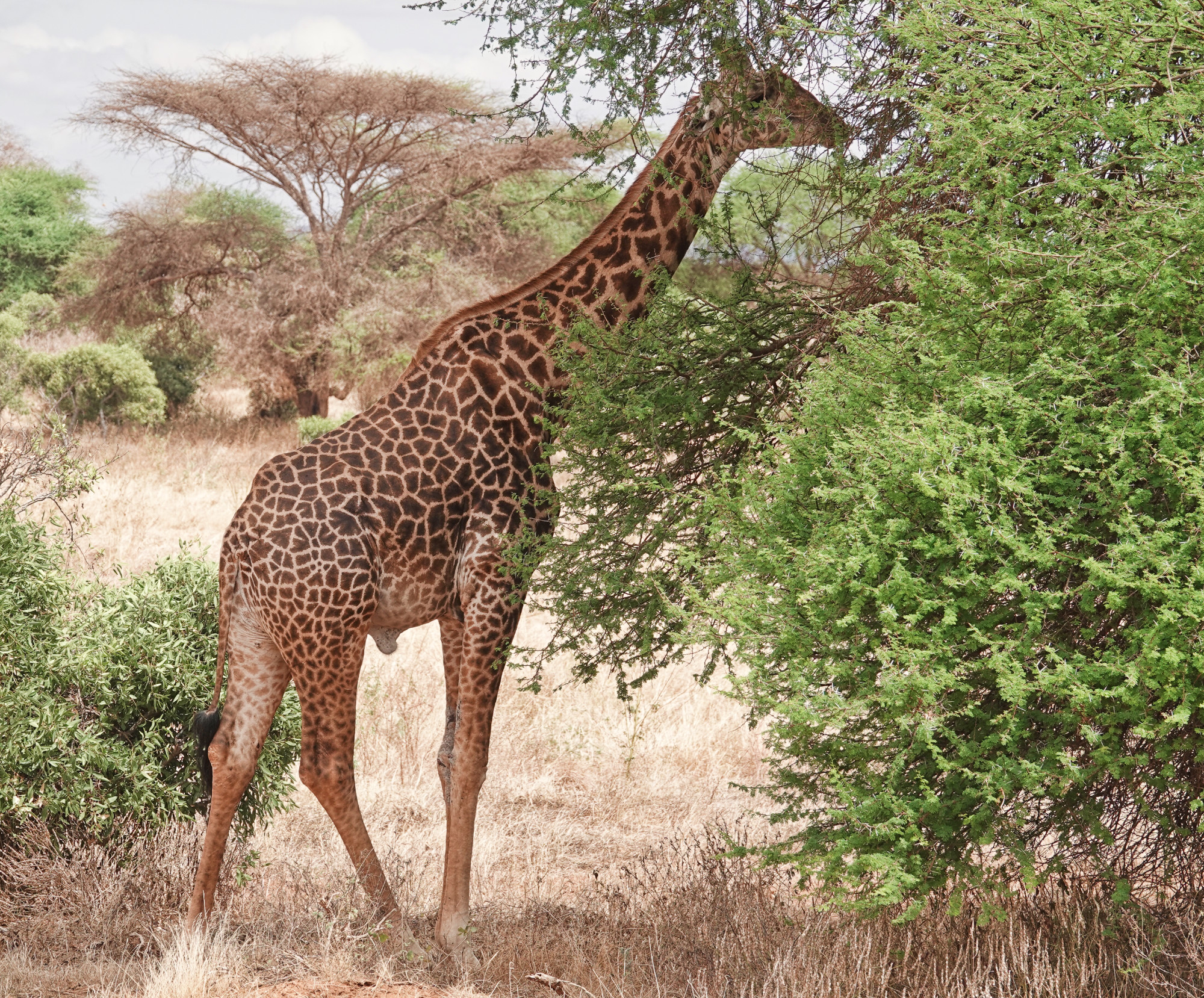
For the first several days of our safari, through Tsavo East and West, and Amboseli, the one animal we did not have close encounters with was the Giraffe. This is as close as we got: a Masai Giraffe (the most common in East Africa), at Tsavo East. (Some spell it “Maasai Giraffe” though I have not seen Masai spelled that way except in the name of this Giraffe.) You can tell it is a Masai by the irregular shapes of the patches. It is a male, and even if you could not see the obvious, the horns have no feathering. We did get closer (much closer) to Masai Giraffes on Crescent Island on Lake Naivasha, but, though living wild now, they were introduced there for the filming of “Out of Africa.” And we saw Rothschild’s Giraffes, also introduced, at Lake Nakuru, where the rarest of the African Giraffes maintains a healthy herd. Most authorities still consider the three varieties of Giraffes in Africa as sub-species or even “varieties” of the same species, through some have proposed full species status for each of them. They do freely hybridize where their ranges overlap. As to the interesting question of why the Giraffe has such a long neck…most, including Darwin, theorized that it developed due to a competitive advantage in reaching the highest foliage. That makes sense. However more recent thinking is that the longer necks and heavier heads of the biggest males provide a much more direct advantage to males who have them…in that “necking” (see a previous post of two Giraffes at Hell’s Gate doing that) is their only form of combat…and more successful males get more opportunities to mate. Of course, it could just be that the creator needed a big tall browser to keep the acacia trimmed to those classic African umbrella shapes across the African savannas…as this fellow is busy doing. Sony RX10iv at 200 and 600mm equivalents. Program mode. Processed in Polarr.
September 2018
I was traveling much of September 2018, with spotty to non-existent Wi-fi, so this is a catch up post. Most of these posts appeared in my Facebook time-line, which I was able to update more frequently.
September 4
 While I have a bit of wi-fi and time. Our lion encounter from yesterday at Tvaso East. 3 young males passed within 6 feet of our van, just ambling along. Totally amazing. The guide shouted, “Close the windows!” as they got so close. 🙂
September 4

Something you don’t see every day. Tsavo East, Kenya. Male Kori Bustard displaying for his mate. ! Hang on to your head guy, you are about to lose it.
September 5


Views from Tsavo West and Ngulia Lodge in Eastern Kenya. As I was preparing this post the Leopard came to a bated stand under lights about 30 yards from the terrace at the Lodge, where he devoured a joint of beef. Pics to follow.
September 6

African bird of the day! Lilac-breasted Roller! Not uncommon, but beautiful whenever you see it. Sony RX10iv. Tsavo West National Park, Kenya.
September 7

Lion of the day! 🙂 Amboseli National Reserve, Kenya. He had love on his mind. She was not so sure. Sony RX10iv at 600mm equivalent.

Just a little love bite! Amboseli National Reserve, Kenya. Sony RX10iv at 600mm.
September 9

EASTERN BLACK AND WHITE COLOBUS Colobus guereza, at Elsamere Lodge, on the shores of Lake Naivasha in the Rift Valley of Kenya. Elsamere is the last home in Africa of Joy Adamson, of Born Free, fame. It was almost dark and the Sony RX10iv was working at ISO 4000, but I got the shot!

We took a boat safari on Lake Naivasha in the Rift Valley of Kenya. I love Kingfishers. Pied Kingfisher, one of several we saw and photographed. Sony RX10iv at 600mm equivalent.

A daylight shot of the EASTERN BLACK AND WHITE COLOBUS at Elsamere Lodge on Lake Naivasha in Kenya’s Rift Valley. Sony RX10iv.
September 10

One of the last remaining “White Rhinoceros” in the wild at Lake Nakuru Reserve in the Rift Valley of Kenya. Distance and heat shimmer make the Rhino seem a bit insubstantial, but it is very real. Sony RX10iv at 600mm. Heavily cropped. Thompson’s Gazelle in the foreground for scale. “White” is actually a corruption of the Dutch/Afrikaner words for “wide lipped”…which is a much better name.

Might be the African bird of the day…but against still competition…Saddle-billed Stork, Lesser Flamingo, Striped Kingfisher, Green Wood Hoopoe, etc….but still, the White-fronted Bee-eater gets my vote. Such a brilliant bird. The noon sun of Equatorial Africa at Lake Nakuru in the Rift Valley of Kenya burns the bird into your mind. Sony RX10iv at 600mm.
September 12

We took a long walk on Crescent Island in Lake Naivasha, where Out of Africa was filmed. We actually got to see some wildlife on foot…and some good birds, sunbirds and love birds, in the gardens. We walked through a herd of Impala and Thompson’s Gazelles to get this shot. Sony RX10iv at 600mm equivalent.

African bird of the day: Fischer’s Lovebird. Crescent Island, Lake Naivasha in the Rift Valley of Kenya. Sony RX10iv at 600mm equivalent. (This is actually a Fischer’s / Yellow-collared Hybrid.)

His majesty resting after a kill. Masai Mara, Kenya. Sony RX10iv. It is this kind of encounter that makes it worth the rough roads getting to the Mara.

Our only Cheetah so far…far and wee but the cat itself none the less. Sony RX10iv at 600mm, heavily cropped. Masai Mara, Kenya.
September 13

Your classic Baboon shot. Masai Mara, Kenya. Sony RX10iv. Our last day in the Mara.

African Bird of the day: Little Bee-eater defending its nest…a borrow in the bank above it. Sony RX10iv at 600mm equivalent.

You are in my way kid! Elephants close to the road at Masai Mara, Kenya. Sony RX10iv.
September 14


Two halves of the equation of survival on the Masai Mara in Kenya. The lion stalking and the Thompson’s Gazelles aware of her every move. Sony RX10iv.

African bird of the day: Collared Sunbird in a sausage tree at Osero Camp, Masai Mara, Kenya. Sony RX10iv.
September 15

African bird of the day: Hamerkop…a heron, but a decidedly odd one. From our boat safari on Lake Naivasha, in the Rift Valley of Kenya. The Hamerkop builds a huge messy nest generally in the fork of a tree, and is by far the most prevalent small heron of East Africa.
September 16

How close did the lions get? That is the edge of the safari van raised top in lower right of the image! These three lions were at about 30 yards off, resting when we first saw them, but they got up and crossed to the other side of the road, passing within 6 feet of the van. Sony RX10iv at 95mm equivalent. Program mode. Processed in Polarr. Tsavo East, Kenya.
September 17

Pic for today: African bird of the day. Ground Hornbill.
When I traveled to South Africa in September 2016, the Ground Hornbills were thin on the ground, so to speak. We saw only a few, two sightings, four birds, in 11 days. In Kenya, this September, they were pretty much everywhere we went, from far eastern Kenya at Tsavo East, where this pic was taken, to Masai Mara in the south-west central area, many hundreds of miles away. Very strange birds. Though they are called Ground Hornbills, and are big and bulky like many other ground dwelling birds, they do fly, and roost in trees. I have seen them in trees in South Africa, and in actual flight in Kenya. They fly much like our Wild Turkey…which is to say, awkwardly and not often…but they do fly. The red wattles on the black bird, the odd eye covers (or eye wattles), the gaping bill, and their strange habits, as well as their relative rarity, make them interesting birds indeed. By the way, all my field guides show or mention the “red eye wattles” but this bird clearly has dark eye wattles. ???. Sony RX10iv at 600mm equivalent. Program mode. Processed in Polarr.
September 18

Pic for today: African bird of the day: Yellow-throated Spurfowl
There are lots of possible Spurfowls and Frankcolins in Kenya, but we only saw Yellow-throated Spurfowl, and we saw them everywhere! This one popped up to a rare elevated perch for a really good view. Sony RX10iv at 600mm equivalent. Program mode. -.3EV. Processed in Polarr.
September 19

Pic for today: Lion!
We had 9 lion sightings, and 4 close encounters at Tsavo East and Masai Mara Reserves. This was from our first full day game drive at Tsavo East. As detailed before, two lions were 30 yards away, taking it easy on little mound, when we stopped, and we were very happy to see them so close. Then a third approached, woke the other two up, and all three came toward us, the closest passing within 6 feet of the van. They then ambled across the road and along behind us for another 30 yards, taking their own sweet time about it, before heading off deeper into the bush. The whole sequence lasted 10 (very intense) minutes. You can see the little flies bothering the ears of the lion in this close shot. They came so close that I had to zoom back to frame the full face. Sony RX10iv at 472mm equivalent. Program mode. Processed in Polarr.
September 20


Pic for today (pics). Elephants
Toward sunset on our first dusty day in Amboseli National Park the main herd of Elephants were getting ready to cross the road on their nightly trek to solid ground. Amboseli turns into a quagmire when it rains, and the elephants want to be somewhere safe, in case of overnight rain, so they don’t get stranded. This road crossing happens most days at sunset, and the safari vans begin to gather anytime after 5. You can hear the chatter on the radios…are they going to cross? Where are they going to cross? By sunset, the road is completely blocked, except for one van length on either side of the “trail” the elephants use. I think the extra pressure of having to pass the gap makes the elephants “feisty” as we saw more interaction between elephants in the 20 minutes we waited for them to cross than in the whole rest of our time in Kenya. Two elephants would face off and butt heads, sometimes repeatedly, pushing with their considerable weight and with trunks and tusks intertwined. Eventually they came, at a pretty good pace, and did indeed pass the gap in the vans, in our case, just two van lengths from the trail. It was impressive. To say the ground shook under us is an understatement, but it as masked a bit by the beating of our hearts 🙂 In 10 minutes it was all over, and the whole herd pass off to the west of us in their cloud of dust. Still pretty feisty from what I could see. Sony RX10iv at various focal lengths and in Program mode. Processed in Polarr.
September 21

Pic for today: Photographing Zebras makes me dizzy!
It does. I can look at them just fine with my naked eye, but when I get them in the viewfinder, if I look too long, it definitely makes me dizzy. Not a big problem, as I won’t have much opportunity for Zebra photography for at least a couple of years, but an interesting observation, none the less. And, of course, I have several dozen Zebra photographs from my trip to Kenya. How could I not? The Zebras are everywhere. In fact, I think it might be a close call as to weather Zebras or Cape Buffalos (Water Buffalos) are the most numerous species of mammal in East Africa…and I have a feeling that the Zebras would win in that competition. Zebras were the first African wildlife we saw on our first day’s drive across eastern Kenya to Tsavo East, and they were the last African wildlife we saw on our drive back to the airport from Masai Mara. We saw them in every park we visited, and we saw them along the road in agricultural areas. Truly, they are everywhere! This shot is from late afternoon on our first day in Tsavo East. Sony RX10iv at 600mm. Program mode. Processed in Polarr.
September 22

Pic for today: Baboon family time
We saw this troop of Baboons acting strangely…they were running full tilt from a waterhole across the open savanna, crossing the road, and continuing into the distance on the other side…all at top speed. There was no apparent reason. Nothing was chasing them. It was like they were all suddenly late for an appointment somewhere. This group stopped at this dead snag and I got off a burst of pics as I liked the setting. Only when I came to process them did I see the infant peaking out of its mother’s protection. Sony Rx10iv at 600mm equivalent. Program mode. Cropped and processed in Polarr.
September 23

Pic for today: Little Hippo in the mud…
Amboseli National Park in Kenya is an exercise in opposites. It is dry desert, with lakes and marshes. The savannas are very dusty, and the lakes and marshes are, well, very wet. It is the only place we saw Hippopotami out of the water in daylight, most at a distance on the “island” in marshy end of Lake Amboseli, but this one right by the road to Observation Hill. This is a young Hippo…not yet full grown, but still very large. Sony RX10iv at ?? . Program mode. Processed in Polarr.
September 24

Pic for today: Elephant swimming…
Here is something you don’t see every day…unless, of course, you are Amboseli National Park in Kenya every day. The big tusker elephants of Amboseli wade and swim in the marshes of Lake Amboseli, often, like this one, submerging themselves almost in Hippo fashion. This elephant is not in trouble…he (or she) is just enjoying the luxury of deep immersion in an otherwise dry existence on the dusty savanna of Africa. Which is one of the wonderful things about living in Amboseli…the wildlife can enjoy the best of both worlds…water in the desert. Sony RX10iv at 600mm equivalent. Program mode. Processed in Polarr.
September 26

Pic for today: Zebras at Lake Nakuru
We may have seen more Zebras in Kenya than any other mammal. They were, as I have noted in a previous post, everywhere we went…and often outside the parks and reserves. This group is at Lake Nakuru, one of the only “fenced” reserves we visited. The reserve is fenced, not to keep the animals in, but to keep the elephants out, to preserve the grazing for the other big mammal that is common, or at lest resident, there (and nowhere else) the endangered White Rhinoceros. Zebras thrive there, as you can see from this photo. I could not resist the pose, which the Zebra held for as long as I wanted to shoot it. Sony RX10iv in-camera HDR at 48mm equivalent. Processed in Polarr.
September 27

Pic for today: Thompson’s Gazelles acting tough!
While walking on Crescent Island on Lake Naivasha (where scenes were filmed for Out of Africa), we passed through a herd of Thompson’s Gazelles and Impalas while working our way closer to 3 feeding Giraffes. There are no predators on Crescent Island, so the walk was relatively safe…we did avoid the small herd of Water Buffalo by the shore, and kept a sharp eye out for Hippos, but it was a unique experience walking among the Gazelles and Wildebeests, Zebras and Giraffes…the Love and Sunbirds, and the ever-present Crowned Lapwings and Cattle Egrets. These two Thompson’s Gazelles decided to have a face off while we watched. You can see from the relative size of the Impala (who was much more interested in us than in the two combative Gazelles), that the Thompson’s Gazelles are quite small…dainty even…and to see them in such a fierce mood was at least a little amusing. Sony RX10iv at 600mm equivalent. Program mode. Processed in Polarr.
September 28


Pic for today: Gerenuk
Of all the antelopes in Kenya, surely the Gerenuk is the strangest. It is the antelope equivalent of a Giraffe, and specializes on the leaves of brush too high for others to browse. No only is it long-legged and long necked, but it can, and does, stand on its hind leges to reach higher browse. It’s tiny head and big ears only add to its odd looks, but check out the recurve on those horns! Tsavo East National Park, Kenya. Sony RX10iv at 600mm equivalent. Program mode. Processed in Polarr.
September 29

Pic for today: You don’t ride our elephants!
I have worked with this image much more than any other from our 12 days in Kenya. It is from the first afternoon game drive in Tsavo East. We had checked into Voi Safari Lodge and headed out late to see what we could see before the park closed at sunset. To me, of all the images of elephants I took, and all the elephants I saw in Kenya, this image captures the “wildness” of the elephant best. Our guide and driver, John, remarked, at some point, “Our elephants are bigger and more wild…not like those elephants in India…no one rides our elephants!” Tsavo East and West have some of last remaining “big tuskers” in East Africa, and this is one of them. There was a lot of dust in the air, and the light was difficult, but with some post-processing this image pretty much captures the the edge of danger you feel in the presence of African Elephants. They are wild. No one rides them! Sony RX10iv in Program mode. 100mm equivalent. Processed in Polarr and frame added in PhotoShop Express.
September 30


Pic for today: Banded Mongoose
We saw this pack of Banded Mongoose scurry under cover of a low hanging acacia tree as we approached. The safari van stopped just where I, and I alone as it happened, had a window through the foreground foliage into the shadows beneath the tree, and the secret life of the mongooses (mongeese?) under there. They knew I was there, and that I could see them, but the stayed just long enough for me to get of some pics before scampering deeper into the bush. Not long enough for others in the van to get to my window. We attempted to move the van up so other’s could see…but they we were instantly off. Sony RX10iv at 600mm equivalent. Program mode. Processed in Polarr. The last shot betrays a bit of the darker side of the Mongoose. Not sure I would want to mess with that fellow. 🙂
The last rose of summer…

Beach Rose (Rugosa Rose), Kennebunk Maine.
Well, probably not literally the last rose of summer…but the last rose on the beach rose bush (Rugosa Rose) along the causeway out to our local beach. Beach roses have run their season, and this one, though bravely blooming still, is looking a bit worse for wear. It is all about the light though! I am packing for Kenya and would have had to dig out my RX10iv for my bike ride yesterday, so this was taken with the Sony HX90V, my pocket camera. 1/320th @ f6.3 @ ISO 80. Processed in Polarr.
And about the trip to Kenya…I am leaving tomorrow morning for two weeks. Pic for today is, very likely, taking a break while I travel as wi-fi access will be somewhat random while on safari. Just saying. 🙂
Scruffy Red-breast 2

Red-breasted Nuthatch, Kennebunk Maine
Another shot of the same scruffy Red-breasted Nuthatch that has been coming to our back deck feeding station. Every which way! Sony RX10iv at 600mm equivalent. Program mode with action and birds-in-flight modifications. 1/1000th @ f4 @ ISO 1250. Processed in Polarr.