Posts in Category: wildlife
Common Paraque, 2018 version :)

This Common Paraque has roosted beside one of the trails at Estero Llano Grande State Park and World Birding Center for so many years in a row that has to be the most photographed bird in Texas. There are always two along this short stretch of trail, but most years we only find one of them…this one, or at least the one sitting in this spot. This year the second was about 4 feet behind this one, kind of on the same line, and also in plain sight. You have to understand that “in plain sight” means something different for Paraques than it would for most birds. Even though I knew the second bird was there, since others were seeing it, it still took me 5 minutes to find it…sitting right out in plain paraque sight. The difference in the 2018 version of my yearly Paraque photo is that this bird is wet…or very damp at the least…since it was raining on and off the morning we visited Estero Llano Grande. Of course, I have only ever photographed this bird in sunlight once in all the years I have been going to Texas in November…even on a bright day it is tucked in under deep shade. Sony RX10iv at 600mm. Anti-motion Blur mode. (A special mode that takes multiple images and stacks them for better performance in low light.) Processed in Polarr.
Yellow-billed Cuckoo

Here is something you don’t see everyday…a Yellow-billed Cuckoo sitting right out in plain sight. This very wet and very bedraggled cuckoo was feeding near the boardwalk at the Birding Center on South Padre Island, Texas, part of a wave of migrants coming through with the storm front. The bird continued to feed in plain sight as long as we watched it. It even perched on the boardwalk for a moment. Sony RX10iv at 600mm equivalent. Program mode. Processed in Polarr.
White Ibis

We spent the morning at Estero Llano Grande State Park and World Birding Center in Weslaco Texas yesterday. It was overcast but the birds were still beautiful on the pond by the Visitor Center, there was lots of activity around the trails. This White Ibis is caught in a classic pose over its reflection. Sony RX10iv at 600mm equivalent. Program mode. +1EV to deal with the bird silhouetted against the bright water. Processed in Polarr.
White Pelicans in the air…

As we got out of the car at Fronteria Audubon in Weslaco Texas the other day, we looked up and into a huge swirl of White Pelicans moving over. They slowly circled over us, the center of the circle moving north slowly until the were behind the trees. Very impressive! I don’t know where they were coming from or where they were going, but the beauty of will remain. Sony RX10iv at about 250mm equivalent. Program mode. Processed in Polarr.
Chachalaca, chachalaca…

I did not know Plain Chachalacas did this thing with their tails…and neither did other birders that I talked to today, but they clearly do. These birds were strutting their stuff at the National Butterfly Center in Mission, Texas, where I was teaching a field workshop for Point and Shoot Nature Photography. Sony RX10iv at about 400mm equivalent. Program mode. Processed in Polarr.
Impala!

On my safari in South Africa in September of 2016, the dominant species of antelope, by far, was the Impala. In fact, in South Africa they call the Impala the MacDonalds of the savanna: they are everywhere, they have a big M on their butt, and they are fast food. 🙂 Because of my experience in South Africa I expected much the same in Kenya. Not so. The Thompson’s Gazelle was the dominant species…found in beards the same size as the Impala herds of South Africa, and we did not see any large groups of Impala. We saw individuals, and small herds of up to 30 animals…often in association with Thompson’s and/or Grant’s Gazelles, but nothing like the numbers or the concentrations I saw in South Africa. This handsome Impala buck is from Tsavo West. Sony RX10iv at 450mm equivalent. Program mode. Processed in Polarr.
On Safari

This is the magic of being on Safari in Kenya. Standing up in the Safari Van, with our heads above the open roof, the wildlife often came to us. Of course it was the the skill of our pilot, John Osege, to put us in the right place at the right time for these views, and, over and over, he managed to do just that. There is nothing like it! Sony RX10iv at about 110mm equivalent. Program mode. 1/1000th @ f4 @ ISO 100. Processed in Polarr.
Warthogs


We also saw Warthogs everywhere we went on our Kenya Safari, but I did not come back with many photos. Again, put it down to prejudice. I have yet to learn to like Warthogs, and they are so common…or put it down to they were always far off and generally running fast. Or put it down to I never saw The Lion King. All of the images above, except the first, are from Hell’s Gate National Park, where foot and bike traffic has acclimated the Warthogs to human presence, and they don’t bolt as soon as the van stops. The first image of the Warthogs feeding is from Amboseli and was taken at full telephoto from a distance. I am sure Warthogs have many redeeming characteristics when you get to know them. Evidently “tastes good” is not one of them, or there would be far fewer of them. Sony RX10iv mostly at 600mm equivalent. Program mode. Processed in Polarr.
Wildebeest


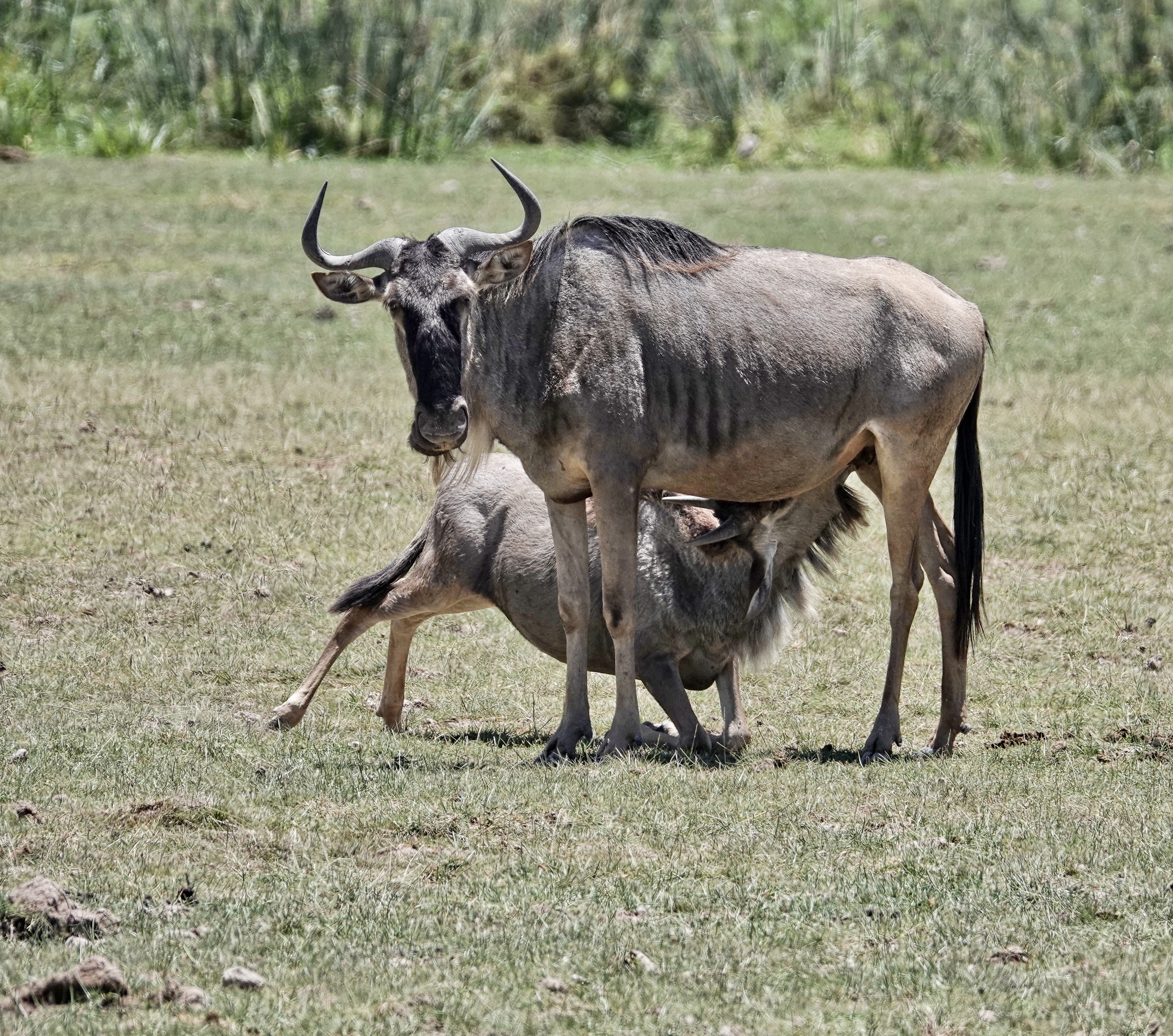

Though we did not see the Wildebeests massed for migration (or crossing the Mara River in Masai Mara…one of the classic East African sights) while we were in Kenya, we did see them just about everywhere we went…in small groups and even wandering alone across the savanna. They are not my favorite African mammal…in fact they are pretty far down on the list. I an not sure why, but I find it hard to find the beauty in them. I am sure it is a prejudice I could get over, if I saw more of then, or learned more about them. Maybe I will try that before my next trip to Africa. Sony RX10iv at various focal lengths. Program mode. Processed in Polarr.
Making a meal of it…

Our first afternoon in Masai Mara we found a group of elephants feeding right next to the road. It turned out we saw them in the same area all three days. It was near a small stream and a tiny marshy area, and they evidently liked the fresh green foliage there. This specimen was disemboweling a bush and went away with a large chunk of it wrapped in its trunk. I like the photo as a action portrait. Sony RX10iv at 600mm equivalent. Program mode. Processed in Polarr.